Kentucky covers 465 towns and 2,678,226 people, from Campbell County in the north to Fulton County in the far west and Pike County in the east. In most of those towns, getting from the kitchen to the bedroom means a staircase. When those stairs start to feel risky, a stair lift is often the fix that lets someone stay in the house they already own.
This page is the starting point for Kentucky families. It covers which kind of lift fits which kind of staircase, the state and federal programs that can help with the bill, and where to find a page for your county.
About 16.2 percent of Kentuckians are 65 or older. That is the age group where we see most first calls, usually from a son or daughter who noticed a parent taking the stairs one at a time or avoiding the second floor.
Roughly 59.5 percent of Kentucky households own their home. Owners can generally choose and install a lift on their own schedule. If your parent rents, talk with the landlord before anything is bolted to the stairs.
If your family member served, check the VA options below before paying out of pocket, because the VA can cover the lift itself in some cases.
A straight lift runs on a single rail along a staircase with no turns or landings. It is the simplest to measure and install, and usually the least expensive option.
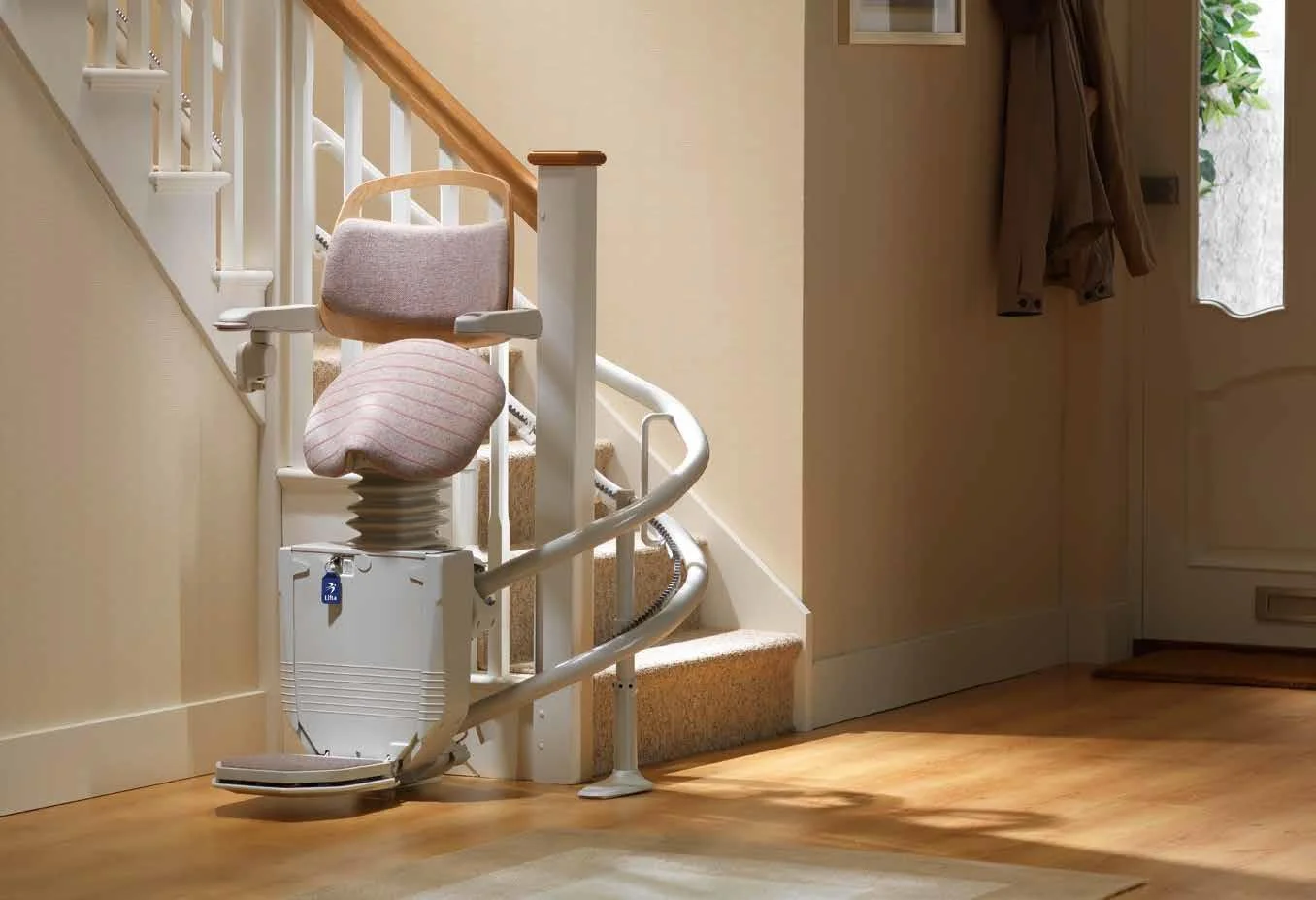
A curved lift uses a rail built to follow turns, landings or a spiral. Because the rail is made for that one staircase, it takes longer to arrive and costs more than a straight unit.
Outdoor lifts are built to handle weather on porch steps or stairs from a driveway to a door. A platform lift carries a wheelchair instead of a seated rider, which makes sense when the person can no longer transfer to a chair. An in-home visit is the only reliable way to know which one fits.
Kentucky families have more options than most people expect. The Kentucky Home and Community Based (HCB) Waiver can pay up to $2,500 per participant per year for home adaptations, and the Hart-Supported Living Program offers up to $45,000 lifetime for disability home modifications.
If grants do not fit, the Kentucky Assistive Technology Loan Corporation (KATLC) offers low-interest loans from $500 to $25,000, plus a no-interest partner option from $100 to $7,000. Veterans can look to VA Prosthetics for a medically prescribed lift.
The Kentucky Homestead Exemption does not pay for a lift, but it takes $49,100 off assessed value for owners 65 and older or totally disabled. Lower property taxes can leave more room in the budget. Details and phone numbers for each program are listed below.
We have a detailed page for Campbell County, with more counties on the way. Families in places like Jefferson County, Fayette County, Kenton County, Warren County and Pike County can use this state page in the meantime.
The funding programs on this page apply statewide, so the phone numbers below work no matter which county you live in.
A Medicaid waiver that covers environmental and minor home adaptations, including accessibility changes, up to $2,500 per participant per year. Call (844) 784-5614 to ask about eligibility.
A state grant for disability home modifications, covering up to $45,000 lifetime per recipient. Call (877) 315-0589 for application details.
Low-interest loans of $500 to $25,000 for stair lifts and home modifications, with a no-interest partner option from $100 to $7,000. Call (877) 675-0195.
VA Prosthetics (PSAS) can cover a medically prescribed stair lift with no set dollar cap, while the HISA grant ($6,800 service-connected, $2,000 non-service-connected) covers ramps and structural changes, not the lift. Call (877) 222-8387.
A property-tax exemption that takes $49,100 off assessed value for 2025-2026 for owners 65 and older or totally disabled. It does not pay for a stair lift, but it can free up cash for one.
The Kentucky Home and Community Based (HCB) Waiver covers home accessibility adaptations up to $2,500 per participant per year. Call (844) 784-5614 to find out if your family member qualifies.
Both can be covered, through different benefits. VA Prosthetics (PSAS) can cover a medically prescribed stair lift, while HISA covers ramps and structural changes, up to $6,800 for service-connected or $2,000 for non-service-connected needs. Call (877) 222-8387.
Yes. The Kentucky Assistive Technology Loan Corporation (KATLC) offers low-interest loans from $500 to $25,000 and a no-interest partner option from $100 to $7,000. Their number is (877) 675-0195.
The Hart-Supported Living Program offers up to $45,000 lifetime for disability home modifications, and the Homestead Exemption also applies to owners who are totally disabled. Call (877) 315-0589 about the Hart program.
No. It reduces your assessed value by $49,100 for 2025-2026, which lowers property taxes. That savings can go toward a lift, but the exemption itself does not pay for one.
Right now we have a dedicated page for Campbell County. For every other Kentucky county, this state page and its statewide programs are the place to start.
Tell us about the stairs in your home and we will explain which lift fits, what it costs and how installation works.
