Missouri covers 738 towns, from St. Louis County in the east to Worth County, Atchison County and Pemiscot County at the far corners of the state. The homes in those towns are as varied as the places themselves, and so are the staircases inside them. A lift that suits a straight flight to a bedroom floor in one house will not fit a split landing or a basement stair in the next.
This page walks through how stair type shapes the kind of lift you need, who in Missouri tends to look into one, and which state and federal programs can cover part or all of the cost. If you are in St. Louis County, there is also a dedicated county page with more local detail.
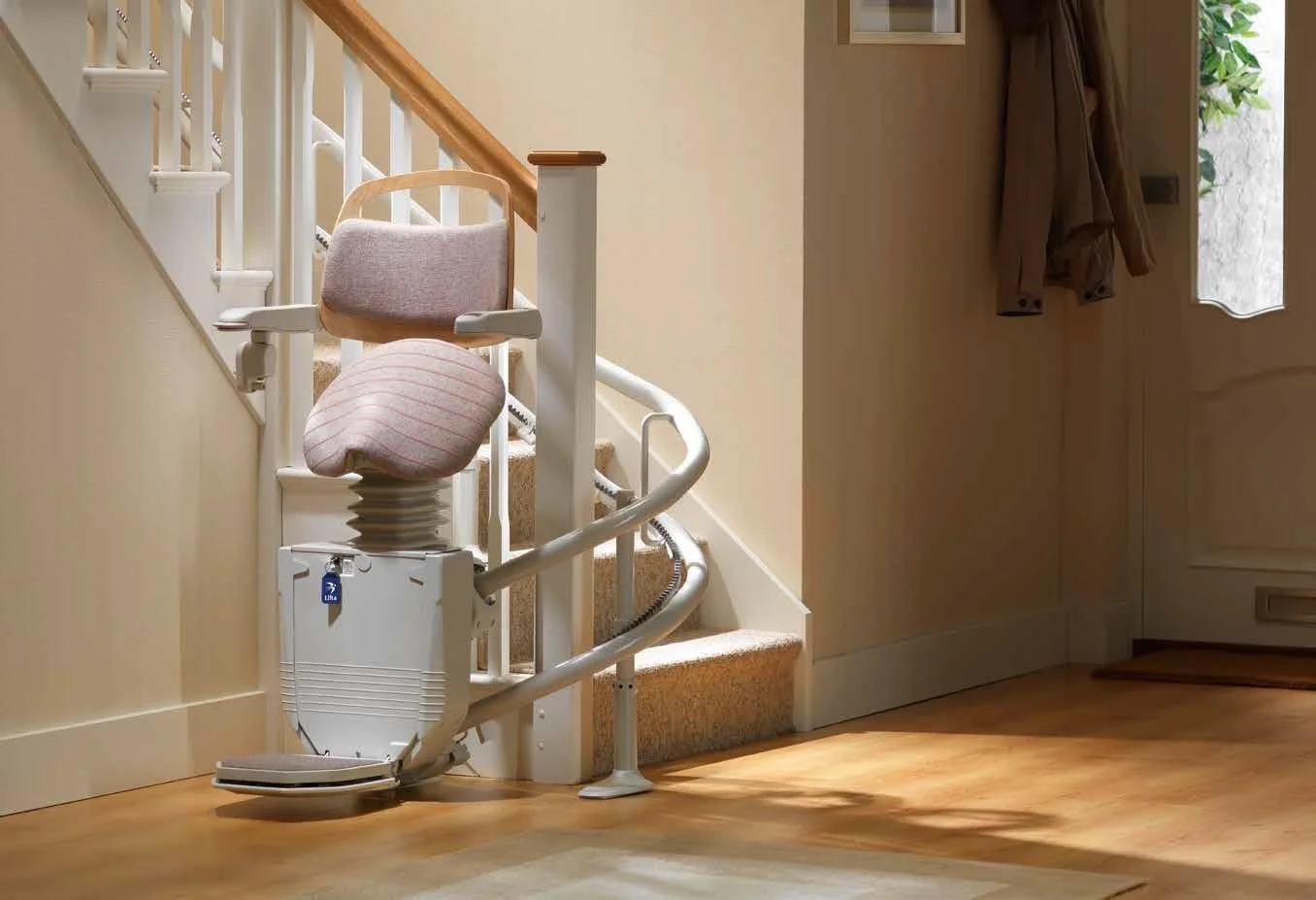
The first question at any home visit is simple: is the stair one straight run, or does it turn? A straight stair with no landing usually takes a straight rail lift, which is the quickest to install and the lowest in cost.
Stairs that turn at a landing, wrap around a corner or change direction partway up need a curved rail. That rail is built to the exact measurements of your staircase, so it takes longer to produce and costs more than a straight unit.
Some households need two lifts, one for the main floor and one for the basement. It is worth measuring both flights during the same visit so you can plan for either now or later.
Not every barrier is inside the house. Outdoor stair lifts are built with weather-resistant parts and covers for front steps, back porches or a stair down from a deck.
For someone who uses a wheelchair full time, a seated stair lift may not be the right answer. A platform lift carries the person and the chair together, and it is often the better choice for a short rise at an entry door or garage step.
About 16.5 percent of Missourians are 65 or older, and 62.6 percent of households own their home. Owning matters here, because a homeowner can approve a rail being fastened to the stairs without waiting on a landlord.
That is a large enough group that the VA benefits listed below are worth checking before you pay out of pocket.
Missouri has more than one route to help with cost, and they can work differently. The MO HealthNet Independent Living Waiver treats a stair lift as a home accessibility adaptation, with up to $5,000 per five-year period. The Missouri Assistive Technology Show-Me Loans program offers low-interest loans sized to the quoted cost of the equipment.
Veterans should look at VA Prosthetics first, since that is the VA route that pays for the lift itself when it is medically prescribed. The Home Repair Opportunity (HeRO) Program may fund accessibility work through a local partner agency, and the Missouri Property Tax Credit (Circuit Breaker) does not pay for a lift but can free up household money. Details and phone numbers for each are below.
We have a dedicated page for St. Louis County with local information. Other Missouri counties, including Boone County, Greene County, Jackson County, Jefferson County and St. Charles County, are on our service list, and pages for them are still to come.
A Missouri Medicaid 1915(c) waiver that funds stair lifts as a home modification under Environmental Accessibility Adaptations, up to $5,000 per five-year period. Call (866) 835-3505.
Low-interest state loans that cover stair lifts and home access modifications, with no fixed cap because the loan is sized to the quoted cost of the equipment. Call (800) 647-8557.
MHDC home-repair grants or forgivable loans, up to $20,000 per home, handled through a local partner agency. Accessibility modifications are eligible, so a stair lift may be covered subject to agency approval.
VA Prosthetics (PSAS) can cover the stair lift itself when medically prescribed, with no set dollar cap, while HISA grants of $6,800 (service-connected) or $2,000 (non-service-connected) cover ramps and structural changes, not the lift. Call (877) 222-8387.
A state tax credit for eligible seniors and disabled homeowners of up to $1,100, rising to $1,500 beginning tax year 2026. It does not cover stair lifts but can offer indirect help with household costs.
It can through the MO HealthNet Independent Living Waiver, which treats a stair lift as a home accessibility adaptation. The limit is $5,000 per five-year period. Call (866) 835-3505 to ask about eligibility.
Yes. Missouri Assistive Technology Show-Me Loans offers low-interest loans for stair lifts with no fixed cap, sized to the quoted cost of the equipment. Their number is (800) 647-8557.
No. HISA covers ramps and structural changes, at $6,800 for service-connected or $2,000 for non-service-connected veterans. The stair lift itself goes through VA Prosthetics (PSAS) when it is medically prescribed. Call (877) 222-8387.
The Home Repair Opportunity (HeRO) Program from MHDC offers up to $20,000 per home through a local partner agency. Accessibility modifications are eligible, but approval is up to the agency.
Not directly. The Missouri Property Tax Credit (Circuit Breaker) does not cover stair lifts, but eligible homeowners can receive up to $1,100, or $1,500 beginning tax year 2026, which can ease the household budget.
Usually, yes. If the stair turns at the landing, a curved rail built to your measurements is needed. If the landing simply sits between two straight flights, two straight lifts can sometimes work instead, which we check during the home visit.
Tell us about the stairs in your home and we will explain which lift fits, what it costs and how installation works.
