From Watauga County and Ashe County to Dare County and Currituck County, North Carolina covers 704 towns. That spread means stair lift work here can look very different from one job to the next. The staircase in a home in Mecklenburg County or Wake County may have little in common with one in Hyde County or Swain County.
This page lays out the basics for the whole state. It covers which kind of lift fits which kind of stairs, who in North Carolina might need one, and which state and federal programs can help with the bill. When you are ready for local detail, jump to your county page from the list on this site.
A straight stair lift runs on a single rail up a staircase with no turns or landings. It is usually the quickest type to install and the simplest to fit.
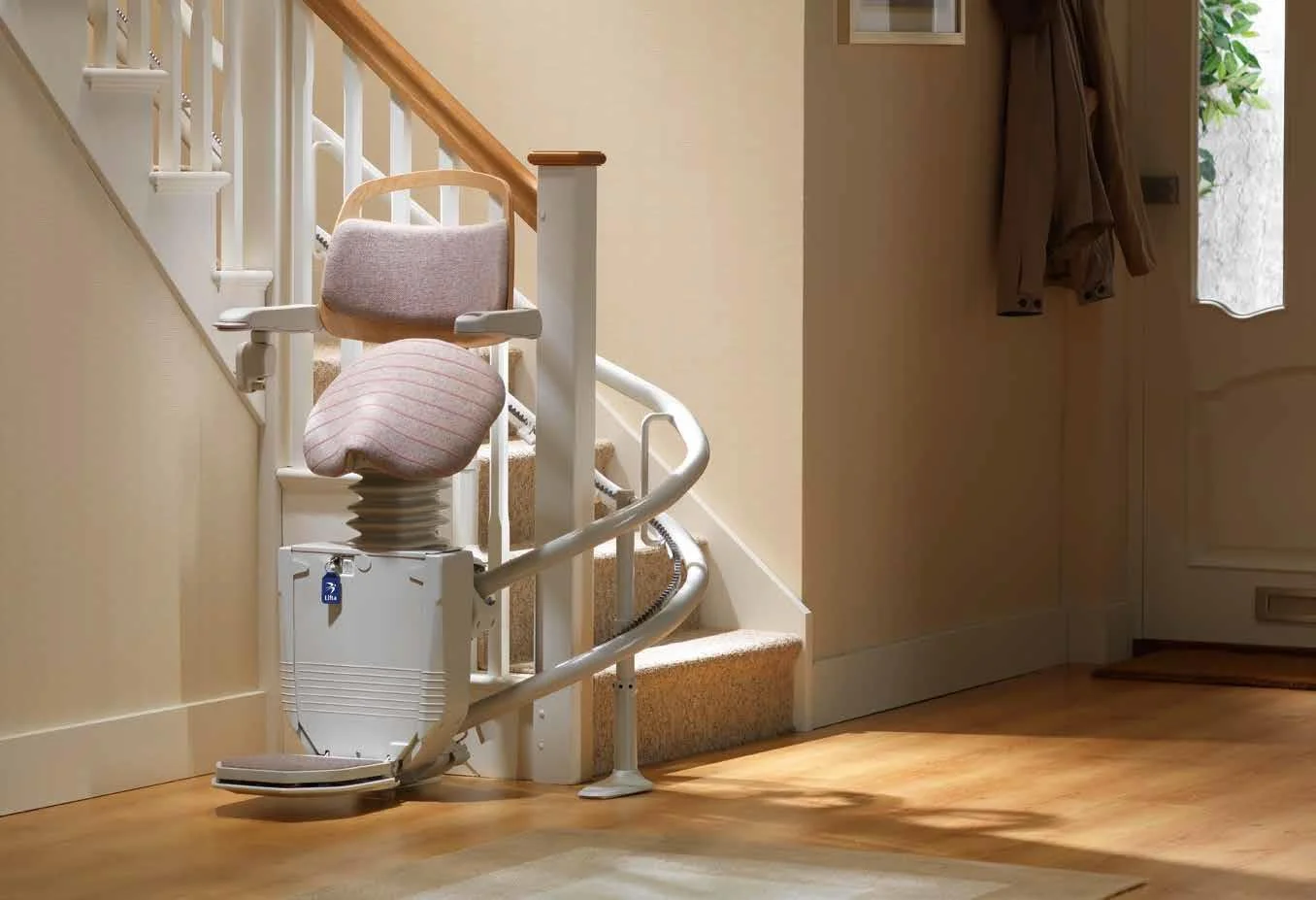
Stairs that turn, wrap around a landing or curve need a curved lift. The rail is built to match that exact staircase, so it takes a careful measurement before anything is ordered.
Steps outside the house, such as a front entry or a back porch, call for an outdoor model made to handle weather. When a wheelchair user cannot transfer to a seat, a platform lift is the option to look at instead.
About 15.4% of North Carolinians are 65 or older. For many of them, the stairs at home are the first thing that gets harder, and a lift can mean staying put rather than moving.
Roughly 58.4% of residents own their homes. Owners can usually install a lift without asking anyone, while renters will need the landlord to agree before a rail goes on the wall.
If someone in your family served, the VA section below is worth reading closely, because the VA can cover the lift itself in some cases.
North Carolina has three Medicaid waivers that list home modifications as covered: CAP/DA for adults, the NC Innovations Waiver for people with intellectual and developmental disabilities, and CAP/C for medically fragile children. Each has its own eligibility rules, so start by checking which one fits the person in your home.
For veterans, the VA splits things up. A stair lift can come through VA Prosthetics when it is medically prescribed, while the HISA grant pays for structural changes like ramps rather than the lift.
The state property-tax homestead exclusion does not pay for a lift. It can lower a qualifying household's tax bill, which may leave more room in the budget for accessibility work. Each program is summarized below.
Every county on our list, from Alamance County to Yancey County, has its own page. Those pages go into the local details that a statewide overview cannot.
Open the page for the county where the home is located, then reach out to plan a measurement of the staircase.
A Medicaid waiver for adults who meet nursing-facility level of care, and it covers home modifications, with up to $28,000 over the waiver period (Nov 2024-Oct 2029) for combined modification, equipment, and technology. Call (919) 855-4340 to ask about it.
A Medicaid waiver for people with I/DD that covers home modifications. It allows up to $50,000 over the waiver period, combined with assistive technology equipment and supplies.
A Medicaid waiver that funds home accessibility changes for medically fragile children, with no fixed dollar cap; the amount follows the approved plan of care. Call (919) 855-4340 for details.
The stair lift itself can be covered through VA Prosthetics (PSAS) when medically prescribed, with no set dollar cap, while HISA pays $6,800 (service-connected) or $2,000 (non-service-connected) for ramps and structural changes, not the lift. Call (877) 222-8387.
Property-tax relief that excludes the greater of $25,000 or 50% of appraised value for qualifying homeowners, with a 2025 income limit of $38,800. It does not pay for a stair lift, but the savings can free up household money.
Not through regular Medicaid alone, but three Medicaid waivers cover home modifications: CAP/DA for adults at nursing-facility level of care, the NC Innovations Waiver for people with I/DD, and CAP/C for medically fragile children. For CAP/DA or CAP/C, call (919) 855-4340.
CAP/DA allows up to $28,000 over the waiver period (Nov 2024-Oct 2029). That amount is shared across modifications, equipment and technology, so a stair lift would draw from the same total.
Both can be possible, through different benefits. VA Prosthetics (PSAS) can cover a medically prescribed stair lift with no set dollar cap, while the HISA grant covers ramps and structural changes. Call (877) 222-8387 to start.
CAP/C is a Medicaid waiver for medically fragile children that funds home accessibility changes. It has no fixed cap; coverage follows the approved plan of care. The phone number is (919) 855-4340.
No. It lowers property taxes for qualifying elderly or disabled homeowners, excluding the greater of $25,000 or 50% of appraised value, with a 2025 income limit of $38,800. The money saved can go toward a lift, but the program does not pay for one.
Yes, every county in our list has a page, including places like Buncombe County, Cumberland County, New Hanover County and Guilford County. Find yours in the county list for local details.
Tell us about the stairs in your home and we will explain which lift fits, what it costs and how installation works.
