Colorado has 366 towns spread across counties as different as Denver County, Summit County, Weld County and La Plata County. A stair lift that works in a city row of steps may not suit a mountain cabin with an outside staircase, so the first job is always to look at the actual stairs in your house.
This page explains which kinds of lifts match which kinds of stairs, what the state's age and veteran figures mean for families planning ahead, and where Colorado residents can look for help with the bill. If you are helping a parent stay in the home they own, start here and then open the page for your county.
A straight staircase with no turns and no landing takes a straight stair lift. These are the simplest to fit, because the rail is a standard section cut to length and bolted to the stair treads, not the wall.
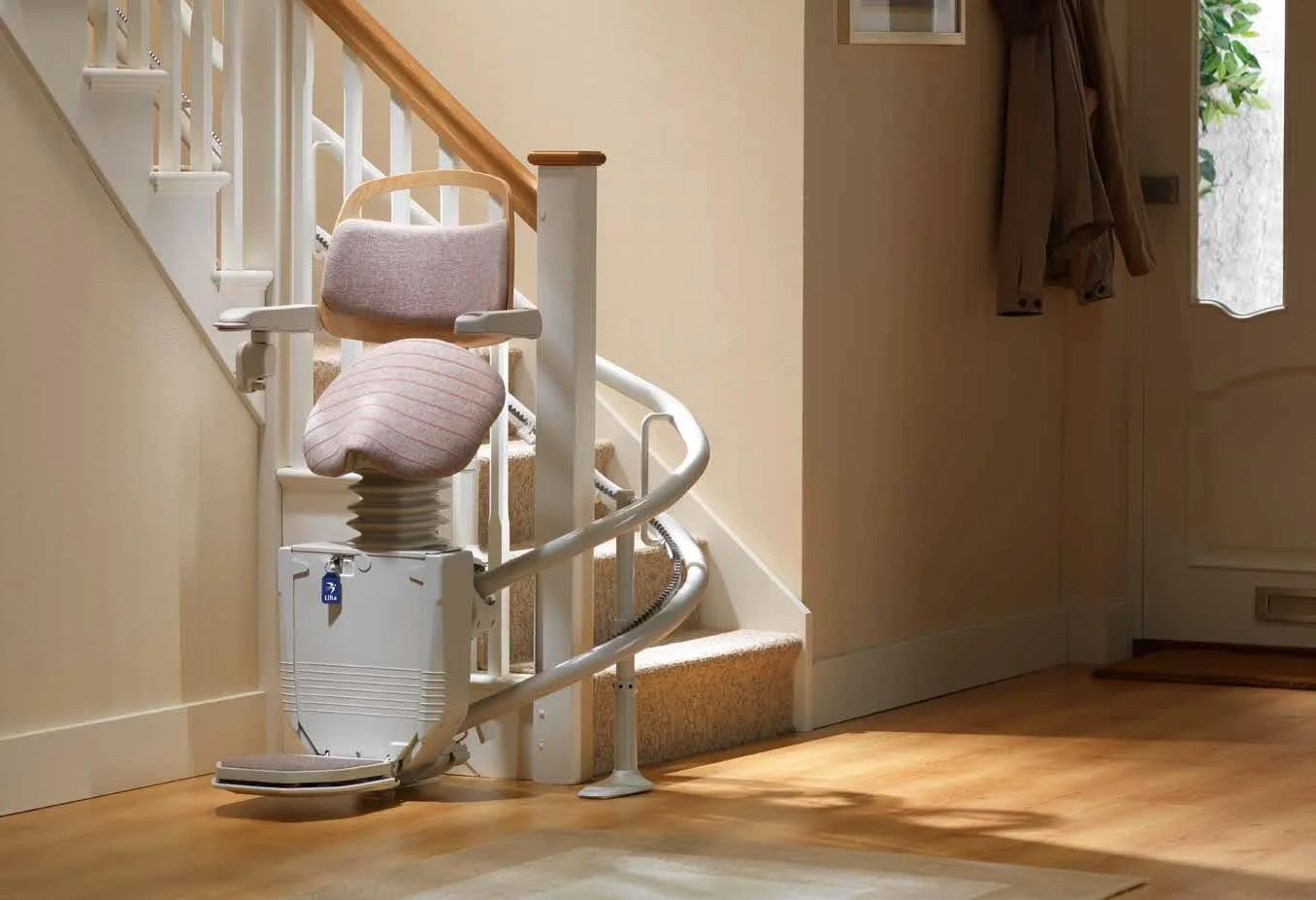
Stairs that turn, wrap around a landing or split into two short flights need a curved lift. The rail is bent to follow your exact staircase, so we measure every step and corner before anything is ordered.
Some homes have the hard steps outside: a run up to the front door, a deck, or a walk down to a garage. An outdoor lift is built to handle weather, and when a wheelchair has to come along, a platform lift may be the better answer.
The counties with their own pages on this site run from Pitkin County and San Juan County in the high country to Baca County, Yuma County and Phillips County on the plains. Homes in steep places often have more exterior steps and stairs that change direction, which points toward curved or outdoor models.
In the larger metro counties such as Arapahoe County, Jefferson County, Adams County and El Paso County, many homes have one interior flight between floors. That is often a straight lift job. Either way, the stairs decide the lift, not the zip code.
Colorado has 5,038,740 residents, and 14.5% of them are 65 or older. Many of those households are making the same choice: move to a one-level home or make the current one work.
With 64.7% of Coloradans owning their homes, a lift is usually a decision the family controls without a landlord's sign-off. Renters should get written permission first, since the rail mounts to the stairs.
If that includes someone in your family, the VA route described below is worth checking before you pay out of pocket.
The strongest state option is the Health First Colorado EBD Waiver, which can pay up to $14,000 per five-year waiver cycle for home modifications. Veterans can ask VA Prosthetics about the lift itself, while the VA's HISA grant goes toward ramps and structural changes.
Two other programs do not pay for lifts but can still help. AT Partners can let you try equipment and point you to funding sources, and the Senior Homestead Exemption lowers property taxes for long-term senior homeowners, which can free up money in the household budget. Details and phone numbers for each are listed below.
A Medicaid HCBS waiver benefit that covers home modifications, up to $14,000 per five-year waiver cycle. Call (800) 221-3943 to ask about eligibility.
VA Prosthetics (PSAS) can cover a medically prescribed stair lift with no set dollar cap, while HISA pays $6,800 for service-connected or $2,000 for non-service-connected needs toward ramps and structural changes, not the lift. Call (877) 222-8387.
A non-financial state program offering device demonstrations, short-term loans and guidance on funding sources; it does not pay for stair lifts. Reach it at (303) 315-1283.
A yearly property-tax exemption for long-term senior homeowners covering 50% of the first $200,000 of home value, up to $100,000 exempted value; it is not a stair lift grant. Call (303) 864-7777.
The Health First Colorado EBD Waiver includes a home modification benefit of up to $14,000 per five-year waiver cycle. Call (800) 221-3943 to find out whether the person you care for qualifies.
Both can happen, through different parts of the VA. The stair lift itself goes through VA Prosthetics (PSAS) when it is medically prescribed, and HISA covers ramps and structural changes. The number is (877) 222-8387.
AT Partners, Colorado's assistive technology program, offers device demonstrations and short-term loans. It does not pay for lifts, but you can call (303) 315-1283 to ask what is available.
No. It exempts 50% of the first $200,000 of home value from property tax for long-term senior homeowners. The savings can help with other costs, and you can ask about it at (303) 864-7777.
Yes. Outdoor stair lifts are made for exterior steps, and a platform lift is an option when a wheelchair needs to go up too. We look at the steps in person to decide.
There are pages for each county listed on this site, from Adams County to Yuma County. Pick yours to see local details.
Tell us about the stairs in your home and we will explain which lift fits, what it costs and how installation works.
