Delaware has 74 towns spread across just three counties: New Castle County, Kent County and Sussex County. We install stair lifts in all three, and each county has its own page with local details.
In Delaware, 17.9 percent of residents are 65 or older, and 63.3 percent of households own their home. For many families, that means a parent who wants to stay in a house they own, with stairs that have become hard to climb. This page explains the lift types we install and the Delaware and federal programs that can help pay for one.
Our service covers every county in the state. Pick your county page for local information, or start here if you are comparing options for a parent who lives in a different part of Delaware than you do.
Because 63.3 percent of Delaware households are homeowners, most of the homes we see can be modified without asking anyone's permission. If your parent rents, talk with the landlord before an install, since a lift is mounted to the stair treads.
A straight lift is for a staircase that runs in one line from bottom to top with no turns or landings. It is the simplest to fit and usually the quickest to install.
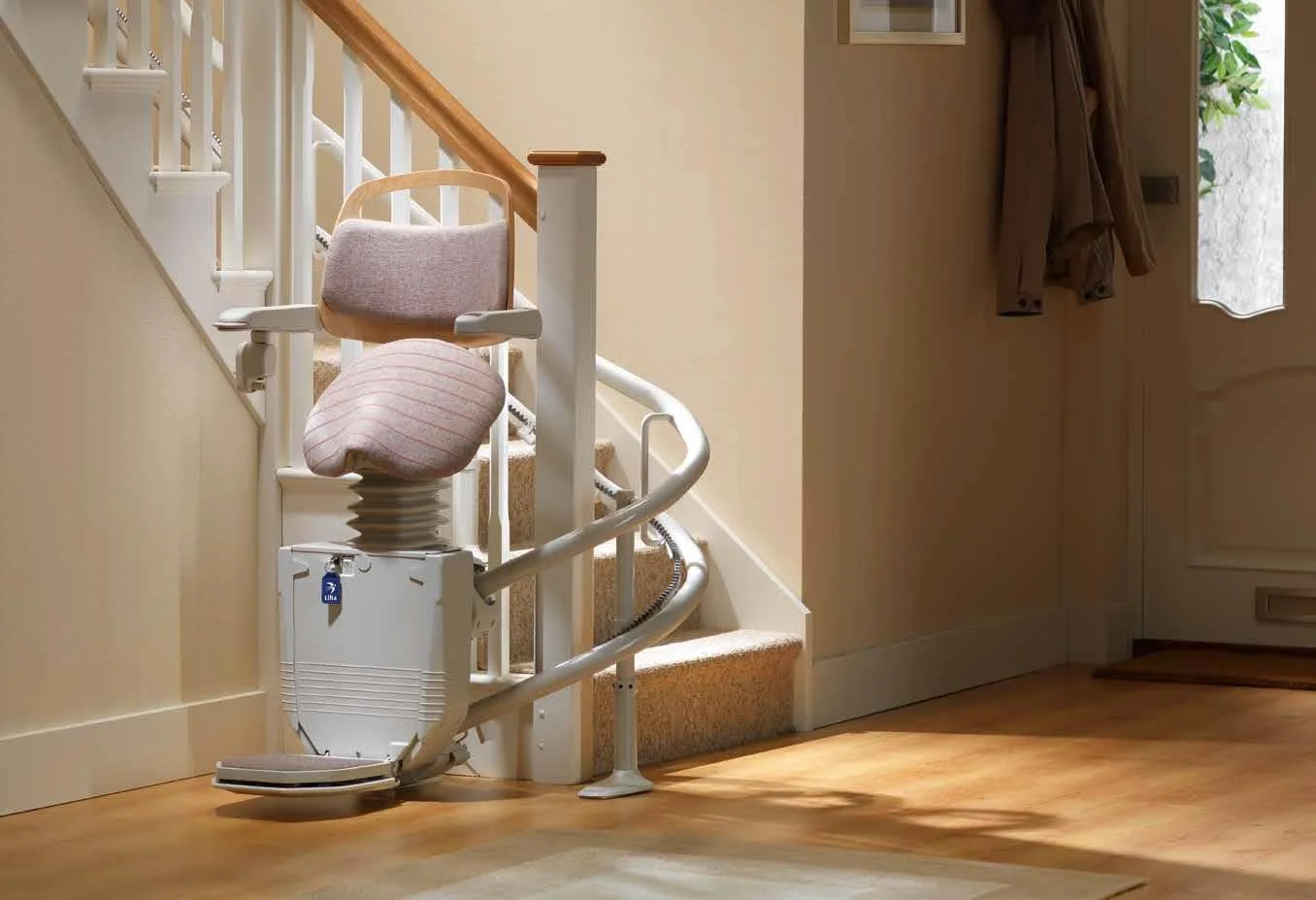
A curved lift follows a staircase that turns, has a landing partway up, or bends around a corner. The rail is made to match your exact stairs, so we measure on site before ordering.
Outdoor lifts handle steps up to a porch or entry door and are built to sit outside year round. A platform lift is the choice when someone needs to stay in a wheelchair rather than move onto a seat.
If your parent served, check VA benefits before paying out of pocket.
The VA splits this into two parts. The stair lift itself can come through VA Prosthetics when it is medically prescribed, while the HISA grant pays for ramps and structural changes, not the lift.
Delaware has more help than many families expect. Medicaid's DSHP-Plus program and the state's DSAAPD home modification program both review stair lifts case by case as home modifications.
If grants do not cover the full cost, the DATI Finance Your Independence Loan offers low-interest financing that does list stairlifts. Older homeowners may also qualify for the Senior School Property Tax Credit, which does not pay for a lift but leaves more cash in the household budget. Details and phone numbers for each program are below.
A Delaware Medicaid managed long-term care benefit that pays for minor home modifications up to $6,000 per project, $10,000 per year and $20,000 lifetime, with stair lifts considered case by case. Call (866) 940-8963.
A state grant for Delaware adults with disabilities worth up to $10,000 lifetime per person or residence, reviewing stair lifts case by case as a home modification. It is a payer of last resort, so other sources are checked first; call (800) 223-9074.
A low-interest loan for assistive technology that does cover stairlifts, with the amount based on the approved equipment cost and a lending review. Call (302) 221-2076.
VA Prosthetics (PSAS) can provide a medically prescribed stair lift with no set dollar cap, while HISA grants of $6,800 (service-connected) or $2,000 (non-service-connected) cover ramps and structural changes, not the lift. Call (877) 222-8387.
An annual school property tax credit of up to $500 per year for older homeowners. It does not cover stair lifts directly but frees up household money for accessibility costs.
It can. DSHP-Plus reviews stair lifts case by case as a home modification, with limits of $6,000 per project, $10,000 per year and $20,000 lifetime. Call (866) 940-8963 to ask about eligibility.
The Delaware Home Modification Program is a payer of last resort, so it steps in after other sources such as Medicaid or VA benefits have been considered. Its limit is $10,000 lifetime per person or residence. Call (800) 223-9074.
Both are possible, through different parts of the VA. VA Prosthetics can provide a medically prescribed stair lift, while the HISA grant covers ramps and structural work. Call (877) 222-8387 to start.
The DATI Finance Your Independence Loan offers low-interest financing for stairlifts, with no fixed cap; the amount depends on the equipment cost and a lending review. Call (302) 221-2076.
No. It is a credit of up to $500 per year on school property taxes, which can leave more room in the budget for a lift but does not pay for one.
Yes. We serve Kent County, New Castle County and Sussex County, and each has its own page.
Tell us about the stairs in your home and we will explain which lift fits, what it costs and how installation works.
