Our Virginia service list covers 574 towns, from Arlington County and the City of Alexandria in the north to Lee County, Wise County and the City of Norton in the far southwest, and east to the City of Virginia Beach and the City of Chesapeake. Every one of those places has homes where the stairs have started to feel steeper than they used to.
This page is the starting point for the whole state. It explains how we match a lift to a staircase, what the numbers say about who lives here, and which Virginia and federal programs can help with the cost. From here you can jump to the page for your own county or independent city.
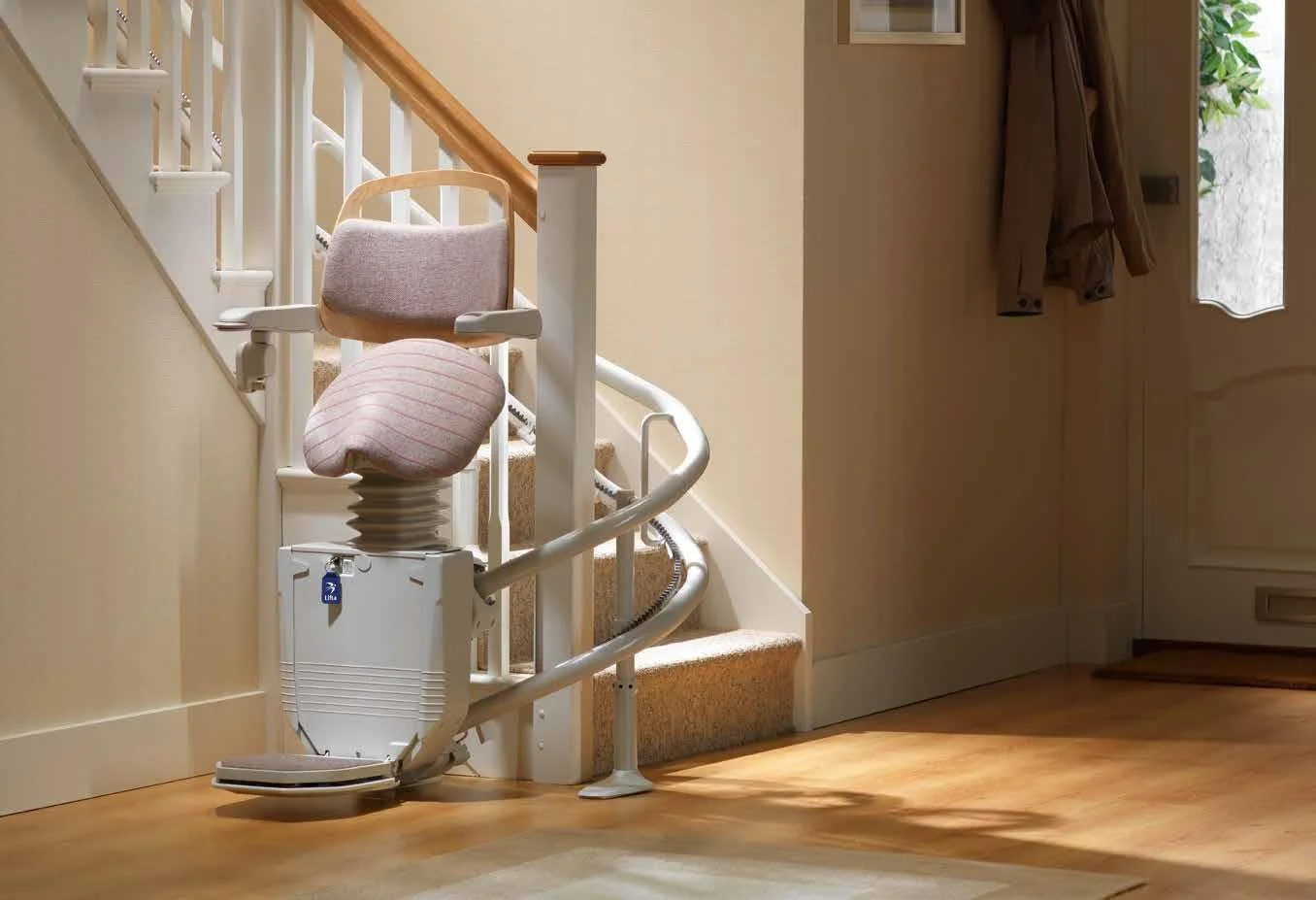
The first thing we look at is the shape of the stairs. A single straight run with no turns takes a straight rail, which is the simplest install and usually the quickest to schedule.
If the stairs turn at a landing or curve partway up, the rail has to be built to follow that exact path. That is a curved lift, and it starts with careful measurements of your steps before anything is ordered.
Steps outside the house, such as from a driveway or porch to the front door, call for an outdoor lift built to handle weather. When someone needs to stay in a wheelchair, a platform lift is the usual answer instead of a seat.
Virginia has 5,943,960 residents, and 14.8% of them are 65 or older. Many of the calls we get come from adult children helping a parent stay in the house they already know.
About 62.1% of Virginians own their homes. Owners can usually decide on a lift themselves, while renters will want to talk with the property owner before an install.
That matters, because the VA has its own path for paying for a stair lift, covered in the next section.
Virginia has more than one way to cut or spread the cost. The CCC Plus Waiver (Cardinal Care Managed Care) can pay up to $5,000 per calendar year in environmental modifications for people who qualify for this Medicaid waiver.
For people paying out of pocket, the Virginia Livable Home Tax Credit (LHTC) returns 50% of the cost of an accessibility retrofit, up to $6,500. The Assistive Technology Loan Fund Authority (ATLFA) offers low-interest loans of up to $30,000, higher in some cases, to finance a stair lift.
Veterans should look at VA Benefits for Veterans (HISA + Prosthetics). The lift itself goes through VA Prosthetics when it is medically prescribed, while the HISA grant covers ramps and structural changes rather than the lift. Details and phone numbers for each program are listed below.
We have a page for each Virginia county and independent city we serve, including Fairfax County, Henrico County, Chesterfield County, the City of Richmond area counties, the City of Roanoke area through Roanoke County and the City of Salem, and the City of Norfolk. Each one focuses on that one place.
Pick your county or city to see the local details, then reach out to set up a look at your stairs.
A Medicaid home and community based waiver that covers environmental modifications, including stair lifts, up to $5,000 per calendar year. Call (804) 786-6145 to ask about eligibility.
A state income tax credit for accessibility retrofits such as a stair lift, worth 50% of the cost up to $6,500. Call (804) 371-7000 for details.
A state program offering low-interest loans that can be used to finance a stair lift, up to $30,000 and higher in some cases. Call (804) 662-9000 to apply.
VA Prosthetics (PSAS) can cover a medically prescribed stair lift with no set dollar cap, while the HISA grant ($6,800 service-connected, $2,000 non-service-connected) covers ramps and structural changes, not the lift. Call (877) 222-8387.
It can through the CCC Plus Waiver (Cardinal Care Managed Care), which covers environmental modifications up to $5,000 per calendar year for people enrolled in the waiver. Call (804) 786-6145 to check eligibility.
The Virginia Livable Home Tax Credit (LHTC) is a state income tax credit for accessibility retrofits. It covers 50% of the cost, capped at $6,500. You can reach the program at (804) 371-7000.
Yes. The Assistive Technology Loan Fund Authority (ATLFA) makes low-interest loans for stair lifts, up to $30,000 and higher in some cases. Call (804) 662-9000.
Both can be covered, but by different parts of the VA. VA Prosthetics (PSAS) covers a medically prescribed stair lift with no set dollar cap, while HISA pays for ramps and structural changes, not the lift. Call (877) 222-8387.
Yes. Stairs with a turn or curve take a curved lift, with a rail made to follow your staircase. It starts with measuring your steps.
Our list covers 574 Virginia towns, with a page for each county and independent city we serve. Find yours on this page to get started.
Tell us about the stairs in your home and we will explain which lift fits, what it costs and how installation works.
