South Carolina has 408 towns on our map, from Greenville County and Spartanburg County down through Richland County and Lexington County to Charleston County, Beaufort County and Horry County. Every county in the state has its own page here, so you can start broad and then narrow down to where your parent or you actually live.
This hub covers the basics that apply statewide: which kind of stair lift fits which kind of staircase, who in South Carolina tends to need one, and which programs can help with the cost. The county pages carry the local detail.
A straight stair lift is the simplest job. If the stairs run in one line from bottom to top with no landing or turn, the rail can usually be cut from stock and installed quickly.
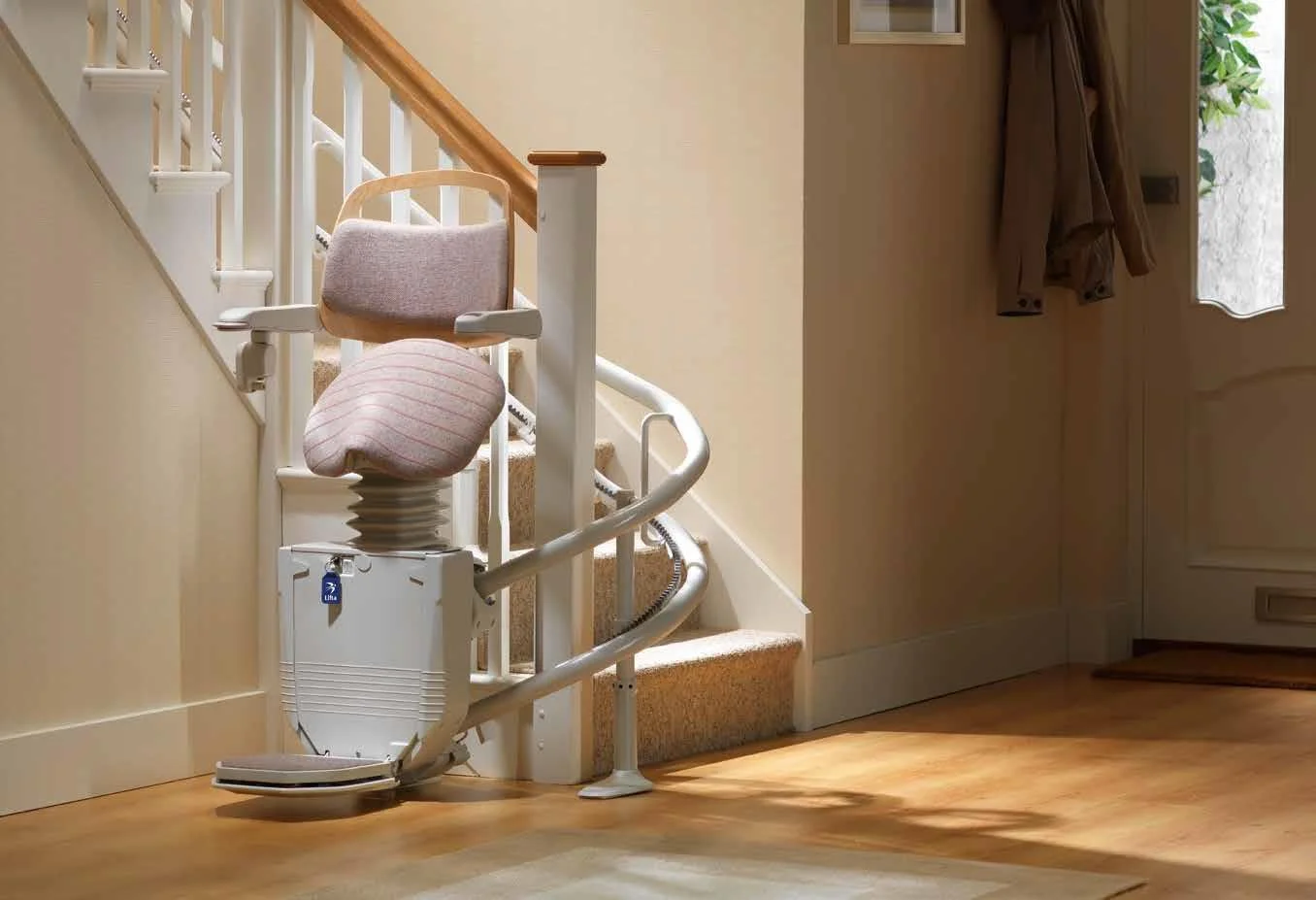
Stairs with a turn, a landing or a curve need a curved rail built to the exact shape of that staircase. We measure on site before anything is ordered, because a curved rail cannot be swapped for a different house later.
Steps outside the house, such as a porch or a back entry, call for an outdoor model built to handle weather. When someone uses a wheelchair and cannot transfer to a seat, a platform lift is the option to look at instead of a chair.
About 17.5% of South Carolina residents are 65 or older, and 62.6% of households own their home. Owners can install a rail without asking a landlord, which is why most of the calls we get come from homeowners or their adult children.
If your parent served, check the VA benefits below before paying out of pocket, because the VA can cover the lift itself in some cases.
South Carolina has more than one route to help. The Community Choices Waiver and the SC Housing Trust Fund decide stair lift and accessibility requests case by case, while the Assistive Technology Loan Program lists stair lifts directly and lends up to $30,000.
For veterans, the VA splits things up: HISA pays for ramps and structural changes, and VA Prosthetics can provide a medically prescribed stair lift. The Homestead Exemption does not pay for a lift, but it lowers property tax for owners 65 and older, which frees up some money each year.
Call the program before you sign a contract with anyone. Some, like the Medicaid waiver, have bid rules that have to be followed from the start.
Each county page, from Abbeville County to York County, focuses on that area. Pick the county where the house is, not where the family member helping out lives, since local details follow the address of the home.
A Medicaid home and community-based waiver for people who need nursing-level care, with home-access funding decided case by case under an approved plan; modifications over $10,000 require three licensed-contractor bids. Call (888) 549-0820.
Low-interest loans of up to $30,000 that cover stair lifts and home modifications, backed by a loan guarantee and interest-rate subsidy. Call (803) 726-7143.
Repairs and accessibility upgrades for low-income homeowners of up to $75,000, with repairs under $15,000 given as a grant and larger amounts as a forgivable loan; stair lifts are considered case by case. Call (803) 896-9001.
VA Prosthetics (PSAS) can provide a medically prescribed stair lift with no set dollar cap, while HISA pays $6,800 for service-connected or $2,000 for non-service-connected veterans toward ramps and structural changes, not the lift. Call (877) 222-8387.
Exempts $50,000 of home value from property tax for owners 65 and older, about $250-$350 a year in savings. It does not pay for a stair lift.
Through the SC Community Choices Waiver, home-access requests are decided case by case for people who need nursing-level care. There is no fixed cap, but modifications over $10,000 require three licensed-contractor bids. Call (888) 549-0820.
Yes. The South Carolina Assistive Technology Loan Program offers low-interest loans of up to $30,000 for stair lifts and home modifications. The number is (803) 726-7143.
Both are possible, through different benefits. VA Prosthetics (PSAS) can provide a medically prescribed stair lift, while HISA covers ramps and structural changes. Call (877) 222-8387 to start.
The SC Housing Trust Fund Home Repair Program funds repairs and accessibility upgrades up to $75,000, with work under $15,000 given as a grant. Stair lifts are reviewed case by case. Call (803) 896-9001.
No. It exempts $50,000 of home value from property tax for owners 65 and older, which saves about $250-$350 a year that can go toward other costs.
Yes, but it will be a curved stair lift with a rail made to fit your staircase. We measure in the home first so the rail matches the turn exactly.
Tell us about the stairs in your home and we will explain which lift fits, what it costs and how installation works.
