From the older streets of Kirkwood, incorporated in 1865, to the postwar subdivisions of Florissant, Hazelwood and Oakville, St. Louis County holds 95 towns and a lot of staircases. Much of the housing went up during the 1950s to 1970s suburban expansion, and a good share of it is split-level or multi-story.
Plenty of people who bought those homes decades ago would rather stay than move. A stair lift is often what makes that possible, but the right one depends on how your stairs are laid out and where in the county you live, since a Chesterfield Valley lot and a bluff-side home in the south of the county ask for different things.
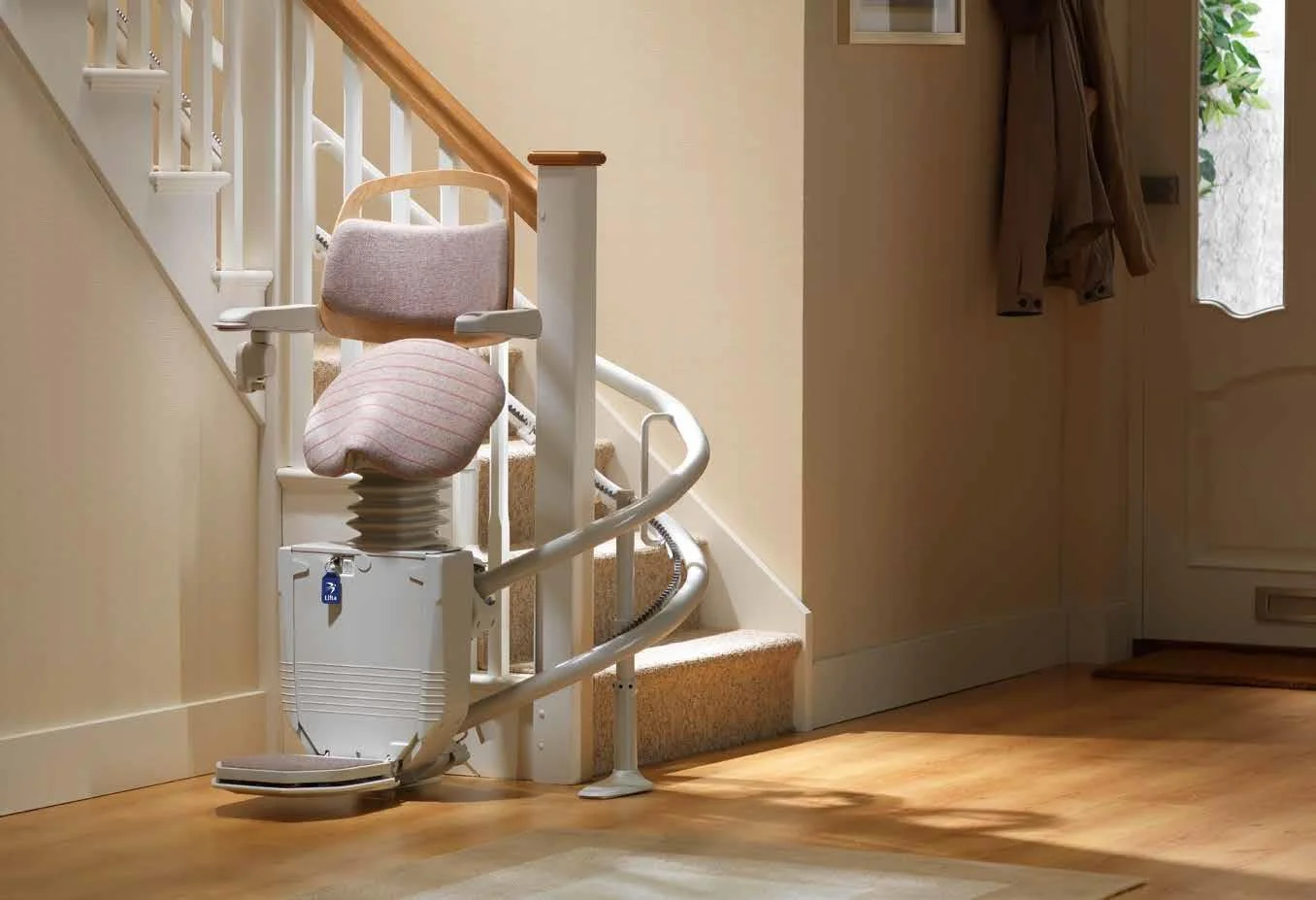
Single-family homes, duplexes, townhouses, low-rise apartments and split-level homes make up most of what we see here. Each one sets up the stairs a little differently, and that decides the kind of lift.
A straight run from the first floor to the bedrooms, common in two-story postwar houses, usually takes a straight stair lift. It is the simplest rail to fit and the quickest to install.
Split-level homes are the tricky ones. The house is broken into short flights between levels, so you may need a lift on more than one flight, or a curved rail if a flight turns. Townhouses tend to stack living space vertically, which can mean more than one floor of stairs to cover.
Older homes in inner-ring places such as Kirkwood and Webster Groves can have narrow or turning staircases. Those often call for a custom curved rail, so it pays to have someone measure before you settle on a plan.
Most of St. Louis County sits on a fairly level plateau, so many homes have only modest entry steps. That changes in a few places, and the outside of the house matters as much as the inside.
In the southwestern part of the county, where the Ozark foothills begin, the ground gets rugged. Homes in areas like Wildwood and Eureka can have steep walks or long exterior stairs, which is where an outdoor stair lift or a platform lift comes in.
Along the Mississippi in the south, bluffs rise roughly 200 to 300 feet above the river. Homes near that edge can sit on sloped lots with stepped entries.
The Chesterfield Valley is low floodplain ground that sat under at least ten feet of water in the Great Flood of 1993. Because of that history, entry heights vary a lot across the county, and the front steps should be part of any home visit.
About 18.4 percent of residents in the listed towns are 65 or older, and 69.8 percent own their homes. That is a large group of long-time owners living in the same multi-story and split-level houses they raised families in.
Owning the home matters for a stair lift. It means you can make the decision yourself, and it opens the door to several of the repair and modification programs below that require owner-occupancy.
The clearest local source is Aging Ahead, the Mid-East Area Agency on Aging. Missouri's description of these agencies names stair lifts among the home modifications they can help fund, though funding is limited, so call early and ask about availability.
Paraquad, the St. Louis County Home Improvement Program, the MHDC HeRO program and the Missouri Independent Living Waiver all help with home modifications or repairs, but their published materials do not name stair lifts. Ask each one directly whether a lift can be approved in your case.
Veterans have a different picture. The VA HISA benefit specifically excludes stair glides, while the SAH and SHA grants cover structural adaptations without naming stair lifts. The St. Louis County Veterans Program at 41 South Central Avenue, 3rd Floor, in Clayton can be reached at (314) 615-4038 for help sorting this out.
Missouri's statewide list also includes the Missouri Assistive Technology Show-Me Loans (General AT Loan) and the Missouri Property Tax Credit (Circuit Breaker), which are worth asking about when you plan a budget.
Serves people 60 and older in St. Louis, St. Charles, Franklin and Jefferson counties, and Missouri lists stair lifts among the home modifications these agencies can help fund, with limited money per case. Call (800) 243-6060.
St. Louis's Center for Independent Living offers an occupational therapist safety assessment and minor modifications for income-eligible older adults and people with disabilities in St. Louis City or County; its page lists grab bars, wider doorways and ramps but does not mention stair lifts. Call (314) 289-4200 and ask whether a lift qualifies.
A county repair program for income-eligible owner-occupants with current property taxes in unincorporated St. Louis County or a participating municipality; available sources mention hand rails but not stair lifts. Details should be confirmed with St. Louis County Human Services.
A Medicaid waiver service for Missouri adults already receiving Consumer Directed Services, run by the Division of Senior and Disability Services; it lists environmental accessibility adaptations but does not name stair lifts. Ask your DSDS case manager whether a lift fits your care plan.
Repair loans and grants for very-low-income owner-occupants in USDA-designated rural areas; stair lifts are not mentioned. Most of suburban St. Louis County is unlikely to qualify, though some outlying western addresses may, so check your address on the USDA eligibility map.
Funds non-cosmetic repairs for low-income owners who have lived in their insured home for at least 3 years, applied for through a participating local agency rather than the state; stair lifts are not mentioned. MHDC can be reached at (816) 759-6600.
Pays for permanent structural changes up to a $6,800 lifetime maximum for service-connected disabilities or $2,000 for other qualifying disabilities, but the VA explicitly excludes stair glides. Call (314) 652-4100.
Grants for veterans with qualifying severe disabilities, up to $126,526 for SAH and $25,350 for SHA, covering structural adaptations; the VA does not name stair lifts among them. Call (800) 827-1000.
Older adults
14 N. Meramec, Suite 401, St. Louis, 63105
Veterans
41 South Central Avenue, 3rd Floor, Clayton, 63105
Aging Ahead's home modification help follows the 60 and older standard. Paraquad serves people with disabilities as well as older adults in St. Louis City or County, based on income, so it is the better first call for a younger adult.
Not through HISA, which explicitly excludes stair glides. The SAH and SHA grants cover structural adaptations but do not name stair lifts, so ask the VA at (800) 827-1000 or the St. Louis County Veterans Program at (314) 615-4038.
No, but it changes the plan. Split-levels have short flights between levels, so you may need a lift on more than one flight or a curved rail where a flight turns.
The southwestern county, where the Ozark foothills begin, has rugged ground and often steep entries. An outdoor stair lift or a platform lift can handle exterior steps, and the site visit should cover the walk and entry as well as the inside stairs.
The program covers unincorporated St. Louis County and participating municipalities, so it depends on whether your town takes part. Its available materials mention hand rails, not stair lifts, so confirm both points with St. Louis County Human Services.
Only at addresses USDA designates as rural. Most of the suburban county is likely ineligible, though some outlying western areas may qualify, so check your exact address on the USDA eligibility map.
Tell us about the stairs in your home and we will explain which lift fits, what it costs and how installation works.
