Gloucester County sits on a 218-square-mile peninsula with nearly 500 miles of shoreline along the Chesapeake Bay, the York River, Mobjack Bay and the North, Ware and Severn Rivers. Homes here range from older two-story houses around the courthouse square in Gloucester Courthouse to split-level and raised houses near the water in places like Gloucester Point.
Those houses share one problem as their owners get older: steps. Some are inside, between floors or half-levels. Others are outside, leading up to a raised front door. This page walks through which kind of stair lift fits which kind of Gloucester home, and where local and state programs may help with the cost.
Gloucester Village on Main Street still has its historic courthouse square and some notable older houses. The T.C. Walker House, built about 1880, is a two-story frame vernacular dwelling with Greek Revival and Gothic Revival details. Cappahosic House, built around 1751, is a two-story brick Georgian dwelling.
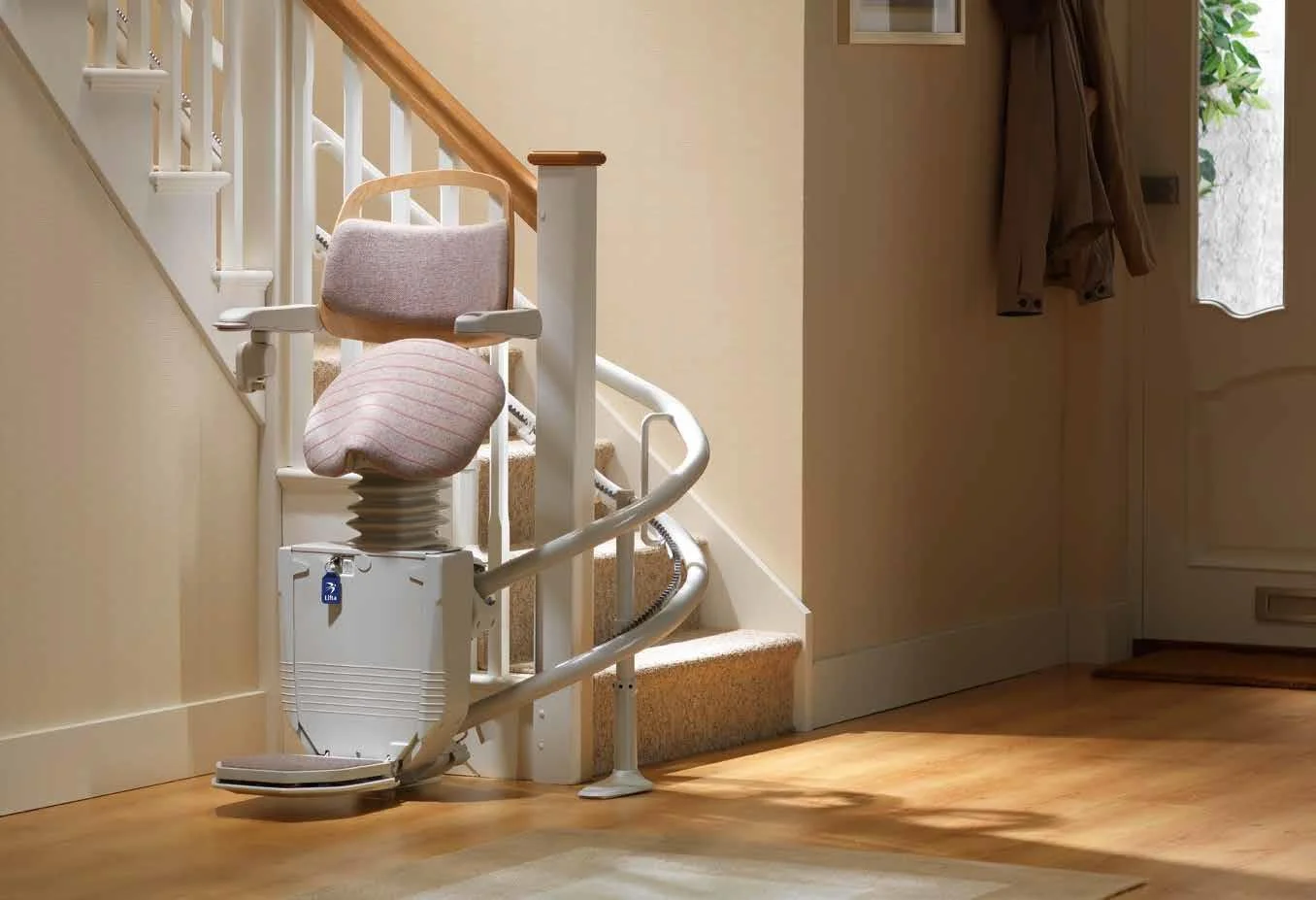
Homes from these eras were built with interior stairs and no thought of accessibility. If the staircase runs in one straight line, a straight stair lift is usually the simplest fit. If it turns at a landing or winds, a curved lift built to that staircase is the answer, and we measure the stairs in person before recommending one.
Much of the county is low-lying tidewater land, so many homes near the water are split-level or raised. A split-level house often has short flights between levels, which can mean more than one lift or a lift on the flight used most each day.
Raised homes usually add exterior steps up to the entry. An outdoor stair lift is built to handle weather on those steps. Where someone uses a wheelchair and cannot transfer to a seat, a platform lift may be the better option, and we can talk through the space it needs.
The county has about 14,668 residents, and 21.7% are 65 or older. About 72.1% of residents are homeowners, so many people are staying in houses they already own rather than moving.
If that includes you or a parent, the VA programs listed below are worth a call, though not every VA grant pays for a stair lift.
The clearest funding source is the Virginia Housing accessibility grant, which lists chairlifts among typical modifications and pays up to $10,000 per household for those who qualify. Several other programs cover home repairs or accessibility work without naming stair lifts, so they are worth asking about case by case.
Bay Aging is the area agency on aging for Gloucester County. Its Urbanna office at 5306 Old Virginia St. can be reached at (804) 758-2386. Veterans can contact the Virginia Department of Veterans Services Williamsburg Office at 203 Ironbound Road, Galt Complex, at (757) 209-0370.
Statewide options to ask about include the CCC Plus Waiver (Cardinal Care Managed Care), the Virginia Livable Home Tax Credit (LHTC) and the Assistive Technology Loan Fund Authority (ATLFA). Check each one's current rules directly before counting on it.
A local nonprofit that helps low-income homeowners age 60 and older in Gloucester and Mathews counties with repairs and accessibility work such as ramps and bathroom conversions. Stair lifts are not listed, so ask about them case by case at (804) 792-5079.
Non-repayable state grants of up to $10,000 per household that explicitly include chairlifts, for people with disabilities who meet income limits, with a Granting Freedom track for disabled veterans and service members. Call (877) 843-2123 and ask which approved application agent covers the Middle Peninsula.
A VA home modification benefit for veterans with qualifying disabilities, up to $6,800 or $2,000 over a lifetime depending on the disability. The VA excludes stair glides, so HISA does not cover a stair lift.
VA grants for veterans and service members with severe service-connected disabilities, up to $126,526 for SAH or $25,350 for SHA in FY2026. Stair lifts are not mentioned by the VA; call (877) 827-3702 to ask.
The information, referral and care coordination hub for older adults and caregivers in Gloucester and nearby counties. It does not list a stair lift grant, but it can point you to help; call (800) 493-0238.
Offers information, referral, advocacy, equipment loan and independent-living skills training for people with disabilities in Gloucester and nearby counties, from its office in Hayes at 2351 York Crossing Drive. Stair lift funding is not listed; call (804) 684-5607 for referrals.
A Virginia DHCD program paying up to $4,000 per applicant for health and safety repairs and accessibility modifications for households at or below 80% of Area Median Income, first come, first served. Stair lifts are not named; call (804) 371-7000 to ask.
Older adults
5306 Old Virginia St., Urbanna, 23175
Veterans
203 Ironbound Road, Galt Complex, Williamsburg, 23185
The Virginia Housing accessibility grants list chairlifts among typical modifications and pay up to $10,000 per household. You apply through an approved application agent, so call (877) 843-2123 and ask which agent serves the Middle Peninsula.
Not through HISA, which excludes stair glides. The SAH and SHA grants do not mention stair lifts either, so call (877) 827-3702 or the Williamsburg veterans office at (757) 209-0370 to ask about your situation.
The Rural Housing Partnership Home Repair Program serves low-income homeowners age 60 and older in Gloucester and Mathews counties. Stair lifts are not on its list, so call (804) 792-5079 and ask.
Yes. Outdoor stair lifts are built for exterior steps like those on raised waterfront homes. If the person cannot transfer to a seat, a platform lift may fit better.
Usually, yes. Staircases that turn or wind take a curved lift made to fit those stairs, which is why we measure in person first.
Bay Aging is the county's area agency on aging, at (800) 493-0238 or its Urbanna office at (804) 758-2386. The Peninsula Center for Independent Living office in Hayes, at (804) 684-5607, also gives referrals.
Tell us about the stairs in your home and we will explain which lift fits, what it costs and how installation works.
