Scott County covers 539 square miles in the far southwestern tip of Virginia, right on the Tennessee line. Homes are spread out between Gate City, Weber City, Hiltons, Nickelsville and Dungannon, and part of the county lies within the Jefferson National Forest. Census figures put 98.3% of residents outside any urban area, so many houses sit a long drive from town centers and medical care.
Out here, the house itself is often the hardest part of getting older at home. Older farmhouses, mid-century ranch homes and manufactured homes make up much of the county, and many were built with entry steps or interior stairs that were never meant for a cane or walker. This page walks through how those homes match up with different stair lifts and which programs may help with the cost.
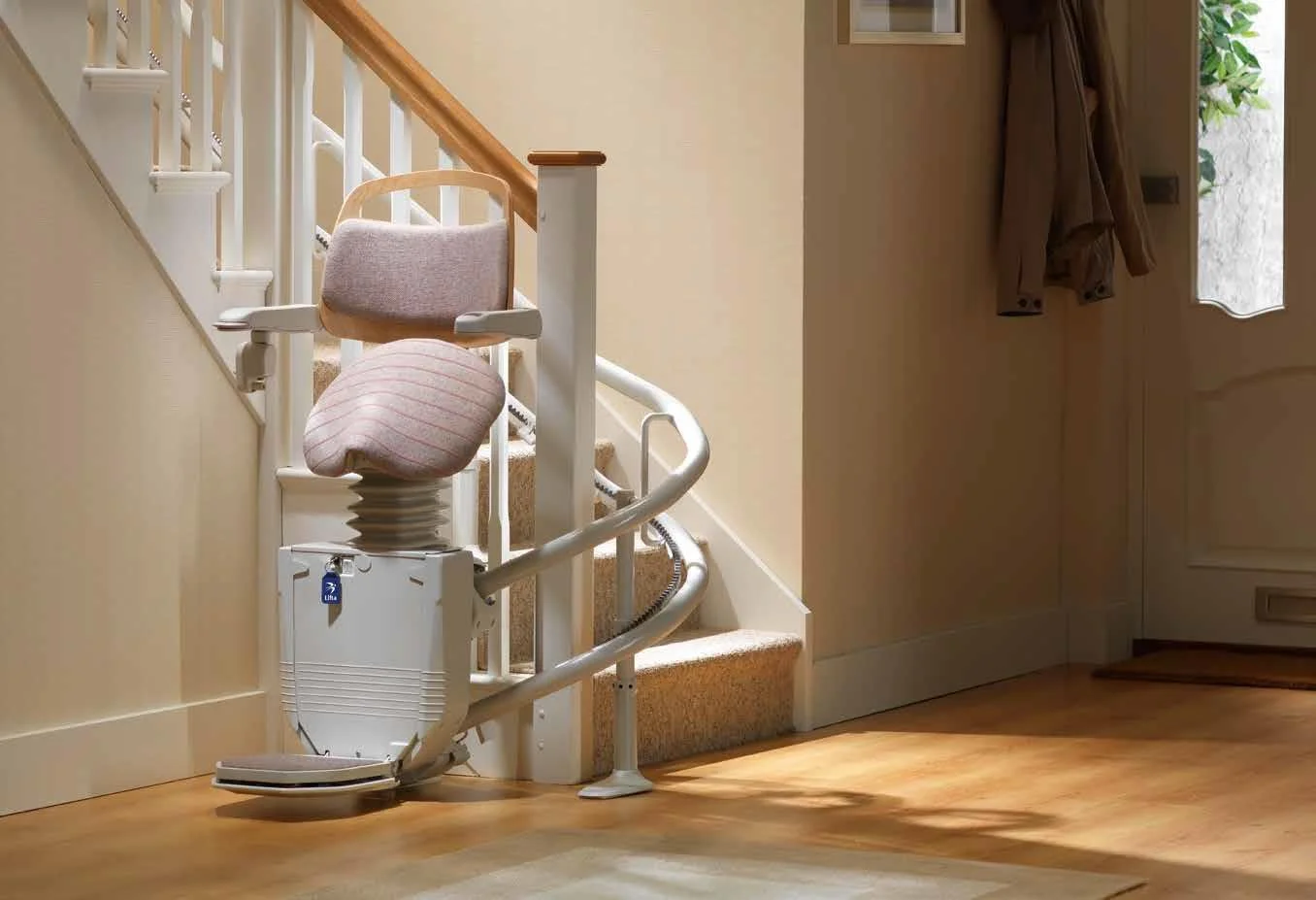
A two-story farmhouse with one straight staircase is usually the simplest job. A straight rail mounts to the stair treads, not the wall, so plaster walls in an older house are not a problem.
Stairs that turn at a landing or wrap around a corner need a curved rail built to fit that staircase. Split-level homes are their own case: two short flights instead of one long one, which sometimes means two lifts or one rail that follows the turn.
Manufactured and mobile homes are common across rural southwest Virginia, and most have a set of steps up to the door. A ranch home can be one level inside and still have steps at the porch or the back door. An outdoor stair lift, built to handle weather, can serve those steps.
When the issue is a wheelchair rather than walking, a platform lift may make more sense than a seat. We look at the steps, the landing space and how the person gets around before suggesting one.
Census figures from 2020 put 24.6% of Scott County residents at age 65 or older, well above the state and national shares. The same 2020 figures show 76.6% of households own their homes, so a lot of people are making changes to houses they plan to keep.
With limited public transit and long distances to care, moving to a facility or to town is a big change. For many families, making the stairs safe is the more practical step.
Only one source in our list names chairlifts directly: the Virginia Housing accessibility grants, at up to $10,000. One track is for disabled veterans and service members with income at or below 80% of area median income, and another is for homeowners at or below 60%. Both go through a Virginia Housing accepted agent.
Other programs cover home modifications but do not mention stair lifts, so ask before you count on them. These include the CCC Plus Medicaid waiver, USDA Section 504 repair loans and grants, and the Virginia Livable Home Tax Credit. The VA HISA grant specifically excludes stair glides.
For local guidance, Mountain Empire Older Citizens in Big Stone Gap is the Area Agency on Aging for Scott County at (276) 523-4202. Veterans can reach the Virginia Department of Veterans Services Big Stone Gap Office at (276) 523-1411.
A Medicaid waiver benefit of up to $5,000 per person per calendar year for home adaptations like ramps, grab bars and doorway widening; stair lifts are not listed. Eligibility starts with an LTSS screening through the local Department of Social Services, and Cover Virginia can be reached at (833) 522-5582.
A VA medical benefit for structural home changes, with a $6,800 or $2,000 lifetime amount depending on disability status. It does not cover stair lifts; the VA excludes stair glides and porch lifts by name.
Grants for veterans with severe service-connected disabilities, up to $126,526 for SAH and $25,350 for SHA in FY2026. The VA's description gives ramps and doorway widening as examples and does not list stair lifts.
Up to $10,000 for disabled veterans or service members with household income at or below 80% of area median income, and chairlifts are named as a typical modification. Applications go through a Virginia Housing accepted agent; call (877) 843-2123.
Up to $10,000 for Virginia homeowners with household income at or below 60% of area median income, with chairlifts named as a covered modification. Call (877) 843-2123 to find an accepted agent.
Repair loans up to $40,000 at 1% fixed for 20 years, and grants up to $10,000 for homeowners age 62 or older who cannot repay a loan, with income below 50% of the county median. Stair lifts are not listed, so check your address and the project with USDA.
A state tax credit for up to 50% of the cost of an accessibility retrofit, capped at $6,500, with the application due to DHCD by January 31 of the following year. Stair lifts are not named; call (804) 371-7000.
The Area Agency on Aging for Scott, Wise and Lee counties and the City of Norton, offering services such as transit, in-home support and nutrition. Its service list does not include stair lifts or home modifications, but staff can help with questions at (276) 523-4202.
JCIL does not pay for modifications but helps people with disabilities in Lee, Scott and Wise counties and the City of Norton fill out applications and find home-repair agencies. Stair lifts are not mentioned; call (276) 524-4081.
Older adults
1501 3rd Ave. E., Big Stone Gap, 24219
Veterans
322 Cloverleaf Square, Suite E-1, Big Stone Gap, 24219
The regulation lists ramps, grab bars, doorway widening and bathroom changes, and does not name stair lifts. The benefit is capped at $5,000 per calendar year. Ask during your LTSS screening or call Cover Virginia at (833) 522-5582.
The Virginia Housing Granting Freedom grant names chairlifts and offers up to $10,000 for disabled veterans and service members with income at or below 80% of area median income. The VA HISA grant does not cover stair glides. The Virginia Department of Veterans Services Big Stone Gap Office is at (276) 523-1411.
The USDA Section 504 grant is only for homeowners age 62 or older, though the repair loan has no such age rule. The Virginia Housing owner-occupied grant is based on income at or below 60% of area median income, not age.
Yes, outdoor stair lifts are built for exterior steps like the ones on many manufactured homes and porches across the county. If a wheelchair is involved, a platform lift may be the better fit, and we can look at both during a home visit.
Apply to DHCD by January 31 of the year after the retrofit is done. The credit covers up to 50% of retrofit cost, up to $6,500, and the state does not name stair lifts, so confirm with DHCD at (804) 371-7000.
Junction Center for Independent Living helps people with disabilities in Scott County complete applications and connects them with home-repair agencies; call (276) 524-4081. Mountain Empire Older Citizens at (276) 523-4202 is another local starting point.
Tell us about the stairs in your home and we will explain which lift fits, what it costs and how installation works.
