Campbell County covers 507 square miles of Virginia's south-central Piedmont, with Timberlake, Altavista, Concord, Rustburg and Brookneal spread across land that runs toward the foothills of the Blue Ridge Mountains. Many homes here are older farmhouses and historic plantation-era houses, with newer building clustered around Altavista and the county seat, Rustburg.
Most of these houses were built as ordinary homes, not accessible ones, so the original interior stairway is often still the only way to the bedrooms. That is usually where a stair lift comes in. This page walks through how local homes affect the type of lift you need and which programs may help with the cost.
A straight stair lift is the simplest and most common fit. It works on a single run of stairs with no turns, which describes many single-family homes, detached houses and townhouses in the county.
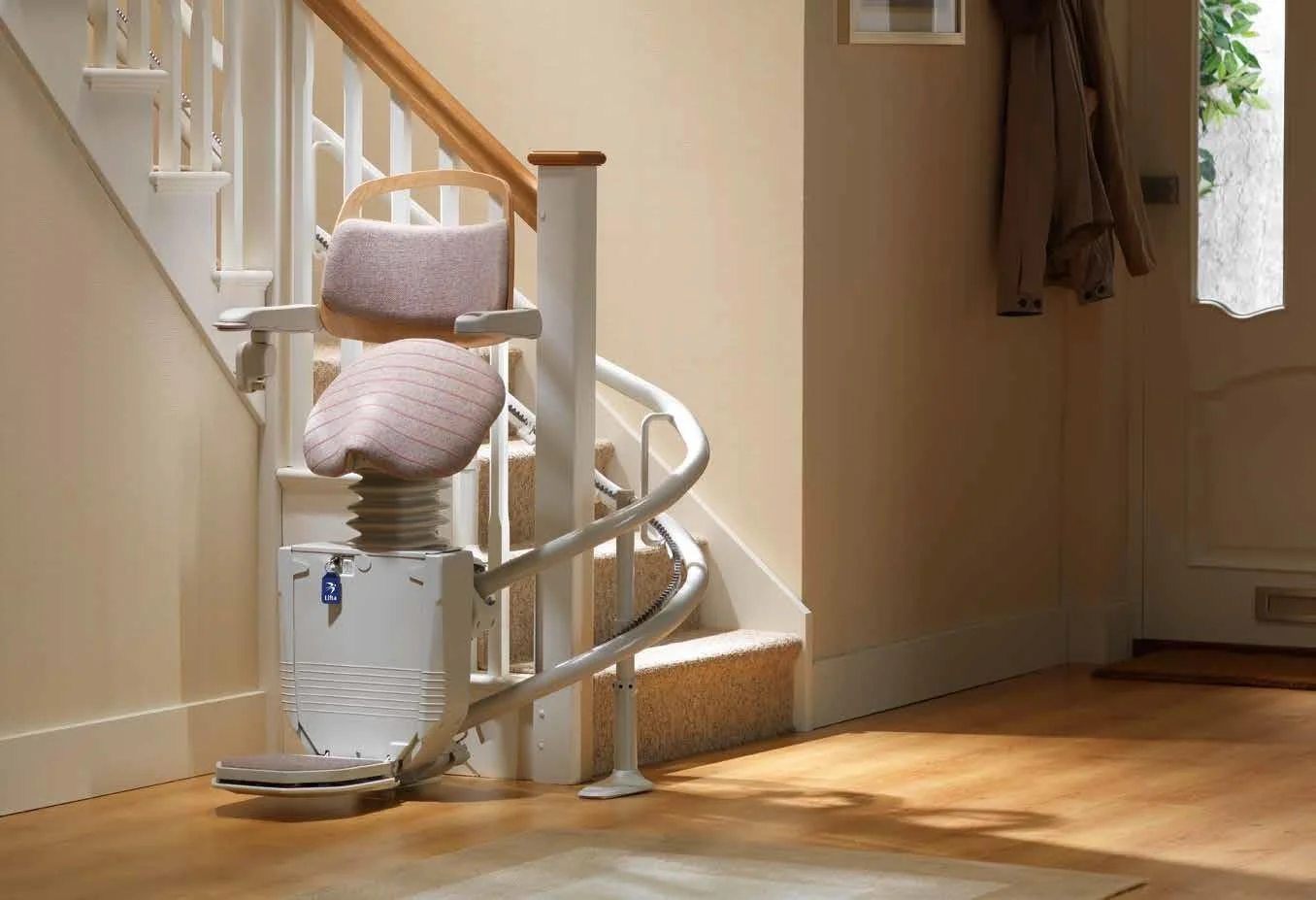
Older farmhouses and plantation-era homes are a different story. If the stairway turns, has a landing partway up, or changes direction, you will need a curved lift with a rail built to match that exact staircase. We measure on site before quoting either type.
Split-level homes often have short flights between levels. Each flight may need its own lift, so it helps to think about which levels the person actually uses every day.
In a county this spread out, plenty of houses sit on rural lots with front or back porch steps. An outdoor stair lift is built to handle weather and can cover those steps so getting in and out of the house is not the hard part of the day.
When someone uses a wheelchair and cannot transfer to a seat, a platform lift may be the better answer. It carries the chair itself, but it needs more space, so we look at the layout before recommending one.
Walk-up apartments are also part of the local housing mix. If you rent, the property owner will need to approve any installation in a shared stairwell.
About 18.3 percent of Campbell County residents are 65 or older, and 63.8 percent of residents own their homes. For many of those homeowners, staying on both floors of a house they already own is the goal.
The VA has its own rules on stair lifts, which are covered below, so veterans should read that part before applying.
No program listed here names stair lifts as a covered item, and the VA HISA grant specifically excludes stair glides. That does not always rule out help, but it means you should ask each program directly before counting on it.
Locally, the Central Virginia Alliance for Community Living at 501 12th Street, Suite A, Lynchburg, 24504, serves Campbell County and can be reached at (434) 385-9070. The Lynchburg Area Center for Independent Living also covers the county. Veterans can contact the Department of Veterans’ Affairs office at 519 Leesville Road, Suite A, Lynchburg, 24502, at (434) 582-5102.
Statewide, you can also ask about the CCC Plus Waiver (Cardinal Care Managed Care), the Virginia Livable Home Tax Credit (LHTC), the Assistive Technology Loan Fund Authority (ATLFA), and VA Benefits for Veterans (HISA + Prosthetics). Details on each program we could confirm are listed below.
This Virginia Medicaid waiver pays for environmental modifications up to $5,000 per person per calendar year for enrolled members who need a nursing-facility level of care. Its listed examples are ramps, grab-bars, doorway widening and bathroom work; stair lifts are not mentioned.
The area agency on aging for Campbell County runs a housing program aimed at accessibility, repairs and energy efficiency for older adults and adults with disabilities. Stair lifts are not specifically listed; call (434) 385-9070 to ask.
This fund pays vendors directly for approved items for people with disabilities, including seniors, in Campbell County and nearby areas. Named items include wheelchair ramps and bathroom modifications, but not stair lifts; call (434) 528-4971.
Owners in eligible rural parts of Campbell County with income at or below 50% of area median income can get loans up to $20,000 at 1% over 20 years, and those 62 or older may get grants up to $7,500, with a combined maximum of $27,500. The program covers removing health and safety hazards and does not name stair lifts, so confirm with the local USDA Rural Development office.
HISA offers a lifetime maximum of $6,800 for a service-connected disability, or $2,000 for other non-service-connected disabilities, for medically necessary home changes. The VA explicitly excludes stair glides, so it does not pay for stair lifts.
For veterans with qualifying severe service-connected disabilities, SAH pays up to $126,526 and SHA up to $25,350 (FY2026). Examples given are ramps and wider doorways; stair lifts are not specifically named.
Older adults
501 12th Street, Suite A, Lynchburg, 24504
Veterans
519 Leesville Road, Suite A, Lynchburg, 24502
The CCC Plus Waiver covers environmental modifications up to $5,000 per calendar year for enrolled members, but its listed examples do not include stair lifts. The modification must also be in the person's Plan of Care.
The HISA grant does not, since the VA lists stair glides as excluded equipment. The SAH and SHA grants do not name stair lifts either, so ask the Department of Veterans’ Affairs office in Lynchburg at (434) 582-5102.
Yes, the USDA Section 504 program offers grants up to $7,500 to owners 62 or older who cannot repay a loan, if income is at or below 50% of area median income. Stair lifts are not named, so approval depends on USDA.
The Central Virginia Alliance for Community Living at (434) 385-9070 is the area agency on aging for the county and runs an Emergency Home Accessibility and Repair program.
Usually, yes. A staircase with a turn or landing needs a curved lift with a custom rail, and we measure the stairs in person before recommending one.
No. The Lynchburg Area Center for Independent Living serves Campbell County along with Amherst, Bedford and Appomattox counties, the City of Lynchburg and the Town of Bedford. Call (434) 528-4971.
Tell us about the stairs in your home and we will explain which lift fits, what it costs and how installation works.
