From Keysville and Drakes Branch to Phenix and the old brick courthouse core of Charlotte Court House, homes in Charlotte County sit on hilly ground above the Staunton River. Many are ranch-style or split-level houses on sloped lots, with exterior entry steps and raised foundations. Those details decide what kind of stair lift will work.
This page walks through how local homes affect the choice between a straight, curved, outdoor or platform lift. It also lists the grants and agencies that serve Charlotte County residents, so you can see what help may be available before anyone measures a step.
Most housing here is single-family and detached, built on rural land. A ranch-style home may have only a few steps, but they are often outside, leading up to a raised foundation. An outdoor stair lift or a vertical platform lift is usually the better fit there than an indoor model.
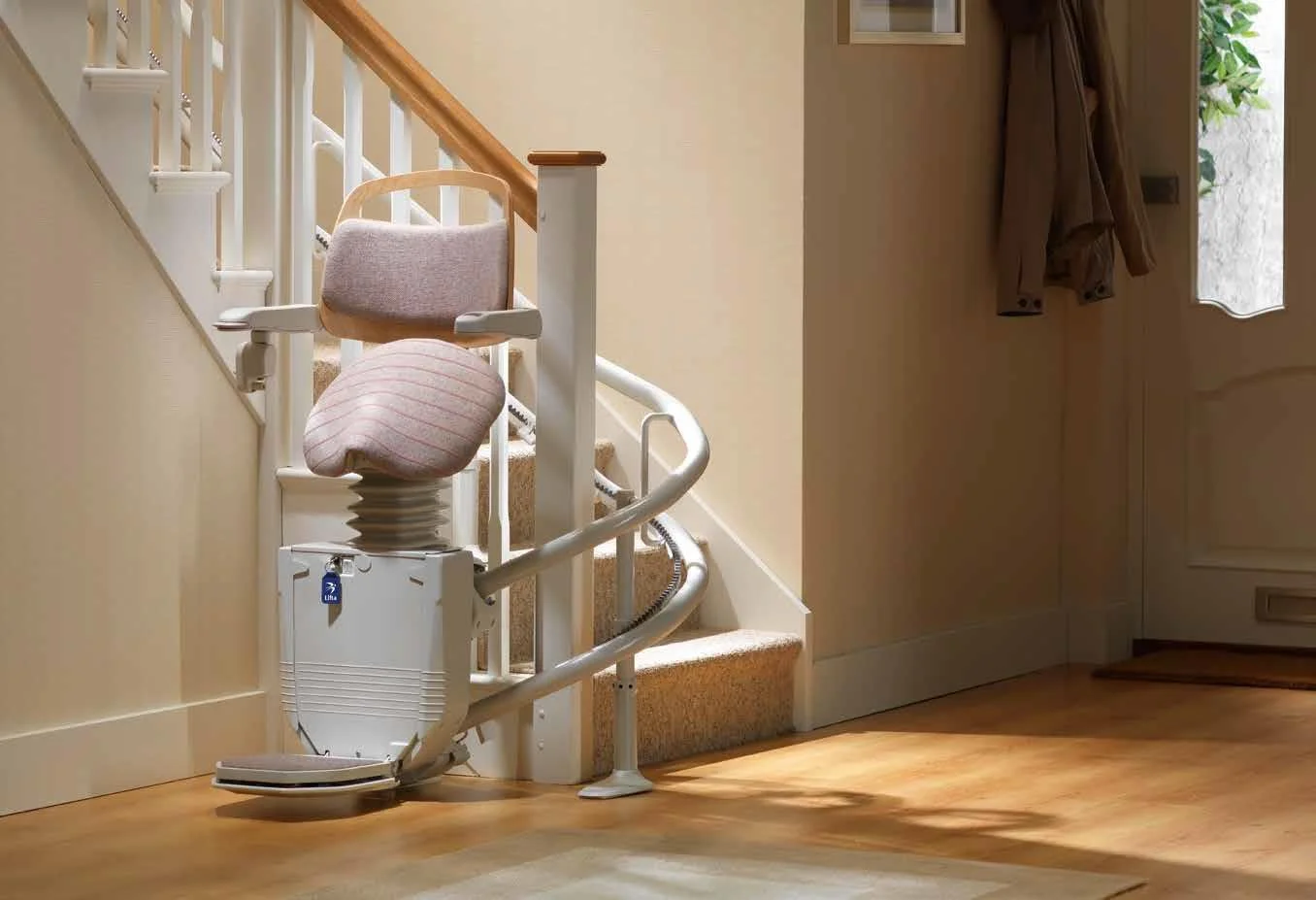
Split-level homes are a different job. They tend to have short runs of stairs between levels, sometimes with a turn or landing. A straight lift handles a single short run, while a turn in the stairs usually calls for a curved rail built to that staircase.
In Charlotte Court House, the National Register historic district counts 46 contributing buildings, with brick structures like the 1820 Brick Tavern. Older homes in and near that core can have narrow or steep stairs, so a careful measurement matters before choosing a rail.
The county covers roughly 475 square miles, and per the 2020 Census 100% of residents live in rural areas. Houses built on sloped lots often have more steps at the front or back door than at the stairs inside.
Travel time is part of the picture too. Service visits come in along U.S. Routes 360 and 15, so it helps to plan the in-home assessment and installation around one trip, with the outdoor steps, the indoor stairs and the power outlet locations all checked at once.
That makes age-based and veteran programs worth a close look when you start pricing a lift.
Roughly 55.5% of residents own their homes. Owners have the widest choice of grants, but some programs below also accept renters, usually with the property owner's approval.
The clearest source of help is the Virginia Housing Accessibility Grants, which name chairlifts among the modifications they fund, up to $10,000 per household with no repayment. Charlotte County residents apply through a local approved agent.
Other programs fund home repairs or accessibility work without naming stair lifts, so call and ask before counting on them. Statewide, the Virginia Livable Home Tax Credit (LHTC) and the Assistive Technology Loan Fund Authority (ATLFA) are also worth asking about.
Veterans should know that the VA HISA grant specifically excludes stair glides. The full list of programs, with phone numbers where available, is below.
Grants of up to $10,000 per household, with no repayment, that list installing ramps and chairlifts among funded modifications; tracks serve homeowners and renters at or below 60% of area median income and disabled veterans or active-duty members at or below 80%. Call (877) 843-2123 and apply through a Virginia Housing-approved agent for your locality.
Serves residents age 60 and older in seven counties including Charlotte, with meals, transportation, legal services, insurance counseling and at-home services; stair lifts and home modifications are not listed. Call (434) 767-5588 to ask about current offerings.
Provides up to $4,000 per household at or below 80% of area median income for repairs, wheelchair ramps and other accessibility modifications, awarded first-come, first-served; stair lifts are not named. Call (804) 371-7000.
A Medicaid waiver for people who need a nursing-facility level of care that funds Environmental Modifications and Assistive Technology among other services; stair lifts are not named, so confirm a specific device with your care coordinator. The general Cover Virginia line is (833) 522-5582.
Offers repair loans up to $40,000 at a fixed 1% for 20 years, and grants up to $10,000 for homeowners age 62 and older, for households at or below 50% of area median income in rural areas like Charlotte County. The source names ramps, grab bars and walk-in tubs; stair lifts are not listed.
Pays for medically necessary home alterations for veterans, up to $6,800 or $2,000 lifetime depending on disability status. It does not cover stair lifts: stair glides and porch lifts are specifically excluded.
Grants for veterans with qualifying severe service-connected disabilities, up to $126,526 (SAH) or $25,350 (SHA) for FY2026, used to build, buy or remodel for accessibility. Stair lifts are not listed in the source.
Serves people with disabilities, with Charlotte County in its secondary service area, offering referrals, peer counseling, discounted adaptive equipment and technical help with environmental modifications; stair lifts are not listed. Call (434) 971-9629.
Serves income-eligible households in Halifax and Charlotte counties with weatherization work such as insulation and heating repair; stair lifts and accessibility work are not listed. Call (434) 404-3455 to ask about its separate Home Maintenance / Private Jobs line.
Offers companion services to elderly residents and screening for in-home support or placement, serving mainly as an intake and referral point; home modification funding is not listed. Call (434) 542-5692.
Older adults
20 Oak Street, Farmville, 23901
Veterans
118 East Danville Street, South Hill, 23970
Yes. The Virginia Housing Accessibility Grants list chairlifts among funded modifications, up to $10,000 per household with no repayment. Income limits apply, and Charlotte County residents apply through a local approved agent. Call (877) 843-2123.
Not through HISA, which specifically excludes stair glides. The SAH and SHA grants do not name stair lifts either way. For help sorting out veteran benefits, the Virginia Department of Veterans Services South Hill Office is at 118 East Danville Street, South Hill, (434) 829-6386. Disabled veterans may also qualify for the Granting Freedom track of the Virginia Housing grants.
Piedmont Senior Resources AAA serves residents 60 and older in Charlotte County from its office at 20 Oak Street, Farmville. Its listed services do not include stair lifts, but you can call (434) 767-5588 to ask what is available now.
Possibly. The RUAM track of the Virginia Housing Accessibility Grants serves renters at or below 60% of area median income, and EHARP accepts tenants with the homeowner's approval. Your landlord will need to agree to any installation.
It can. Raised foundations and exterior entry steps are common on the county's hilly lots, and an outdoor stair lift or a platform lift is built for that kind of entry. An in-home visit will show which one fits your steps.
The Charlotte County Department of Social Services Adult Services line, (434) 542-5692, handles screening and referrals for elderly or disabled residents. For direct stair lift funding, the Virginia Housing grant line at (877) 843-2123 is the most direct call.
Tell us about the stairs in your home and we will explain which lift fits, what it costs and how installation works.
