Amelia County covers about 359 square miles of rolling Piedmont farmland southwest of Richmond, with Amelia Court House as its one town and the Appomattox River along its northern and western edges. The land rises from about 158 feet near Lake Chesdin to 525 feet near Gills, and nearly every home sits on a rural lot.
Many houses here are older farmhouses, ranch-style homes and split-level homes, and most are lived in by the people who own them. That combination of older stair layouts, hilly lots and long drives to Richmond-area providers is why stair lifts come up so often when families plan for a parent to stay at home.
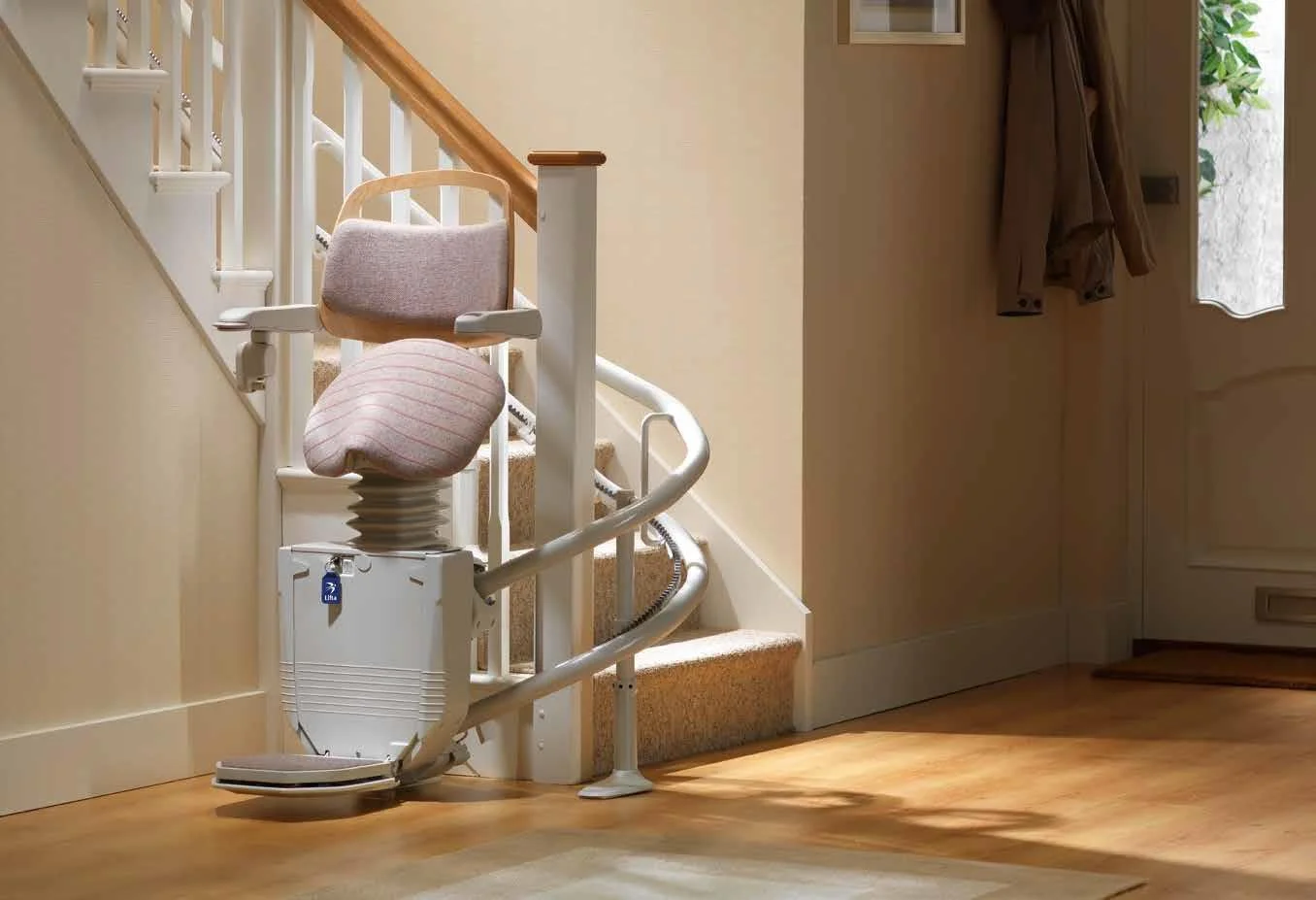
The county's housing grew out of farmhouse and plantation-era building, typical of central Virginia's Piedmont. Older farmhouses often have steep, narrow stairs and few single-story options, so moving a bedroom downstairs is not always practical.
A straight staircase with no landing usually takes a straight stair lift, the simplest and quickest install. Stairs that turn, have a landing partway up or wind around a corner need a curved rail built to that staircase.
Split-level homes have short flights between floors, and each flight can be handled on its own. Ranch-style homes may be one floor inside but still have steps at the porch or down to a lower level.
On a hilly rural lot, the climb to the front door can be the hardest part of the day. An outdoor stair lift built for weather can handle porch and entry steps, and a platform lift is the option when someone uses a wheelchair and cannot transfer to a seat.
The 2020 Census counted 13,265 residents in Amelia County, with a median age of 46.1 and 21.0% age 65 or older. The Census also classifies 100% of the population as rural, and 81.8% of the county's 5,704 housing units are owner-occupied.
Because medical and mobility-equipment providers are mostly in the Richmond area, it helps to measure the stairs and line up funding before a fall or hospital stay forces a quick decision. Owners can make changes to their homes, which keeps most stair lift options open.
The clearest match is the Virginia Housing Accessibility Grants program, which names chairlifts among covered modifications and pays up to $10,000 with no repayment for homeowners at or below 60% of area median income. Applications go through a Virginia Housing-approved agent.
Other programs cover accessibility work in general without naming stair lifts, so ask each one directly. These include EHARP, USDA Section 504 repairs, the CCC Plus Medicaid waiver and VA grants for veterans. Statewide, you can also ask about the Virginia Livable Home Tax Credit (LHTC) and the Assistive Technology Loan Fund Authority (ATLFA).
Veterans can reach the Richmond VA Medical Center office of the Virginia Department of Veterans Services at (804) 675-6546. Piedmont Senior Resources in Farmville, at 20 Oak Street, serves residents age 60 and older and can be reached at (434) 767-5588.
This Medicaid waiver covers environmental modifications and assistive technology for eligible adults who need a nursing-facility level of care but want to stay at home, approved case by case by the member's managed care organization; stair lifts are not named on the program page. Call the Cover Virginia Call Center at (833) 522-5582.
A true grant of up to $10,000 for homeowners at or below 60% of area median income, and it explicitly lists installing ramps and chairlifts. Call Virginia Housing at (877) 843-2123 to find an approved agent serving Amelia County.
Pays up to $4,000 per applicant for repairs and accessibility modifications such as wheelchair ramps for households at or below 80% of area median income, first-come, first-served; stair lifts are not named. Call DHCD at (804) 371-7000.
Offers 1% loans up to $40,000 and, for homeowners 62 and older who cannot repay a loan, grants up to $10,000 for very-low-income owners in eligible rural areas like Amelia County; accessibility improvements are covered, but stair lifts are not named. Call USDA Rural Development at (804) 287-1500.
National VA grants for veterans with specific service-connected disabilities, up to $126,526 for SAH and $25,350 for SHA in FY2026, for modifications such as ramps and wider doorways; stair lifts are not named.
Provides $6,800 or $2,000, depending on disability status, for medically necessary home improvements prescribed by a VA physician. HISA does not cover stair lifts, since it excludes removable equipment such as stair glides and porch lifts.
The Area Agency on Aging for Amelia County residents 60 and older, offering in-home services, personal care aides and information and referral; it does not list a stair lift or home modification program. Call (434) 767-5588 to ask about current referrals.
Older adults
20 Oak Street, Farmville, 23901
Veterans
1201 Broad Rock Blvd. Room 1M-169B, Richmond, 23249
Yes. Virginia Housing Accessibility Grants lists installing chairlifts as a covered modification, up to $10,000 with no repayment, for homeowners at or below 60% of area median income. Call (877) 843-2123 to find an approved agent.
Usually, yes. Straight stairs take a straight rail, while stairs with landings or turns need a curved rail made for that staircase. Steep, narrow farmhouse stairs are a common reason families choose a stair lift over moving downstairs.
HISA excludes stair glides and porch lifts, so it will not. SAH and SHA grants cover modifications for qualifying service-connected disabilities but do not name stair lifts, so ask the Virginia Department of Veterans Services office at the Richmond VA Medical Center at (804) 675-6546.
USDA Section 504 offers grants up to $10,000 to homeowners 62 and older below 50% of area median income who cannot repay a loan, and Amelia County is a USDA-eligible rural area. Stair lifts are not named, so confirm with USDA Rural Development at (804) 287-1500.
Piedmont Senior Resources, based at 20 Oak Street in Farmville, serves Amelia County residents 60 and older. Call (434) 767-5588 to ask about in-home services and any current home modification referrals.
Outdoor stair lifts are built for porch and entry steps on hilly rural lots. If the person uses a wheelchair and cannot move to a seat, a platform lift is the better fit.
Tell us about the stairs in your home and we will explain which lift fits, what it costs and how installation works.
