Hopewell sits where the Appomattox and James Rivers meet, and a good part of its housing dates back about a century. Many homes were built quickly by DuPont to house plant workers during World War I, when the city's population jumped almost overnight. Those older multi-story houses are still standing in the core neighborhoods, and their stairs are often the reason families call us.
The city has about 22,944 residents, and 15.0% are 65 or older. If you or a parent lives in one of those older homes, a townhouse, a duplex or a walk-up apartment, this page walks through which kind of stair lift tends to fit and which local and state programs are worth a phone call before you pay out of pocket.
Hopewell's housing is mostly relatively small, older homes, with pockets of newer construction. When the middle class moved to newer houses in Prince George and Chesterfield counties during the 1960s and 1970s, the core neighborhoods kept their aging inventory of multi-story homes.
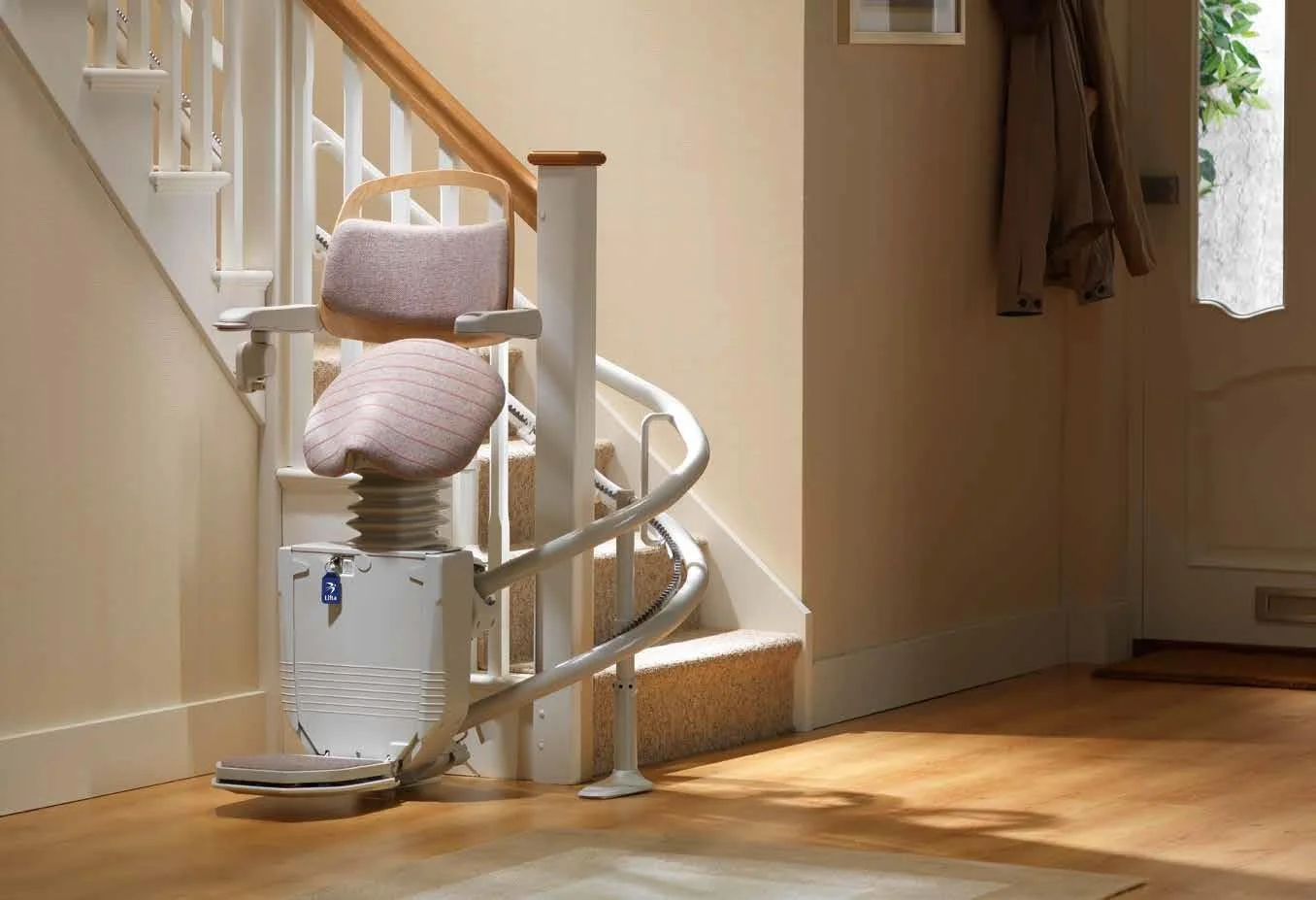
In a house with one straight run of stairs, a straight stair lift is usually the simplest and least costly choice. The rail mounts to the stair treads, not the wall, so plaster walls in an older home are not a problem. If the staircase turns at a landing or has winder steps, you will need a curved lift built to that exact staircase.
Before we recommend anything, we measure the stair width, check for a landing at the top and bottom, and look at whether a door or hallway opens right at the first step. Those details decide whether a folding rail or a swivel seat is needed.
Townhouses and duplexes in Hopewell often have one interior staircase between floors, which is a common setup for a straight or curved lift. Walk-up apartments and low-rise buildings are different, because the stairs are usually shared space and the building owner has to approve any installation.
Only 55.5% of households in the city own their home, and the city has many rental properties. If you rent, talk with your landlord before ordering a lift. Some Virginia Housing grant programs, covered below, are open to people who occupy a rental home, not only owners.
Many older houses have steps up to the front or back porch, and those can be harder to manage than the inside stairs. An outdoor stair lift uses weather-resistant parts and a cover for the seat. Hopewell's humid subtropical climate means hot summers and mild winters, so sun and moisture matter more than ice when choosing materials.
When someone uses a wheelchair and cannot transfer to a seat, a platform lift may be the better answer for a short rise at the entry. We can look at both options during the same visit.
Paying for home changes is a real hurdle here. Hopewell's median household income is about $54,729, and the poverty rate is 21.8%, more than double the statewide rate of 9.9%. That makes grant programs worth checking first.
The program that names chairlifts as an eligible modification is the Virginia Housing Accessibility Grants program, with grants up to $10,000, and Hopewell is listed among the cities it serves. Medicaid's CCC Plus waiver covers environmental modifications as a category, though it does not name stair lifts. Hopewell is not part of the state EHARP home-accessibility program, so home repair requests go through the City of Hopewell CDBG program instead.
Hopewell properties are generally understood to be ineligible for USDA Section 504 rural home-repair loans and grants because the city is part of the Richmond metro area, though that has not been confirmed. Statewide, you can also ask about the Virginia Livable Home Tax Credit (LHTC) and the Assistive Technology Loan Fund Authority (ATLFA). The programs list below gives a phone number for each local and state option.
The VA HISA grant specifically excludes stair glides, so it will not pay for a stair lift, and the VA SAH and SHA grants do not list stair lifts either.
The Virginia Housing Granting Freedom grant is aimed at veterans with household income at or below 80% of area median income and is a stronger lead for a stair lift. For help sorting out benefits, Virginia Veteran and Family Support has an office at 22 W. Washington St., Petersburg 23830, at (804) 489-6098.
Grants up to $10,000 that name chairlifts as an eligible modification, and Hopewell is a served city; Granting Freedom is for veterans at or below 80% of area median income, while Owner-Occupied Rehabilitation and RUAM are for households at or below 60%. You must own or occupy the home, and applications go through Virginia Housing's accepted agents at (877) 843-2123.
A Virginia Medicaid waiver for people who meet nursing-facility level of care and are at imminent risk of nursing facility placement; it covers environmental modifications and assistive technology as categories, but stair lifts are not listed by name. Call Cover Virginia at (833) 522-5582.
The city's annual HUD CDBG funding, awarded to public agencies and nonprofits for housing and community projects; accessibility or stair lift funding is not itemized. Because Hopewell is excluded from the state EHARP program, ask Kelly Davis at (804) 541-2269 about home-accessibility repair options.
The local intake and counseling point for adults 60 and older in Planning District 19, which includes Hopewell; it does not list a stair lift benefit but can connect you with services. Call the Senior Helpline at (804) 732-7020.
A nonprofit repair program for income-eligible homeowners that lists Hopewell/Petersburg as a current service area; its examples include wheelchair ramps and tub-to-shower conversions, and stair lifts are not listed. Call (804) 447-3841 for income details.
Offers advocacy, peer support, information and referral for people with disabilities in Hopewell and nearby areas, but states it does not provide financial assistance; stair lifts are not listed. Call (804) 862-9338.
A VA grant with a $6,800 lifetime maximum for service-connected disabilities or $2,000 for other disabilities, but it explicitly excludes stair glides, so it does not cover stair lifts. Call (800) 827-1000.
Larger VA grants for veterans with specific severe service-connected disabilities, with SAH up to $126,526 and SHA up to $25,350 for a permanent residence (FY2026); stair lifts are not listed. Call (800) 827-1000.
Older adults
23 Seyler Drive, Petersburg, 23805
Veterans
22 W. Washington St., Petersburg, 23830
The Virginia Housing Accessibility Grants program names chairlifts as an eligible modification and offers grants up to $10,000. Hopewell is one of the cities it serves. Call (877) 843-2123 to find an accepted agent who can take your application.
The VA HISA grant explicitly excludes stair glides, so it will not. The SAH and SHA grants do not list stair lifts. Veterans should look at the Virginia Housing Granting Freedom grant, which is for veteran households at or below 80% of area median income.
No. Hopewell is listed among the CDBG entitlement jurisdictions excluded from EHARP. Home-accessibility repair requests should go through the City of Hopewell CDBG program, reached through Kelly Davis at (804) 541-2269.
Yes, possibly. The Virginia Housing RUAM program serves rental households at or below 60% of area median income, and the grants require that you own or occupy the home. You will still need your landlord's permission to install a lift.
Start with the Crater District Area Agency on Aging at (804) 732-7020. Its office is at 23 Seyler Drive, Petersburg 23805, and it serves Hopewell residents 60 and older. It can help you sort through local services before you apply for grants.
Probably not. Because Hopewell is part of the Richmond metro area, its properties are generally understood to be ineligible for USDA Section 504 loans and grants, though that has not been confirmed. Virginia Housing, the city CDBG program and the CCC Plus Medicaid waiver are the more likely routes.
Tell us about the stairs in your home and we will explain which lift fits, what it costs and how installation works.
