Fauquier County covers 651 square miles of Piedmont between the Blue Ridge and the Washington, DC area, and its houses are as varied as its roads. In Warrenton, the county seat, historic in-town homes still have their original stairways. Out toward New Baltimore and Bealeton, newer subdivisions keep going up, while older multi-story farmhouses stand on the rolling land around Marshall, Remington, Opal and Midland.
That mix matters when someone in the family starts having trouble with the stairs. A stair lift that fits a straight run in a newer house is a different job from one that has to follow a turning staircase in a farmhouse. Below we walk through what local homes usually need and which programs can help with the cost.
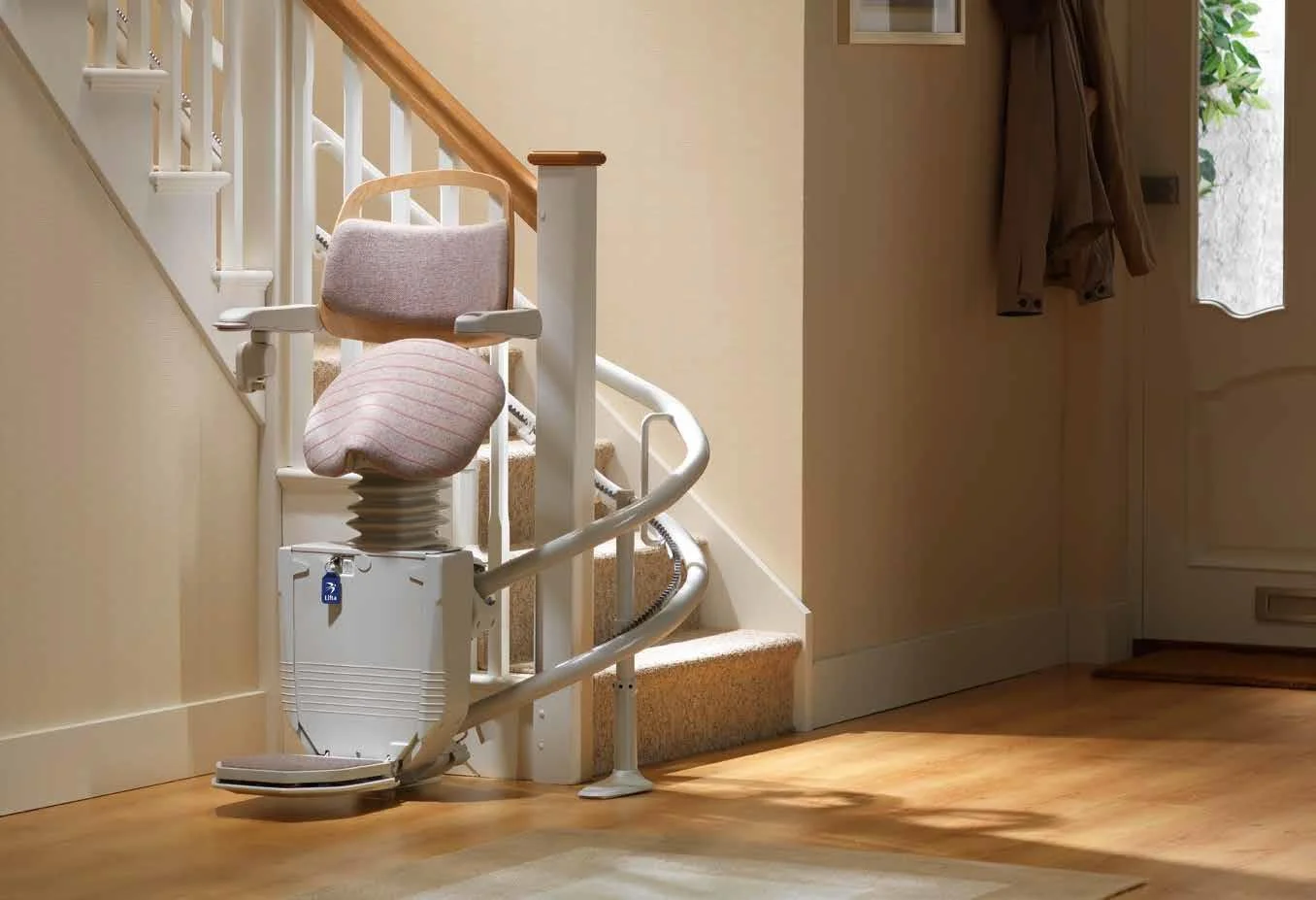
Many of the county's older multi-story farmhouses and historic in-town homes were built with stairways that turn, narrow or stop at a landing. Those staircases usually call for a curved stair lift, which runs on a rail built to follow that specific stairway.
In the Warrenton Historic District Area, owners often want to keep original woodwork intact. A stair lift rail mounts to the stair treads rather than the wall, so the staircase itself stays in place. We measure on site before recommending a curved or straight unit.
Single-family homes in the newer subdivisions built out from Warrenton and New Baltimore often have one straight flight to the second floor. A straight stair lift is the simplest fit for that layout and is usually the quickest to install.
Split-level homes are a different case. They tend to have several short flights between levels, so a family may need a lift on the flight used most, or a curved rail that covers more than one section. Townhouses can stack two or three flights, which is worth planning for before choosing a unit.
Walk-up apartments also appear across the county. Anyone renting should get the owner's permission before any installation.
The land rises toward Blue Mountain, at 2,208 feet on the northwestern border, and many homes sit on slopes with steps up to the porch or down to a garage. An outdoor stair lift built for weather exposure can handle those entry steps. For a wheelchair user, a platform lift may be a better match than a seat.
With about 113 people per square mile, homes in the more remote parts of the county can be far apart. That affects how far in-home aging services and contractors travel, so it helps to book a measuring visit early rather than waiting for an urgent need.
One point surprises families: the VA HISA grant specifically excludes stair glides, porch lifts and portable ramps. The VA SAH and SHA grants do not name stair lifts as covered or excluded, so ask the VA directly.
Virginia Housing's Granting Freedom grant is a stronger fit for many veterans, since its eligible work includes installing chairlifts. The Virginia Department of Veterans Services Manassas Office at 9300 West Courthouse Road Suite 305 can be reached at (703) 479-7437.
Only two programs below say outright that they can cover a stair lift: the CCC Plus Medicaid Waiver, through environmental modifications, and the Virginia Housing Accessibility Grants, which list chairlifts by name. Others fund home repairs or accessibility work without naming stair lifts, so it is worth asking before you apply.
Owner-occupancy matters for several of these grants, and 79.7% of the county's housing units were owner-occupied in the 2020 census. Statewide, families can also look into the Virginia Livable Home Tax Credit (LHTC) and the Assistive Technology Loan Fund Authority (ATLFA).
A good first call is Encompass Community Supports, the area agency on aging, at (540) 825-3100. Its office is at 15361 Brandford Road in Culpeper.
A Medicaid waiver for people who need a nursing-facility level of care, with environmental modifications as a covered service; stair glides are listed as possible modifications by a secondary source. Confirm with your MCO care coordinator or EM/AT provider before counting on coverage.
The area agency on aging for Culpeper, Fauquier, Madison, Orange and Rappahannock counties, offering options counseling and referrals to home-modification funding; stair lifts are not listed as a direct benefit. Call (540) 825-3100.
Grants of up to $10,000 that explicitly include installing ramps and chairlifts, with income limits of 80% of area median income for veterans and 60% for the other programs. Applications go through a Virginia Housing accepted agent; call (877) 843-2123.
Up to $4,000 for accessibility and repair work for households at or below 80% of area median income, first-come, first-served; stair lifts are not specifically listed. Call (804) 371-7000.
Repair loans up to $40,000 at 1% and grants up to $10,000 for very-low-income homeowners 62 or older in eligible rural areas; stair lifts are not specifically listed as an eligible repair.
A lifetime grant of $6,800 or $2,000 for medically necessary home alterations, but it does not cover stair lifts, since stair glides and porch lifts are excluded. Call (800) 827-1000.
Grants up to $126,526 (SAH) or $25,350 (SHA) for veterans with qualifying severe service-connected disabilities; stair lifts are not named as covered or excluded. Call (800) 827-1000.
A monthly payment added to the VA pension for wartime-era veterans or surviving spouses who need help with daily activities; it is not a home-modification grant and stair lifts are not listed.
Grants and no-interest loans up to $20,000 for critical repairs and hazard elimination in homes at least 10 years old, with a $150 fee after approval; stair lifts are not mentioned. Call (540) 341-4952.
Benefits screening, Adult Protective Services and referrals for county residents, not a home-modification grant; stair lifts are not listed. Call (540) 422-8400.
Older adults
15361 Brandford Road, Culpeper, 22701
Veterans
9300 West Courthouse Road Suite 305, Manassas, 20110
Not through the HISA grant, which excludes stair glides and porch lifts. The SAH and SHA grants do not name stair lifts either way, so call (800) 827-1000. Virginia Housing's Granting Freedom grant does list chairlifts for veterans at or below 80% of area median income.
The CCC Plus Medicaid Waiver covers environmental modifications for people who need a nursing-facility level of care, and a secondary source names stair glides among them. The official program page does not itemize stair lifts, so confirm with your care coordinator first.
Fauquier Habitat for Humanity's Housing Preservation / Aging in Place Program serves the Warrenton Historic District Area, with grants and no-interest loans up to $20,000. The home must be owner-occupied and at least 10 years old, and stair lifts are not specifically mentioned. Call (540) 341-4952.
The program's excluded jurisdictions are Arlington, Chesterfield, Fairfax, Henrico, Loudoun and Prince William, and Fauquier is not on that list. It offers up to $4,000 for households at or below 80% of area median income. Call (804) 371-7000.
USDA Section 504 grants require the applicant to be 62 or older, but the repair loans of up to $40,000 at 1% are not tied to that age limit in the program details. You must own and occupy the home in an eligible rural area and have very-low income.
Encompass Community Supports, the area agency on aging, at (540) 825-3100 can point you to funding sources. The Fauquier County Department of Social Services at (540) 422-8400 handles benefits screening and Adult Protective Services for anyone 60 or older.
Tell us about the stairs in your home and we will explain which lift fits, what it costs and how installation works.
