Newport News runs along roughly 23 miles of James River waterfront, down to the river's mouth at Hampton Roads Harbor. Much of the city was built in the mid-to-late 20th century. About 30.45% of homes went up between 1940 and 1969, and another 47.2% between 1970 and 1999.
That means a lot of original stairways in houses that were never planned for aging in place. Here is how those homes, the low-lying Tidewater setting and the local and state programs fit together when you are deciding on a stair lift for yourself or a parent.
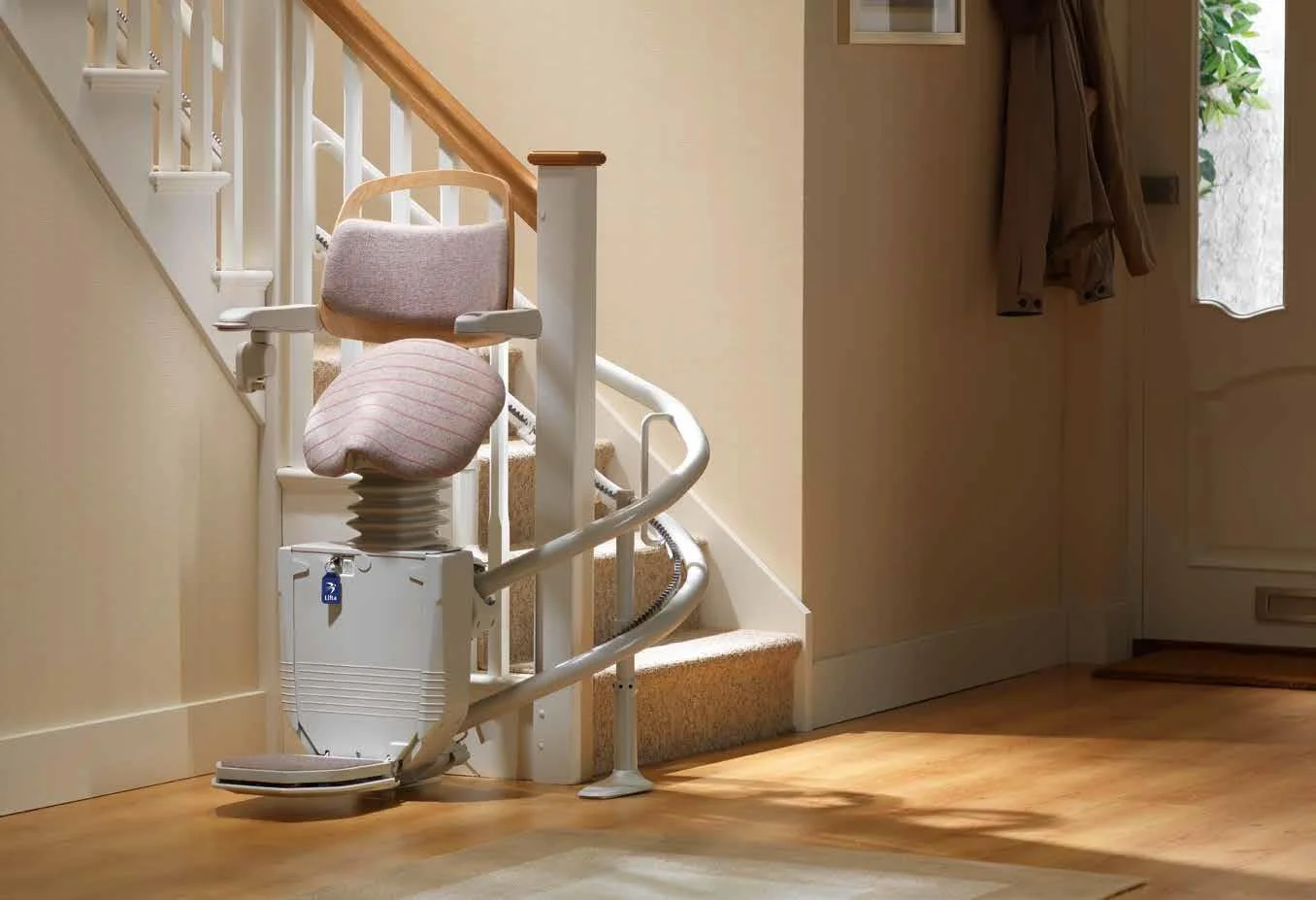
Single-family detached homes make up 50.21% of the city's housing units. In a two-story house with one straight flight, a straight stair lift is usually the simplest install. The rail mounts to the stair treads, not the wall, so original plaster and trim stay intact.
Split-level homes are a different job. They often have two or more short flights with a landing or turn between them. That can call for a curved rail, or a separate straight lift on each flight, and we measure each run before recommending either one.
Townhouses tend to have narrow, steep stairs between floors. We check the stair width and the clearance at the top and bottom so a folded lift does not block the path for everyone else in the house.
Newport News is low-lying, with about 46 inches of rain a year and temperatures that run roughly 32 to 88°F. Of the city's 309.82 sq km, 131.14 sq km is water. If the hard part is getting from the driveway or porch into the house, an outdoor-rated stair lift or a vertical platform lift may make more sense than an indoor unit.
Outdoor lifts are built with weather covers and sealed parts for rain and humidity. Where front steps are short but a wheelchair is involved, a platform lift is often the better fit than a seat-style lift.
About 48.1% of Newport News households own their home, so many families rent, including in walk-up apartments and low-rise buildings. Renters generally need the owner's written permission before any lift goes in. One state grant track, described below, is set up specifically for renters.
Veterans should know that the VA HISA grant does not pay for stair glides, though other state options do list chairlifts. The Virginia Department of Veterans Services Hampton Benefits Office at 2101 Executive Drive, Suite 420, Tower Box 48, Hampton 23666, can be reached at (757) 825-7893.
The program that names chairlifts outright is the Virginia Housing Accessibility Grants, which offer up to $10,000 with no repayment. You apply through an approved local agent, such as Peninsula Center for Independent Living or NNRHA, and grants are first-come, first-served.
Several other programs fund accessibility work but do not mention stair lifts in their own materials. That includes the NNRHA Emergency Repair & Handicap Accessibility Program, the Virginia Livable Home Tax Credit and the Medicaid waivers. Ask each one directly whether a stair lift qualifies before you count on it.
A good first call for older adults is the Peninsula Agency on Aging at (757) 873-0541, 739 Thimble Shoals Blvd., Suite 1006, Newport News 23606. Staff there can point you toward the right referral.
Offers 0-1% loans and grants of up to $8,000 for accessibility improvements, such as wheelchair ramps, to residents with household income below 80% of area median income. Stair lifts are not named in the program's materials, so call (757) 928-2657 to ask.
A state tax credit for Virginia homeowners that covers up to 50% of retrofit costs, not to exceed $6,500, for permanent accessibility features; rental units are not eligible. The program page does not list stair lifts, and an older guide cites a January 31 filing deadline, so confirm details with DHCD at (804) 371-7000.
Grants of up to $10,000, with no repayment, that explicitly cover installing chairlifts, with separate tracks for disabled veterans and service members, homeowners and renters, each with its own income limit. Apply through an approved local agent, or call (877) 843-2123.
For enrolled CCC Plus waiver participants, this provides up to $5,000 per household per year for environmental modifications and up to $5,000 per individual per year for assistive technology, resetting each July 1. Stair lifts are not named among the listed examples.
Covers up to $5,000 per calendar year in home adaptations for people on the Building Independence, Family & Individual Support or Community Living waiver. The listed examples include ramps and grab-bars, but stair lifts are not named.
Provides a lifetime maximum of $6,800 or $2,000, depending on disability status, for medically needed home alterations prescribed by a VA physician. HISA does not cover stair glides or porch lifts, which the VA treats as removable equipment.
For veterans with qualifying severe service-connected disabilities, these grants provide up to $126,526 (SAH) or $25,350 (SHA) for FY2026 to build, buy or remodel an accessible home. Stair lifts are not named among the example modifications.
Serves older adults in Newport News and nearby localities with care coordination, caregiver support, veteran services and a no-cost Assistive Technology Lab, but it does not list a stair lift grant. Call (757) 873-0541 to ask about referrals.
Offers independent living skills, advocacy, peer support and transition services to people with disabilities on the Peninsula; stair lifts are not listed among its services. PCIL is also referenced as an approved local agent for Virginia Housing grant applications, reachable at (757) 827-0275.
Uses volunteers and donated materials to provide no-cost home repairs, including accessibility modifications, for cost-burdened residents in Hampton and Newport News. Stair lifts are not specifically named.
Older adults
739 Thimble Shoals Blvd., Suite 1006, Newport News, 23606
Veterans
2101 Executive Drive, Suite 420, Tower Box 48, Hampton, 23666
The Virginia Housing Accessibility Grants explicitly list installing chairlifts. They pay up to $10,000 with no repayment, and you apply through an approved local agent such as Peninsula Center for Independent Living or NNRHA.
Yes, possibly. The Rental Unit Accessibility Modification track of the Virginia Housing grants is for renters with income at or below 60% of area median income, and the unit must be your primary residence. You will also need the owner's permission.
The VA HISA grant does not, because it excludes stair glides as removable equipment. Disabled veterans and service members can look at the Granting Freedom track of the Virginia Housing grants, which lists chairlifts, or call the Hampton Benefits Office at (757) 825-7893.
Not always. Some split-levels work with a curved rail that runs around the landing, and others are better served by a straight lift on each flight. We measure both runs during the home visit before recommending one.
The current DHCD page does not name stair lifts, so it is not confirmed. Retrofits that are a permanent part of the home can qualify for up to 50% of cost, not to exceed $6,500. Call DHCD at (804) 371-7000 to check before you file.
For an older adult, start with the Peninsula Agency on Aging at (757) 873-0541. They can help sort out referrals to NNRHA and the Virginia Housing programs.
Tell us about the stairs in your home and we will explain which lift fits, what it costs and how installation works.
