Giles County sits on the West Virginia state line in southwestern Virginia, with most of its homes in Pearisburg, Narrows, Pembroke, Rich Creek and Ripplemead and the rest spread out along rural roads. It covers about 360 square miles and is the site of two of the highest mountain peaks in Virginia, so plenty of houses here were built into hillsides rather than on flat lots.
That shapes the stair question. Split-level and multi-level homes are common, and many owners have lived in them a long time. When the steps to the bedroom or the front door get hard, a stair lift is often a better answer than moving. This page walks through which kind of lift fits which kind of home and where Giles County families can look for help paying for one.
About 22.8% of Giles County residents are 65 or older, and 72.3% of households own their home. That is a large group of people who plan to stay put in houses they already know.
Owning the home matters for a stair lift. You can mount a rail to the stair treads without asking a landlord, and most of the grant programs below require that you own and live in the house.
Ranch-style homes usually have just a few steps at an entry or a single flight down to a basement. A short straight rail often handles that job, and it is the simplest and quickest kind to install.
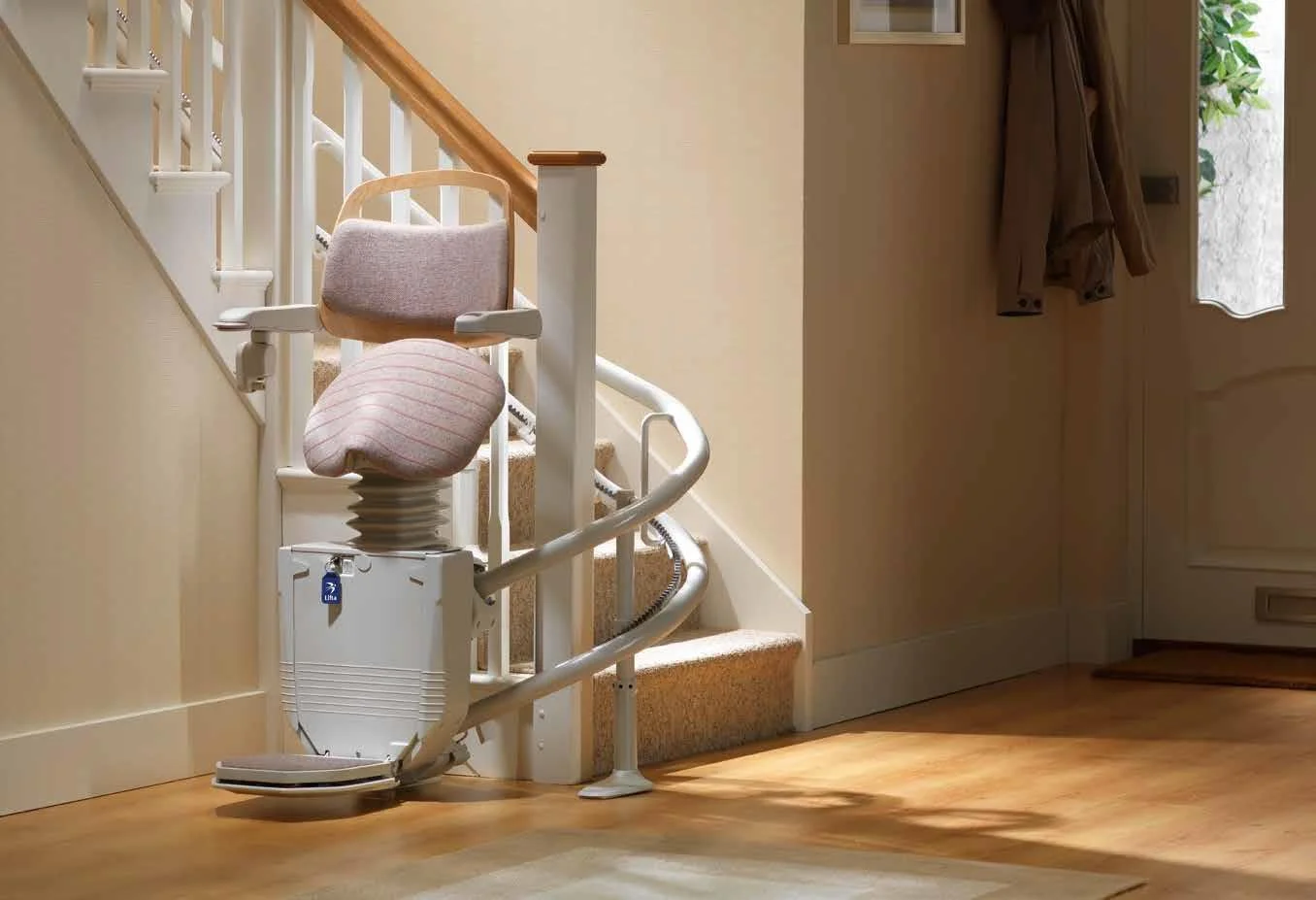
Split-level homes are different. You may have two or three short runs of stairs between levels, sometimes with a turn or a landing. A single straight rail cannot follow a turn, so these homes often need a curved rail built to the exact stairway, or a separate lift on each run.
Townhouses tend to have one long, narrow flight. Before choosing a lift we measure the width so a person can still walk past the folded seat. Walk-up apartments raise a separate issue, because the stairs are often shared and the building owner has to agree to any installation.
On mountain terrain, the hardest stairs are often outside: steps from the driveway up to the porch, or down a slope to a side door. An outdoor stair lift is built for weather and can run along those exterior steps.
Where steps are short but someone uses a wheelchair, a platform lift may make more sense than a seat. We look at the whole path from the car to the kitchen before recommending one type over another.
The program most likely to help directly is the Virginia Housing Accessibility Grants program, which names chairlifts as a typical funded change and does not need to be repaid. It has an income limit, and you apply through a local agent that Virginia Housing accepts.
Medicaid's CCC Plus waiver pays for environmental modifications for people who qualify for a nursing facility level of care, though stair lifts are not named in its rules. Veterans should know that the VA HISA grant specifically excludes stair glides, while the larger SAH and SHA grants cover home remodeling for severe service-connected disabilities.
Virginia also has statewide options worth asking about, including the Virginia Livable Home Tax Credit (LHTC) and the Assistive Technology Loan Fund Authority (ATLFA). The New River Valley Agency on Aging in Radford can point you toward the right office if you are not sure where to start.
Grants up to $10,000 with no repayment for homeowner-occupants with disabilities at or below 60% of Area Median Income, and the program lists installing ramps and chairlifts as a typical use. Apply through a Virginia Housing-accepted local agent; call (877) 843-2123.
Pays up to $5,000 per calendar year for environmental modifications such as ramps, grab bars, widened doorways and bathroom changes for Medicaid members who need a nursing facility level of care; stair lifts are not named in the rules. Start with the Giles County Department of Social Services or call (844) 374-9159.
A federal repair loan and grant program for homeowners in rural areas; its current dollar limits and eligibility could not be confirmed, and the source does not mention stair lifts. Check details directly with USDA before relying on it.
Provides up to $6,800 lifetime for service-connected disabilities or $2,000 for other disabilities, but it explicitly does not pay for stair glides or porch lifts. It funds permanent changes like ramps and accessible bathrooms; call (800) 827-1000.
For FY2026, SAH pays up to $126,526 and SHA up to $25,350 to build, buy or remodel a home for veterans with certain severe service-connected disabilities; stair lifts are not specifically named. Call (800) 827-1000.
Serves Giles County residents age 60 or older with meals, transportation, homemaker help and care coordination, but it does not list a home modification or stair lift grant. It can refer you to other programs; call (540) 980-7720.
Serves people with disabilities, including older adults and veterans, in Giles County; its website does not mention a stair lift or home modification program. Call (540) 266-1435 to ask about current projects and whether it acts as a local agent for Virginia Housing grants.
Older adults
6580 Valley Center Dr., Suite 124, Radford, 24141
Veterans
335 West Monroe Street, Suite 200, Wytheville, 24382
The CCC Plus waiver covers environmental modifications up to $5,000 per calendar year, but the rules list items like ramps and grab bars and do not name stair lifts. Apply for screening through the Giles County Department of Social Services and ask whether a stair lift would be approved.
The HISA grant does not; it specifically excludes stair glides. The SAH and SHA grants fund remodeling for severe service-connected disabilities without naming stair lifts. The Wytheville Benefits Office at (276) 228-5211 handles VA benefits questions for this area.
Yes, in some cases. CCC Plus accepts people under 65 with a qualifying disability, and the Virginia Housing grant is based on disability and income rather than age.
Usually, yes. Split-levels often have short runs with landings or turns, so they may need a curved rail or more than one straight rail. We measure each run before recommending a setup.
Outdoor stair lifts are built for exterior steps, and a platform lift can work where a wheelchair is involved. On hillside properties we look at the route from the driveway to the door first.
Virginia Housing runs a separate renter track called RUAM for households at or below 60% of Area Median Income. In a walk-up building, the owner must agree before anything is installed on shared stairs.
Tell us about the stairs in your home and we will explain which lift fits, what it costs and how installation works.
