In the town of Culpeper, the old courthouse complex at Davis and Main Streets dates to 1752, and many of the antebellum estates and Victorian-era homes nearby still have their original staircases. Out in the county, farmhouses, cabins, and cottages sit on rolling Piedmont ground between the Rappahannock River to the northeast and the Rapidan River to the south.
Those stairways were built long before anyone thought about accessibility. If a parent is finding the steps harder, or you are the one gripping the rail, this page walks through what kind of stair lift tends to fit Culpeper County houses and which programs may help cover the cost.
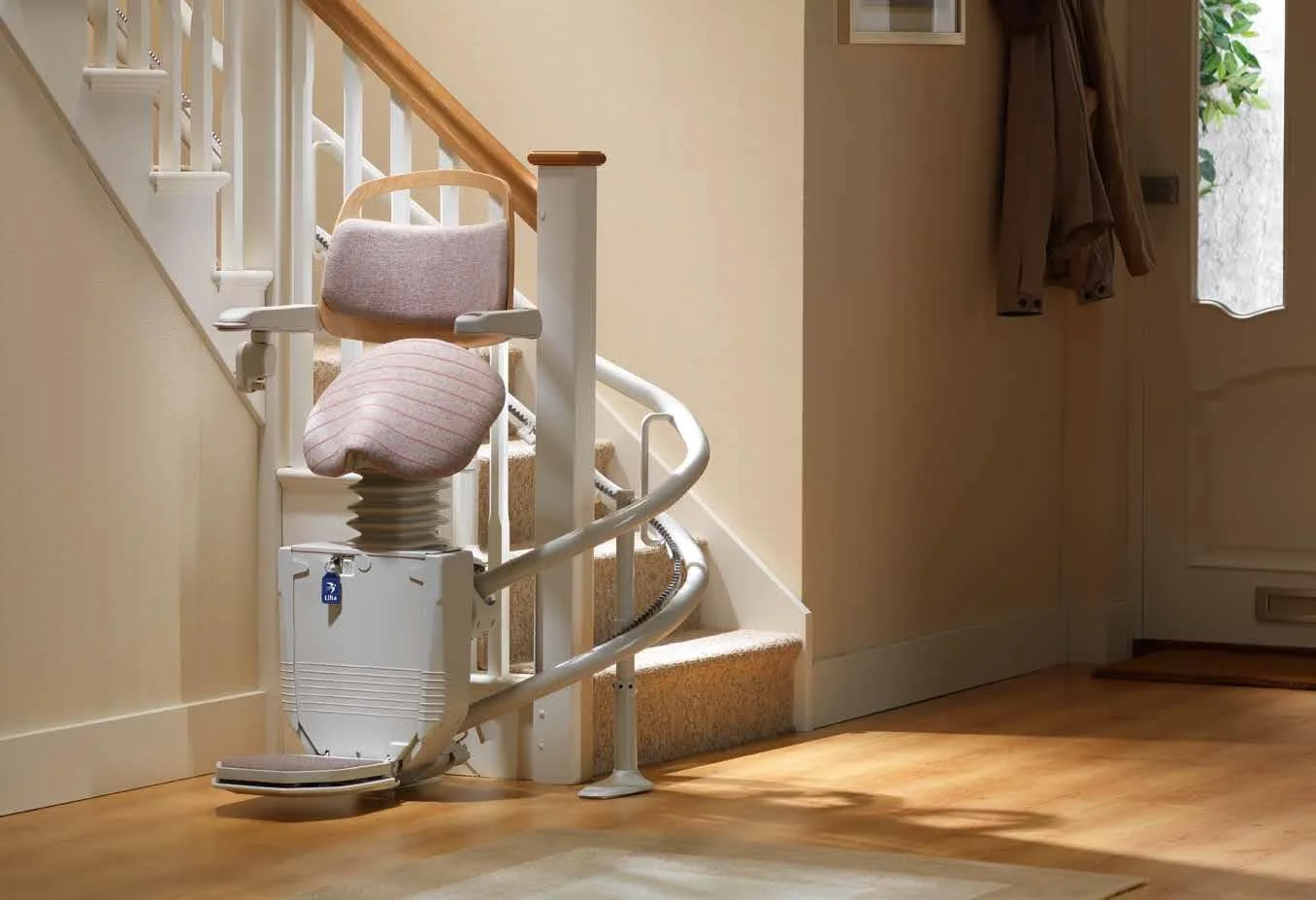
Historic homes often have steep, narrow stairs, landings that turn, and woodwork owners want to protect. A straight stair lift can work when the run goes top to bottom without a turn, and the rail mounts to the treads rather than the wall.
Where a staircase curves or turns at a landing, a curved lift is built to follow that exact path. We measure each step in person, because older stairs are rarely as even as they look.
Split-level homes usually have short flights between levels, and a straight lift often handles each one well. Townhouses tend to have one long straight run, which is the simplest install.
Rural farmhouses and cabins can be a different story. Some have back stairs, porch steps, or a slope from the driveway to the door, and that is where an outdoor lift or a platform lift for a wheelchair may make more sense than an indoor chair.
Culpeper County sits in the foothills of the Blue Ridge Mountains, with ground falling from about 705 feet in the west toward the rivers that bound it. The 2020 Census counted 57.1% of residents as rural, so many people live a good drive from town services.
On a hillside lot, the entry is often up a set of exterior steps. Planning for both the inside staircase and the way into the house helps someone stay in a rural home they know well.
Read the details closely: some VA programs pay for home changes but do not list stair lifts, and one names them as excluded.
The Virginia Housing Granting Freedom grant does name chairlifts. For VA questions, the Quantico Office can be reached at (703) 630-2810.
Two Virginia Housing grants and the CCC Plus Medicaid waiver explicitly name stair lifts or chairlifts. Other programs below fund home repairs or accessibility work but do not mention stair lifts, so ask before counting on them.
A good first call is Encompass Community Supports at (540) 825-3100, at 15361 Brandford Road in Culpeper. They connect adults 60 and older to funding programs. Statewide, you can also ask about the Virginia Livable Home Tax Credit (LHTC) and the Assistive Technology Loan Fund Authority (ATLFA).
Virginia's main home and community waiver for people 65 and older or younger with a qualifying disability who meet nursing-facility level of care; its Environmental Modifications benefit names stair lifts. Apply through your MCO care coordinator or the local Department of Social Services, or call (833) 522-5582.
A grant of up to $10,000 with no repayment for homeowners at or below 60% of area median income who need accessibility changes, and chairlifts are listed as covered. Applications go through an approved local agent; call (877) 843-2123.
Up to $10,000 with no repayment for veterans and service members with a service-connected disability and household income at or below 80% of area median income; chairlifts are covered. Apply through an approved local agent; call (877) 843-2123.
Free or low-cost home modifications for people 62 and older at or below 80% of area median income in an eight-county area that includes Culpeper County, scoped by an occupational therapist. The source lists grab bars, handrails and lighting but does not mention stair lifts; call (540) 369-6155.
The Area Agency on Aging for adults 60 and older in Culpeper, Fauquier, Madison, Orange and Rappahannock Counties, offering information and referral to funding programs rather than direct grants. Stair lifts are not listed as a benefit; call (540) 825-3100.
Repair loans up to $40,000 at 1% for 20 years, and grants up to $10,000 for owners 62 and older who cannot repay a loan, with income at or below 50% of area median income. Ramps, grab bars and walk-in tubs are listed but stair lifts are not; call (804) 287-1500.
Up to $6,800 lifetime for a service-connected disability or $2,000 for other disabilities, for medically necessary home changes. The VA page says HISA will not pay for porch lifts and stair glides; call (800) 827-1000.
SAH grants up to $126,526 and SHA grants up to $25,350 help veterans with qualifying severe service-connected disabilities buy, build or change a home. Stair lifts are not mentioned as a covered change; call (800) 827-1000.
Older adults
15361 Brandford Road, Culpeper, 22701
Veterans
Quantico Marine Corps Base Education Center 3089 Roan Street, Quantico, 22134
Usually, yes. The rail typically attaches to the stair treads, and a curved lift can follow a staircase that turns at a landing. An in-person measurement tells us which type fits.
The CCC Plus Medicaid Waiver lists stair lifts as an example of its Environmental Modifications benefit. You must meet nursing-facility level of care and Medicaid financial limits, which were $2,982 a month in income and $2,000 in assets for a single applicant in 2026. Call (833) 522-5582.
CCC Plus covers younger adults with a qualifying disability, and the Virginia Housing Owner-Occupied Modification grant is based on disability and income rather than age. Both name stair lifts or chairlifts.
The VA HISA grant states it will not pay for stair glides, and the SAH and SHA grants do not mention stair lifts. The Virginia Housing Granting Freedom grant does cover chairlifts for veterans with a service-connected disability, at (877) 843-2123.
Encompass Community Supports, the local Area Agency on Aging at 15361 Brandford Road, can point adults 60 and older to funding programs. Their number is (540) 825-3100.
An outdoor stair lift or a platform lift can handle exterior steps on a hilly rural lot. We look at the porch, the ground and the path to the door before suggesting one.
Tell us about the stairs in your home and we will explain which lift fits, what it costs and how installation works.
