Hanover County runs from the busy Mechanicsville and Ashland corridor out to farm roads and rural communities, about 12 miles north of Richmond. The housing mix is just as wide: colonial-era houses in historic districts, split-level and ranch-style homes from past decades, townhouses, and newer suburban single-family subdivisions.
Each of those homes puts a different staircase in front of a family deciding whether a stair lift will work. This page walks through what Hanover's homes and terrain mean for the type of lift you need, and which Virginia and federal programs may help with the cost.
Hanover County has 10 properties and districts on the National Register of Historic Places, including the Ashland Historic District, the Hanover County Courthouse Historic District, the Montpelier Historic District, Berkleytown Historic District, Brown Grove Rural Historic District and Hanover Wayside. Many older homes in and around these areas still have their original multi-story layouts and staircases.
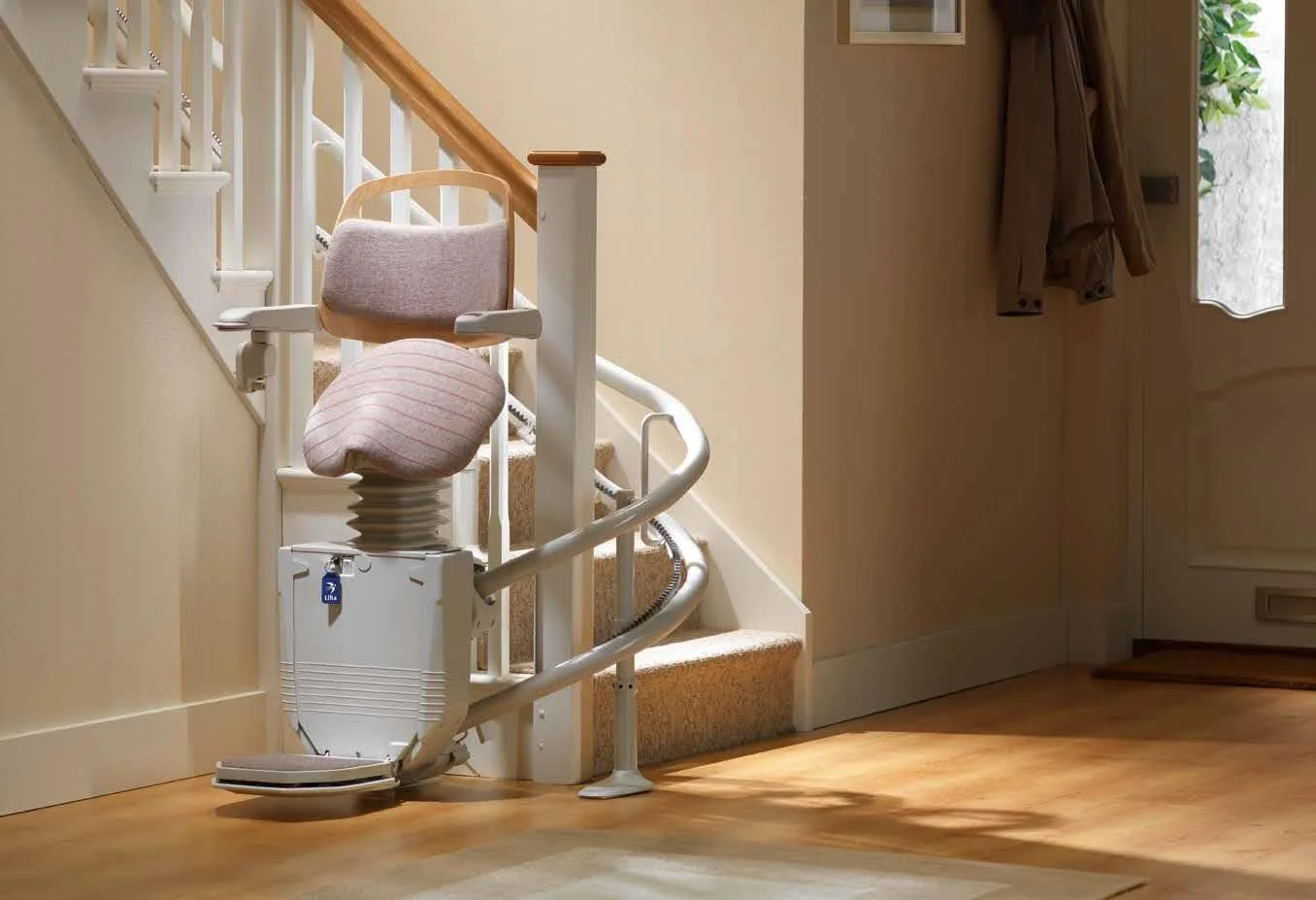
Older staircases are often narrower or steeper than newer ones, and some turn at a landing. A turn usually means a curved stair lift built to fit that exact staircase. When the stairs run straight from bottom to top, a straight rail is simpler and installs faster.
Split-level homes are common here, and they bring short flights between levels rather than one long staircase. Some families need a lift on one short flight, others on two, so we look at which levels the person actually uses every day.
Ranch-style homes keep living space on one floor, but many still have steps down to a basement or up from a garage or porch. Townhouses tend to have straight interior stairs on more than one floor, which often suits straight stair lifts well.
As of the 2020 census, 63.0% of Hanover residents lived in urban areas and 37.0% in rural areas, across about 469 square miles. Outside the Mechanicsville and Ashland corridor, homes are more spread out and the front or back entry steps can be the bigger problem than the inside stairs.
For outside steps, an outdoor-rated stair lift is built to handle weather. Where someone uses a wheelchair, a platform lift may make more sense than a seat. The rural split also matters for services: aging and home-modification help can be harder to reach in outlying communities, so it pays to call the agencies below early.
For many families, the question comes up when a parent wants to stay in the house they have lived in for years but the stairs have become a fall risk.
Veterans should know that VA programs differ in what they pay for, and one of them excludes stair glides outright. The program list below spells out what each source says.
The strongest fit for many homeowners is the Virginia Housing Accessibility Grants program, which lists installing ramps and chairlifts among its eligible modifications and offers up to $10,000 per household with no repayment. Funds go first-come, first-served, and you must apply through a Virginia Housing-accepted agent.
Other options, such as the CCC Plus Waiver, EHARP and USDA Section 504, cover home modifications or repairs but do not name stair lifts in their published materials, so ask directly before you count on them. Statewide, it is also worth asking about the Virginia Livable Home Tax Credit (LHTC) and the Assistive Technology Loan Fund Authority (ATLFA).
Senior Connections - Capital Area AAA (PSA 15) at 24 E. Cary Street in Richmond, (804) 343-3000, can help sort out which programs you may qualify for. Veterans can reach the Richmond VA Medical Center Office at 1201 Broad Rock Blvd, Richmond, at (804) 675-6546.
A true grant of up to $10,000 per household for households at or below 60% of area median income, or 80% for veterans and service members under the Granting Freedom track; installing ramps and chairlifts is listed as an eligible modification. Call (877) 843-2123.
A Medicaid waiver for older adults and people with disabilities who meet a nursing-facility level of care; Environmental Modifications is a covered service, but the source does not mention stair lifts. Call (833) 522-5582.
Up to $4,000 per applicant for homeowners and renters at or below 80% of area median income, and Hanover County is a covered locality; it funds wheelchair ramps and other accessibility modifications but does not mention stair lifts. Call (804) 371-7000.
Loans up to $40,000 at 1% fixed interest over 20 years, and grants up to $10,000 for homeowners age 62 or older, for very-low-income owners in USDA-eligible rural parts of Hanover County; stair lifts are not mentioned as a covered repair.
A lifetime benefit of $6,800 or $2,000 depending on disability status, for medically necessary permanent changes like ramps, roll-in showers and widened doorways. Stair lifts are not covered, since stair glides are specifically excluded.
Grants of up to $126,526 (SAH) or $25,350 (SHA) for veterans with certain severe service-connected disabilities who own their home; the source mentions ramps and widened doorways but does not mention stair lifts.
The area agency on aging serving Hanover County, offering assessment, care coordination and referrals rather than direct funding; stair lifts are not mentioned. Call (804) 343-3000.
A nonprofit serving people with disabilities in Hanover and nearby localities with information, referral and advocacy rather than cash grants; stair lifts are not mentioned. Call (804) 353-6503.
Older adults
24 E. Cary Street, Richmond, 23219
Veterans
1201 Broad Rock Blvd, Room 1M‑169B, Richmond, 23249
Usually, yes. Many older Hanover homes keep their original staircases, and narrow or turning stairs often call for a curved lift made to fit. We measure the staircase first to tell you which type will work.
The Virginia Housing Accessibility Grants program lists chairlifts among its eligible modifications and offers up to $10,000 per household with no repayment. Income limits apply, and you apply through a Virginia Housing-accepted agent. Call (877) 843-2123.
Not through HISA, which excludes stair glides. The SAH and SHA grants do not mention stair lifts either, so ask the Richmond VA Medical Center Office at (804) 675-6546. Veterans may also qualify for the Granting Freedom track of the Virginia Housing grant at 80% of area median income or less.
USDA Section 504 serves USDA-eligible rural areas, including parts of Hanover County, with grants up to $10,000 for homeowners age 62 or older. It focuses on health and safety repairs and does not list stair lifts, so confirm before applying.
Senior Connections - Capital Area AAA (PSA 15) at (804) 343-3000 serves Hanover County and helps with care coordination and referrals. Resources for Independent Living at (804) 353-6503 assists people with disabilities.
Tell us about the stairs in your home and we will explain which lift fits, what it costs and how installation works.
