Iowa has about 700 towns spread across counties from Allamakee County in the northeast to Fremont County in the southwest, and from Lyon County down to Lee County. A stair lift question sounds the same in Polk County as it does in Winneshiek County: can the person who lives here still get up and down the stairs safely, and what will it cost to make that happen?
This page walks through how we match a lift to the staircase in front of us and which Iowa and federal programs can help with the bill. The state has 2,577,740 residents, and the answers below are written for the homeowners and the grown children helping them.
About 17.0% of Iowans are 65 or older, and 68.0% of households own their home. Owning matters here, because a lift is attached to your stairs and most programs that help with home changes expect you to have the right to make them.
If someone in your home served, the VA section further down is worth reading before you spend your own money.
A straight lift runs on a single rail along a staircase with no turns or landings. It is the simplest to install and usually the first thing we check for when we measure.
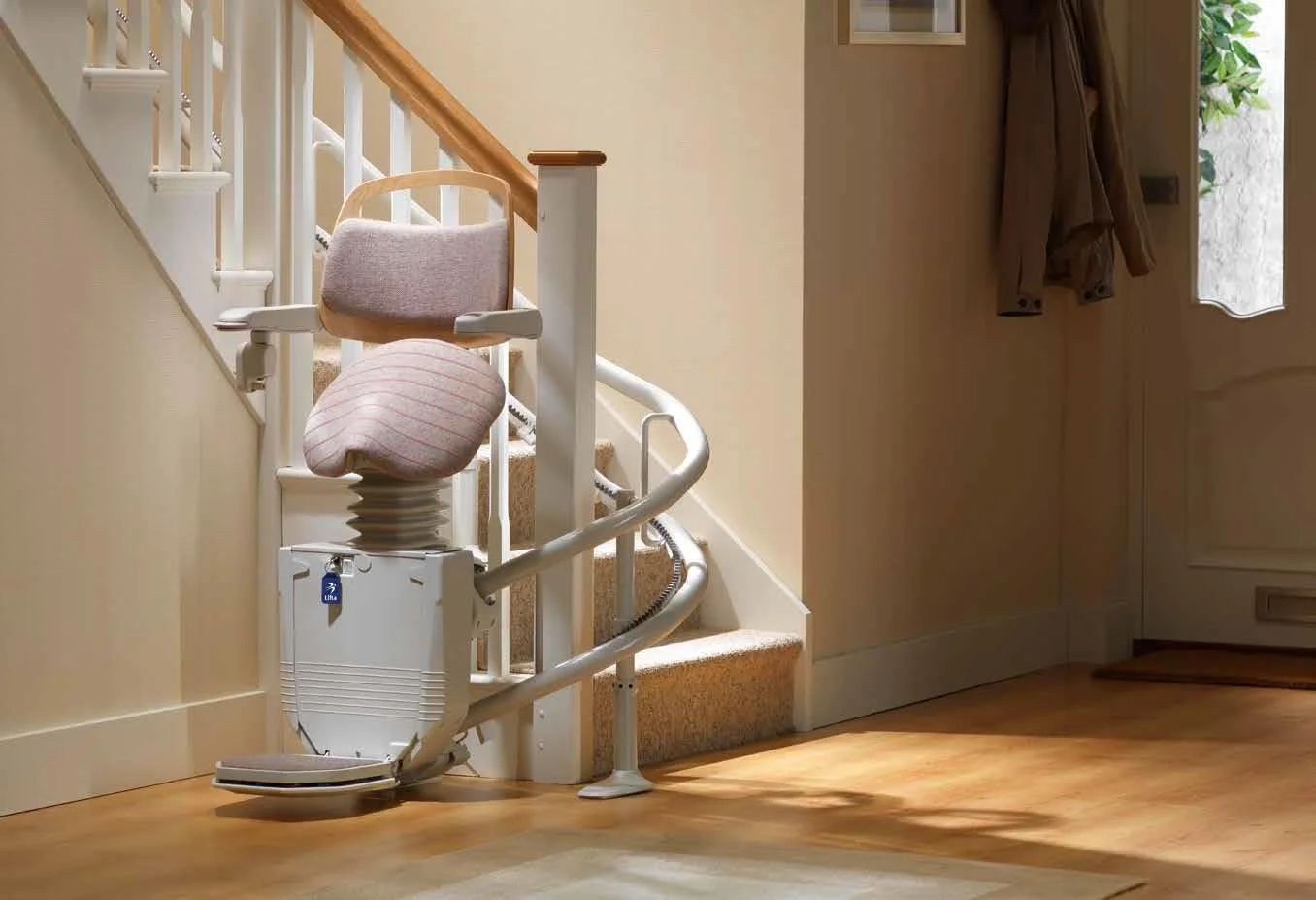
If the stairs turn, wrap around a landing or change direction partway up, the rail has to be bent to fit that exact staircase. That is a curved lift, and it takes more measuring and more lead time.
Steps outside the house, such as entry stairs or a deck, call for an outdoor model built to handle weather. When someone uses a wheelchair and cannot transfer to a seat, a platform lift is the option to talk through instead of a seat-style lift.
We measure the stairs, check for turns and landings, and look at where the rail would start and stop at the top and bottom. We also ask who will ride the lift and how they move today, since that decides between a seat and a platform.
Bring up any outside steps you use every day. It is easier to plan indoor and outdoor access at the same visit than to come back later.
Iowa has two Medicaid waivers that can treat a stair lift as a home modification. One is for people 65 and older and one is for adults under 65, and both are reached through the same phone number, (800) 338-8366.
For people who do not qualify for Medicaid, the Able Up Iowa Loan Program offers loans up to $25,000, and stair lifts are explicitly eligible. Veterans have a separate route through the VA, where the lift itself goes through VA Prosthetics.
The Iowa Elderly and Disabled Property Tax Credit does not pay for a lift, but it can lower yearly housing costs. Details on each program are listed below.
A Medicaid HCBS waiver for seniors 65 and older that covers a stair lift as a home modification, with a limit of $1,098.78 lifetime for home and vehicle modification. Call (800) 338-8366.
A Medicaid HCBS waiver for adults under 65 that covers a stair lift as a home modification, up to $6,592.66 per year for home and vehicle modification. Call (800) 338-8366.
A low-interest loan program of up to $25,000, and stair lifts and home modifications are explicitly eligible. Call (515) 292-2972.
The stair lift itself can be covered through VA Prosthetics (PSAS) when medically prescribed, with no set dollar cap, while HISA ($6,800 service-connected, $2,000 non-service-connected) covers ramps and structural changes, not the lift. Call (877) 222-8387.
A property tax credit of up to $1,000 per year that offers indirect cost relief. It does not cover stair lifts.
Yes. The Iowa Medicaid Health and Disability (HD) Waiver is for adults under 65 and covers a stair lift as a home modification, up to $6,592.66 per year for home and vehicle modification. Call (800) 338-8366.
The Iowa Medicaid Elderly Waiver lists $1,098.78 lifetime for home and vehicle modification combined. That may cover part of a lift, so some families pair it with another option such as a loan.
No. HISA covers ramps and structural changes. The lift itself goes through VA Prosthetics (PSAS) when it is medically prescribed, and that has no set dollar cap. Call (877) 222-8387 to start.
The Able Up Iowa Loan Program offers low-interest loans up to $25,000, and stair lifts are explicitly eligible. Reach them at (515) 292-2972.
No. The Iowa Elderly and Disabled Property Tax Credit is worth up to $1,000 per year off property taxes. It does not pay for a lift, but it can free up money in the household budget.
Separate county pages are not up yet. We list Iowa counties such as Black Hawk County, Johnson County, Linn County, Polk County, Scott County and Woodbury County, and this page covers the programs available across the state.
Tell us about the stairs in your home and we will explain which lift fits, what it costs and how installation works.
