Illinois has 1,205 towns spread across counties as different as Cook County and DuPage County in the north, Sangamon County and McLean County in the middle, and Alexander County and Pope County at the southern tip. A stair lift plan for a house in Winnebago County will not look the same as one for a home in Jackson County, so we start with the house itself.
This page covers the basics for the whole state: which kind of lift fits which kind of staircase, who in Illinois is likely to need one, and the state, federal and loan programs that can help pay. Each county listed further down has its own page with local details.
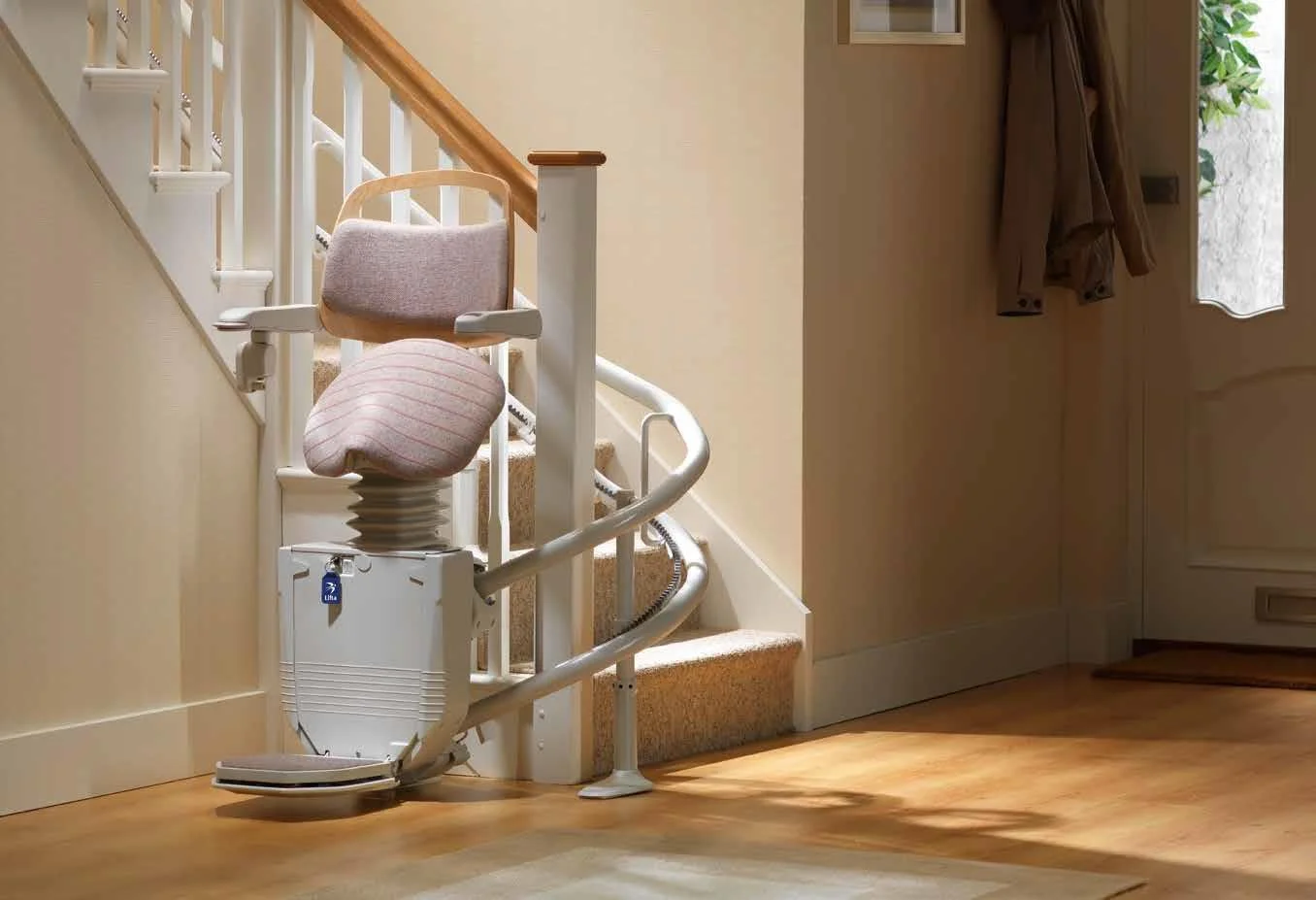
The first question at any home visit is the shape of the staircase. A straight run from bottom to top usually takes a straight stair lift, which is the simplest to fit and the quickest to install.
If the stairs turn at a landing or curve along the way, the rail has to be built to follow that path. A curved lift takes more measuring and more lead time, but it lets someone stay on the same seat from the first step to the last.
Steps outside the house, such as a run from the driveway up to a porch, call for an outdoor model built to handle the weather. When someone cannot transfer to a seat at all, a platform lift that carries a wheelchair may be the better fit.
Illinois has a population of 11,199,997, and 16.0% of residents are 65 or older. That is a large group of people who may find one flight of stairs harder each year.
About 65.0% of Illinois households own their homes. Owners can usually install a lift without asking a landlord, which matters because the rail is fastened to the stair treads.
If someone in your family served, the VA section below is worth reading before you decide how to pay.
Most families combine more than one source. Medicaid waiver programs can pay for home modifications, the VA can cover a lift that is medically prescribed, and a low-interest loan can fill the gap.
Age is the first sorting line. The Illinois Community Care Program (CCP) serves adults 60 and older, while the Home Services Program, Persons with Disabilities Waiver, serves disabled adults under 60.
Some programs give indirect help only. The Senior Citizens Assessment Freeze Homestead Exemption lowers property-tax pressure for low-income seniors but does not pay for a lift. Each program is summarized below.
We have pages for Illinois counties from Adams County to Woodford County, including Cook County, Lake County, Will County, Kane County, Peoria County, Madison County and St. Clair County. Pick yours from the county list to see what applies where you live.
A Medicaid home and community-based waiver benefit for adults 60 and older that covers home environmental modifications, with up to $3,000 for those changes and higher amounts considered case by case. Call (800) 252-8966.
A Medicaid waiver for disabled adults under 60 that covers home accessibility adaptations, with no fixed cap and amounts set by the approved plan. Call (877) 581-3690.
Low-interest loans from $500 to $20,000 that can be used for stairlifts and home modifications. Call (800) 852-5110.
A state grant-funded program that pays for home modifications for disabled residents who are not on the Home Services Program. There is no fixed cap; the amount follows the approved plan.
VA Prosthetics (PSAS) can cover a medically prescribed stairlift with no set dollar cap, while the HISA grant ($6,800 service-connected, $2,000 non-service-connected) covers ramps and structural changes, not the lift itself. Call (877) 222-8387.
A property-tax assessment freeze for low-income seniors. It does not cover stair lifts, but the tax relief can free up money in the household budget.
Yes. The Home Services Program, Persons with Disabilities Waiver, serves disabled adults under 60 and covers home accessibility adaptations. You can reach it at (877) 581-3690. Disabled residents not on that program can look at the DRS Home Modification Program through Centers for Independent Living.
The Illinois Community Care Program (CCP) lists up to $3,000 for environmental modifications, with higher amounts considered case by case. It is for adults 60 and older. Call (800) 252-8966.
Both, through different benefits. VA Prosthetics (PSAS) can cover a medically prescribed stairlift with no set dollar cap. The HISA grant covers ramps and structural changes, up to $6,800 if service-connected or $2,000 if not. Call (877) 222-8387.
The IATP ATLOAN$ Program offers low-interest loans from $500 to $20,000 for stairlifts and home modifications. The number is (800) 852-5110.
No. The Senior Citizens Assessment Freeze Homestead Exemption is property-tax relief for low-income seniors. It is indirect help and is not a stairlift grant.
We have pages for counties across Illinois, from Adams County and Alexander County through Williamson County, Winnebago County and Woodford County. Find yours in the county list for local details.
Tell us about the stairs in your home and we will explain which lift fits, what it costs and how installation works.
