From the historic districts of Hinsdale, Glen Ellyn and Naperville to the Lustron steel houses clustered in Lombard, DuPage County homes were built over a long stretch of time, starting in the 1800s. Many of them have raised entries, full basements or more than one floor above ground. Those are the details we look at first when someone asks if a stair lift will work.
The county's 31 towns also include plenty of later suburban building, like split-level homes in Bartlett or Woodridge and townhouses in Lisle or Westmont. This page walks through how those home styles affect the lift you would need, what local winters mean for outdoor steps, and which programs may help with the cost.
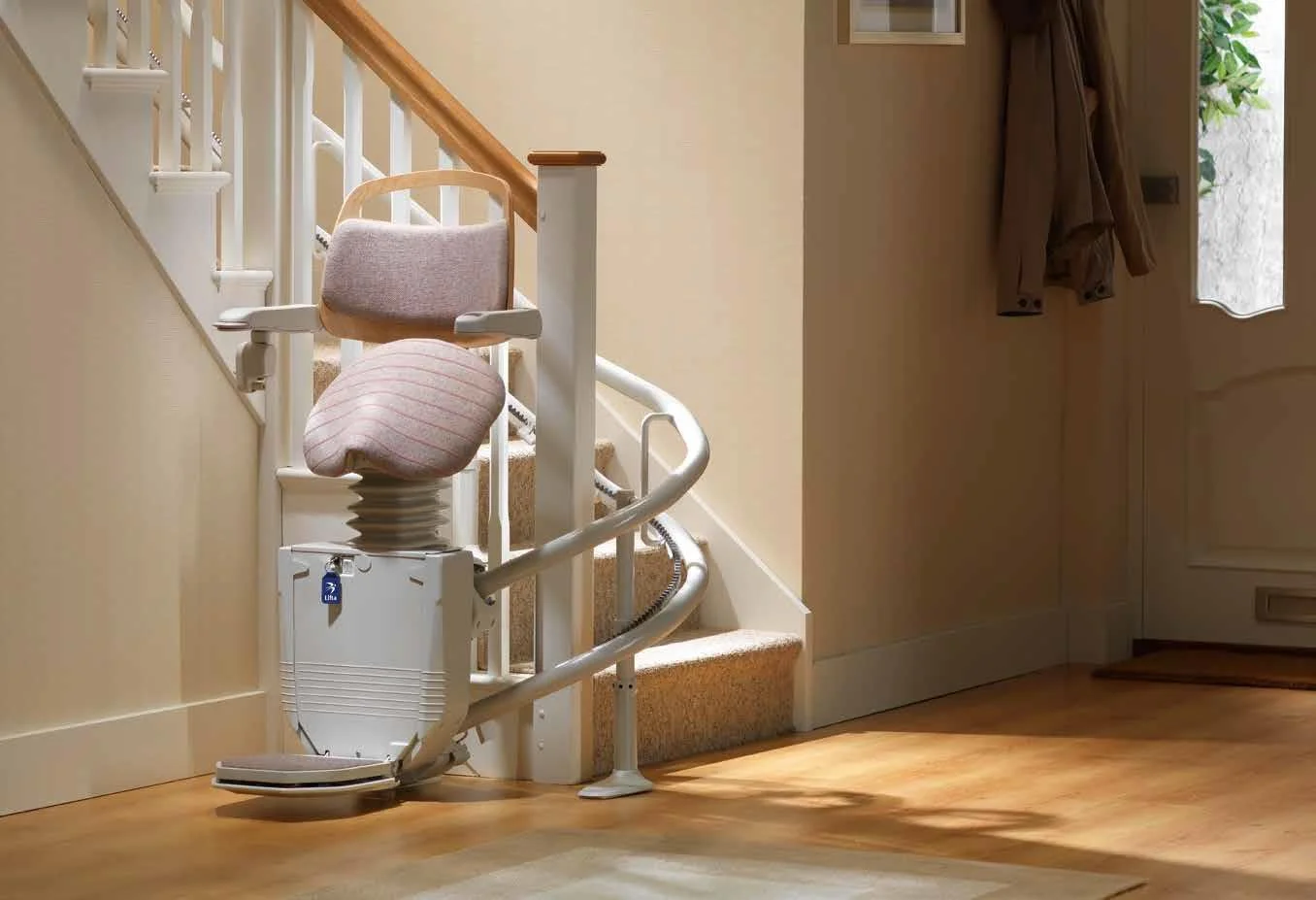
Pre-war and mid-century houses in the county's established towns often have staircases with landings, turns or narrow treads. A straight staircase with no turns can usually take a straight stair lift, which is the simplest and quickest to install.
If the stairs turn at a landing or curve along a wall, a curved lift with a custom-built rail is the usual answer. In historic homes in places like Hinsdale or Glen Ellyn, we also check how the rail mounts to the treads so the original woodwork stays in good shape.
Full basements are common here too. A second lift for the basement stairs can matter if the laundry or a family room is down there.
Split-level homes bring short flights of stairs between several levels. Each flight is its own run, so a household may need one lift or more depending on which levels the person uses every day.
Townhouses often have a tall, straight flight between floors, which tends to suit a straight lift. In low-rise buildings, the stairs may be shared, so the building owner or association usually has to approve any equipment before we install it.
DuPage County is mostly flat, but a raised entry still means steps up to the front or back door. Wheaton weather data puts the average January low near 14°F, and ice and snow on those steps come back every winter.
For exterior stairs, an outdoor-rated lift is built to handle the weather. Where a wheelchair is involved, a platform lift at the entry may be a better fit than a seat-style lift. We look at the steps, the landing and the path to the door before suggesting either one.
About 16.8% of DuPage County residents are 65 or older, and 73.5% of households own their homes. For many families, that adds up to a parent who wants to stay in a long-held house that has stairs they did not think twice about years ago.
If that applies to your family, the VA benefits below are worth checking, though their rules on stair lifts differ.
Some programs name stair lifts or home modification directly, and some do not mention them at all. The Illinois DHS Home Modification and Assistive Technology Program lists stair lifts as an example, and the DuPage County Caregiver Resource Center lists home modification among its services.
Age matters for which door you knock on. The Community Care Program serves people 60 and older, while the Persons with Disabilities Waiver is for people under 60 at application. For general aging services, AgeGuide (PSA 2) in Lombard can be reached at (630) 293-5990.
Veterans can call the Veterans Assistance Commission of DuPage County in Wheaton at (630) 407-5655. Each program is summarized below.
A statewide program for Illinois residents with a documented disability that lists stair lifts among its example modifications, with no dollar cap stated. Call (800) 843-6154.
A Medicaid waiver for Illinois residents under age 60 at application with a severe disability; it describes home modifications in general terms, and the source does not mention stair lifts. Call (877) 581-3690.
Serves income-eligible homeowners and renters (with landlord approval) in all 102 Illinois counties, but the source does not mention stair lifts and lists over 800 people on its waiting list. Call (217) 525-1308.
In-home care for DuPage residents age 60+ with liquid assets under $17,500 (single person); the source does not mention stair lifts or home modification. Call (630) 407-6500.
A county resource and referral center for unpaid caregivers that lists home modification and assistive devices among its services. Call (630) 407-6500.
A VA benefit with a $6,800 or $2,000 lifetime maximum for home accessibility changes, but it specifically excludes stair glides. Veterans can call the Veterans Assistance Commission of DuPage County at (630) 407-5655 for guidance.
Grants of up to $126,526 (SAH) or $25,350 (SHA) for veterans with qualifying severe disabilities to buy, build or change a home; the source does not mention stair lifts. Call (877) 222-8387.
Older adults
1910 S. Highland Ave., Suite 100, Lombard, 60148
Veterans
421 N. County Farm Road, 2nd Floor, Wheaton, 60187
The HISA benefit specifically excludes stair glides. The SAH and SHA grants help qualifying veterans change a home, but the VA source does not mention stair lifts, so ask at (877) 222-8387 or the Veterans Assistance Commission of DuPage County at (630) 407-5655.
Yes, possibly. The Persons with Disabilities Waiver is for Illinois residents under 60 at application, and the Caregiver Resource Center serves caregivers of adults 18 to 59 with a disability.
The state and county sources describe in-home care, emergency home response and adult day services, with no mention of stair lifts. For home modification, the county points caregivers to the Caregiver Resource Center at (630) 407-6500.
The Illinois Home Modification Program serves renters with landlord approval. Be aware that it has over 800 people on its waiting list and limited funding.
Yes, with an outdoor-rated lift built for weather. With January lows near 14°F and regular ice and snow, we look closely at the steps and landing during the home visit.
AgeGuide (PSA 2) is at 1910 S. Highland Ave., Suite 100, Lombard, and can be reached at (630) 293-5990.
Tell us about the stairs in your home and we will explain which lift fits, what it costs and how installation works.
