St. Clair County stretches across 674 square miles, from the built-up streets of Belleville, East St. Louis and Fairview Heights near St. Louis to the corn and soybean country around Marissa, Lenzburg and New Athens. The homes change just as much along the way, from townhouses and walk-up apartments in the west to detached houses on larger lots farther east and south.
Those differences matter when you are planning a stair lift. A split-level in O'Fallon, a two-story house in Millstadt and a home near the Mississippi River bluff each raise different questions about the rail, the landing and the steps outside. This page walks through what we look at in local homes and which programs in the county and state may help with the cost.
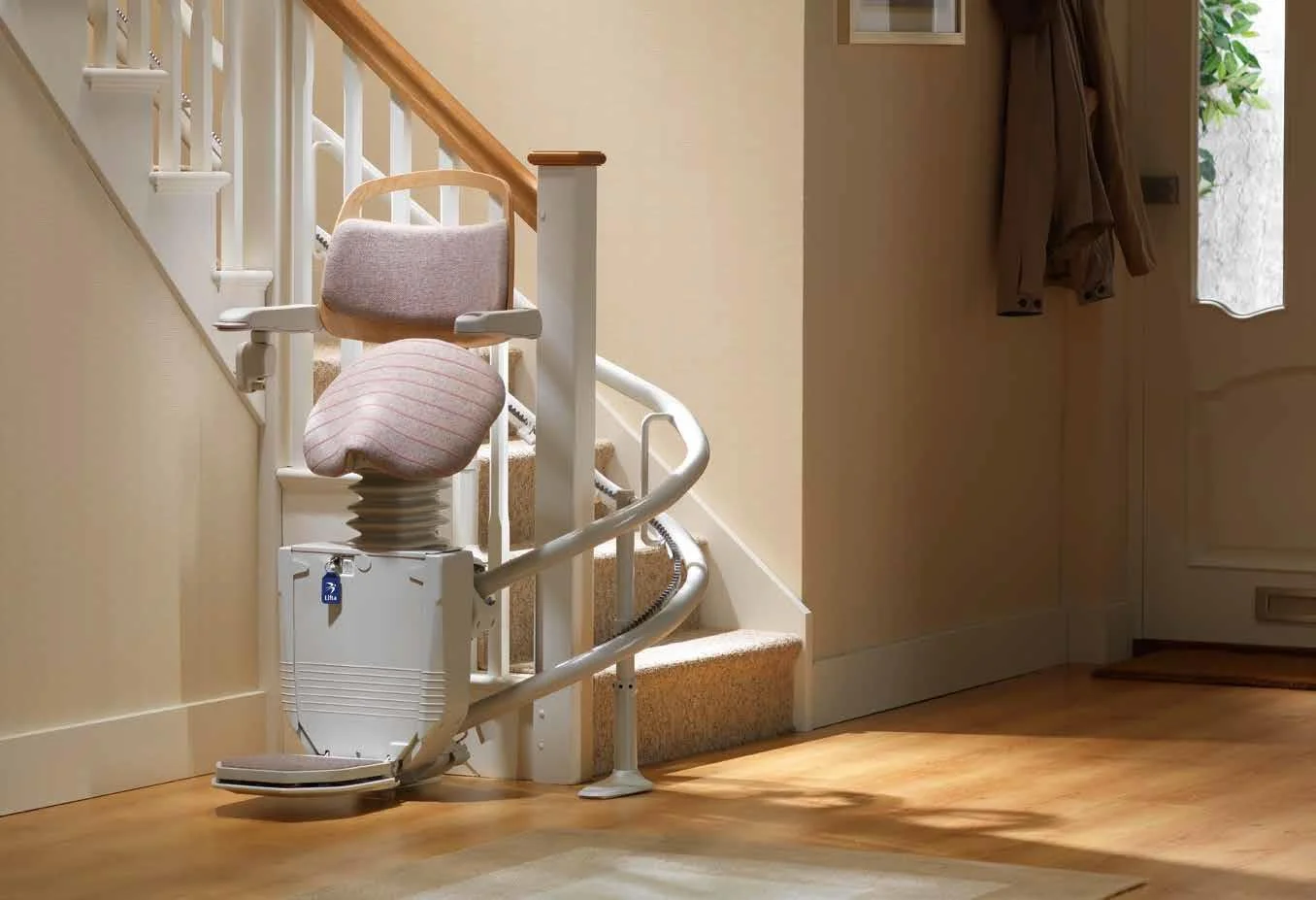
About 85.8% of county residents live in urban areas, mostly in the western towns such as Belleville, Swansea, Shiloh, Caseyville and Cahokia Heights. Here we see a lot of single-family homes, townhouses and split-level homes. A single straight flight usually takes a straight stair lift, which is the simplest to fit.
Split-level homes are different. They often have two or three short runs of steps between floors, so you may need a lift on each short run or a curved rail that follows the turn. We measure every landing before suggesting one or the other.
In the more rural eastern and southern parts of the county, around Mascoutah, Lebanon, Freeburg, St. Libory, Fayetteville and Summerfield, detached houses are common. Many of these have a straight main staircase, but basement stairs and narrow older steps need a closer look at width and headroom.
A bluff runs along the Mississippi River through the central part of the county. Homes near the river valley, in towns like Dupo, Sauget and East Carondelet, can sit on graded lots with several steps just to reach the front or back door.
If the trouble starts before you get inside, an outdoor stair lift built for weather exposure may fit along exterior steps. Where a wheelchair is involved, a platform lift is often the better choice because the rider stays seated in the chair. We check the slope, the footing and where the lift will park when not in use.
About 64.3% of households in the county own their home, so a good share of people rent. Walk-up apartments, with shared stairs and no elevator, are a hard case because the building owner controls the stairwell.
If you rent, talk with your landlord before anything else. The Illinois Home Modification Program through INCIL accepts renters who have landlord approval, which can open a path that would otherwise be closed.
Scott Air Force Base, home to U.S. VA housing help is real, but it does not always reach stair lifts.
The VA HISA grant specifically excludes stair glides. The SAH, SHA and TRA grants do not mention stair lifts either way. For help sorting out VA benefits locally, the Veterans Assistance Commission of St. Clair County is at 19 Public Square, Suite 300, Belleville, and can be reached at (618) 277-0040.
About 16.8% of county residents are 65 or older, and several programs serve older adults and people with disabilities. Only one of the programs below names stair lifts in its own materials: the IDHS Home Modification and Assistive Technology Program. The others cover home modifications or repairs more generally, so ask each one directly whether a stair lift qualifies.
A good first call is AgeSmart Community Resources at (618) 222-2561, which works as an information and referral hub. For people with a documented disability, LINC, Inc. in Swansea handles local intake for the state home modification program serving St. Clair County. Income limits, waitlists and lotteries apply to some programs, so it helps to apply early.
The Area Agency on Aging for the seven-county Southwestern Illinois region, offering benefits assistance, meals, caregiver and veterans resources, and referrals. Its materials do not mention stair lifts; call (618) 222-2561.
An Illinois Department of Human Services program for residents with disabilities, delivered through a Center for Independent Living, that lists stair lifts among its examples. Call the IDHS Help Line at (800) 843-6154.
A state-funded program for homeowners, or renters with landlord approval, with a household member who has a documented disability and who meets income limits; stair lifts are not listed by name. Intake for St. Clair County goes through LINC, Inc., and INCIL can be reached at (217) 525-1308.
Financial help and guidance for St. Clair, Monroe and Randolph County residents with a documented disability who need to adapt their homes; stair lifts are not listed. Call the Swansea office at (618) 235-9988.
A Medicaid waiver benefit for Illinois residents under age 60 with severe disabilities, meant to improve safety and independence at home; stair lifts are not named. Call the DRS hotline at (877) 581-3690.
State grant funds for health and safety repairs and accessibility improvements for low- and very low-income homeowners, with property value limits and frequent waitlists; stair lifts are not named. Call (312) 836-5200.
Offers rehab grants up to $19,000 and emergency grants up to $5,000 for income-qualified owner-occupants in participating communities, with rehab grants chosen by an annual lottery generally held mid-August; listed repairs do not include stair lifts or accessibility work. Call (618) 825-3215.
A VA grant with a lifetime maximum of $6,800 for service-connected disabilities or $2,000 for other qualifying conditions, for medically necessary home modifications. It specifically excludes stair glides.
VA grants for veterans with qualifying service-connected disabilities, with SAH up to $126,526 and SHA up to $25,350 for FY2026. Stair lifts are not mentioned as covered or excluded.
Older adults
2365 Amann Dr., Swansea, 62226
Veterans
19 Public Square, Suite 300, Belleville, 62220
The IDHS Home Modification and Assistive Technology Program lists stair lifts as an example, alongside ramps and widened doorways. It serves Illinois residents with disabilities through a Center for Independent Living. Call (800) 843-6154.
Yes. The Illinois Home Services Program Environmental Modification benefit serves residents under age 60 with severe disabilities who qualify for the Medicaid waiver. Stair lifts are not named, so ask at (877) 581-3690.
The HISA grant excludes stair glides outright. The SAH, SHA and TRA grants do not mention stair lifts at all. The Veterans Assistance Commission of St. Clair County in Belleville, (618) 277-0040, can help you review your options.
The St. Clair County CDBG program lists electrical, plumbing, heating, roofing, painting, windows, doors and lead-hazard reduction, not stair lifts. Rehab grants require income at or below 50% of area median, for example $39,000 for 1 person or $44,600 for 2. Call (618) 825-3215 to ask.
The Illinois Home Modification Program accepts renters who have landlord approval and a household member with a documented disability. In St. Clair County, intake runs through LINC, Inc. at (618) 235-9988.
AgeSmart Community Resources at (618) 222-2561 is the local referral hub for older adults and adults with disabilities. They can point you to the right program before you schedule an in-home measurement with us.
Tell us about the stairs in your home and we will explain which lift fits, what it costs and how installation works.
