Princeton, the Bureau County seat, was founded by settlers from New England in the early-1800s push west into the former Northwest Territory. That history left long-established towns with an older housing stock, and many families in Princeton, Spring Valley, Walnut, Tiskilwa and the other 17 towns still live in multi-level homes they have owned for years.
Out past the town limits, the county is rolling prairie farmland along Big Bureau Creek, with 55.0% of residents living in rural areas as of the 2020 Census. When a single-story or assisted living option is a long drive away, keeping a parent safely in the house they know often comes down to one question: can the stairs be made safe?
The 2020 Census counted 22.4% of Bureau County residents at age 65 or older, with a median age of 44.8. Among occupied homes, 74.8% were owner-occupied, and the homeowner vacancy rate was a low 1.8%. People here tend to stay put.
That matters for a stair lift. A homeowner who plans to stay for years gets far more use out of the equipment than someone planning to sell soon. It also means the home can be fitted to the person, not the other way around.
Detached houses and single-family homes with one full staircase are usually the simplest job. A straight stair lift runs on a rail fastened to the stair treads, not the wall, so plaster and older trim are left alone.
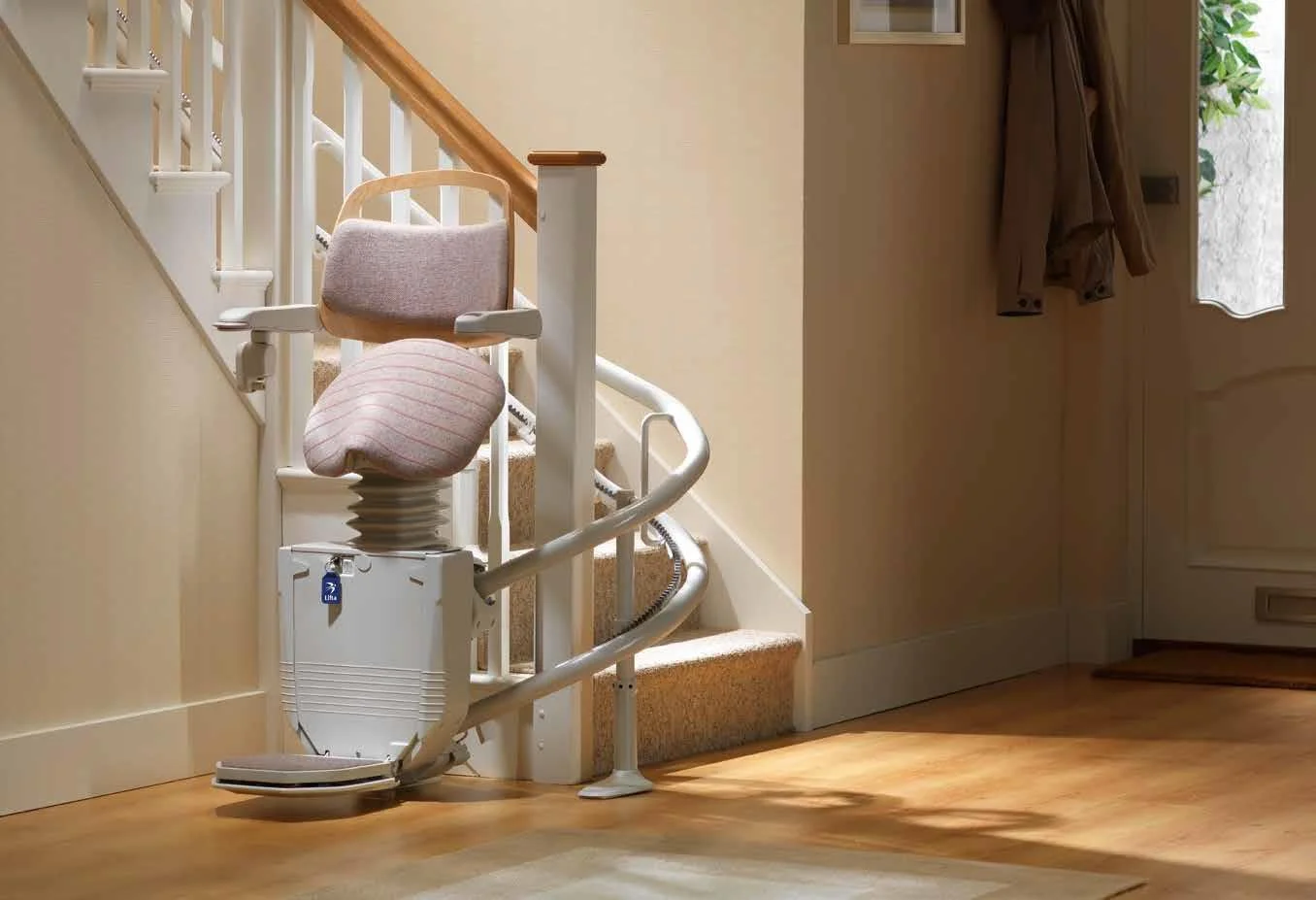
Split-level homes are different. They often have several short flights with landings or turns, which usually calls for a curved rail built to the exact shape of the stairs, or a separate straight lift on each flight. We measure every step before recommending one or the other.
Ranch-style homes look like they need nothing, but many have steps down to a lower level or up to the entry. For porch and entry steps on farm properties, an outdoor-rated lift or a vertical platform lift can be a better fit than a ramp that would need a long run of yard.
Walk-up apartments can take a stair lift too, but the building owner has to agree before anything is installed on a shared stairway.
Funding depends mostly on age, disability and veteran status. For adults under 60 with a severe disability, the Illinois Home Services Program is the one state source that names stair lifts outright as a covered home adaptation.
For people 60 and older, the Community Care Program pays for in-home help but not equipment. The Illinois Valley Center for Independent Living, which serves Bureau County, runs an Equipment Loan program and a Community Grant and is worth a direct call. Rural homeowners may also look at USDA Section 504 repair help, and veterans have VA options with real limits on what they cover.
Each program below lists who it serves and whom to call. Ask every office the same plain question: can a stair lift be funded, and what do you need from me?
The Illinois Department of Veterans Affairs has an office at 2 South Main St, Princeton, phone (815) 879-8404, which is a good first stop.
Be aware that the VA HISA benefit specifically excludes stair glides. The larger SAH and SHA grants cover home adaptations for veterans with qualifying severe disabilities, though the VA does not name stair lifts among their examples, so ask before counting on them.
A Medicaid waiver for Illinois residents under 60 at application with a severe, long-lasting disability who are at risk of nursing facility placement; the state lists stair lifts among covered Environmental Accessibility Adaptations. Call (877) 581-3690.
The same waiver as described by HFS, covering home changes that accommodate a loss of function for Medicaid-eligible adults under 60; this page does not mention stair lifts by name. Call (877) 581-3690.
In-home service, emergency home response, adult day service and medication dispensers for residents 60 and older with non-exempt assets of $17,500 or less; it does not cover stair lifts or home modifications. Call (800) 252-8966, or the Bureau County Care Coordination Unit, Alternatives for the Older Adult, at 309-277-0167.
The regional referral hub for older adults, funding the Bureau County Senior Center (815-879-3981), Alternatives for the Older Adult, Voluntary Action Center and Prairie State Legal Services; it does not list stair lift funding. Call (309) 793-6800.
Serves people with disabilities in Bureau, LaSalle, Marshall, Putnam and Stark counties through an Equipment Loan program and a Community Grant; stair lifts are not listed, so ask directly. Call (815) 224-3126.
Low-interest repair loans for very-low-income homeowners in USDA rural areas, with grants for owners 62 or older to remove health and safety hazards; stair lifts are not named, and eligibility is checked by address. Call (217) 403-6200.
A lifetime benefit of up to $6,800 or $2,000 for medically necessary home accessibility changes for enrolled VA patients; it explicitly excludes stair glides and porch lifts. Call (800) 827-1000.
Grants of up to $126,526 (SAH) or $25,350 (SHA) for FY2026 to adapt the homes of veterans with qualifying severe disabilities; the VA does not list stair lifts among its examples.
Funds health and safety repairs and accessibility improvements for low- and very low-income homeowners through local grantee organizations; stair lifts are not itemized, and demand far exceeds available funding.
Older adults
729 34th Avenue, Rock Island, 61201
Veterans
2 South Main St, Princeton, 61356
Yes. The Illinois Home Services Program serves Medicaid-eligible adults under 60 at application with a severe disability expected to last 12 months or longer, and it lists stair lifts as a covered adaptation. Call (877) 581-3690 or the Illinois Valley Center for Independent Living at (815) 224-3126.
No. The Community Care Program covers in-home service, emergency home response, adult day service and medication dispensers for people 60 and older. It can still help keep someone at home, so it is worth calling Alternatives for the Older Adult at 309-277-0167.
The HISA benefit excludes stair glides. SAH and SHA grants fund home adaptations for veterans with qualifying severe disabilities but do not name stair lifts, so ask the Illinois Department of Veterans Affairs office at 2 South Main St, Princeton, (815) 879-8404.
Usually, yes. Short flights with landings often need a curved rail made for that staircase, or a straight lift on each flight. A measurement visit settles which one makes sense.
It can. USDA Section 504 repair help is limited to USDA-defined rural areas, and grants require the owner to be 62 or older and have a very low income. Eligibility is checked by address, so call (217) 403-6200.
For a parent 60 or older, start with the Western Illinois Area Agency on Aging at (309) 793-6800. For a younger adult with a disability, start with the Illinois Valley Center for Independent Living at (815) 224-3126.
Tell us about the stairs in your home and we will explain which lift fits, what it costs and how installation works.
