Galesburg grew up fast as a railroad town, and much of what it built is still standing. The 496-acre Galesburg Historic District, listed on the National Register of Historic Places, holds a concentration of older, multi-story homes from the Chicago, Burlington and Quincy Railroad years. Many of those houses put every bedroom and the only full bath upstairs.
Outside the county seat, Knox County spreads across 720 square miles of flat prairie farmland, with 13 towns that include Abingdon, Knoxville, Wataga, Oneida, Yates City, Williamsfield and Victoria. A lot of older residents live on farms or in small towns far from Galesburg's in-town services. For them, a stair lift is often the practical way to keep using a long-owned two-story home instead of moving.
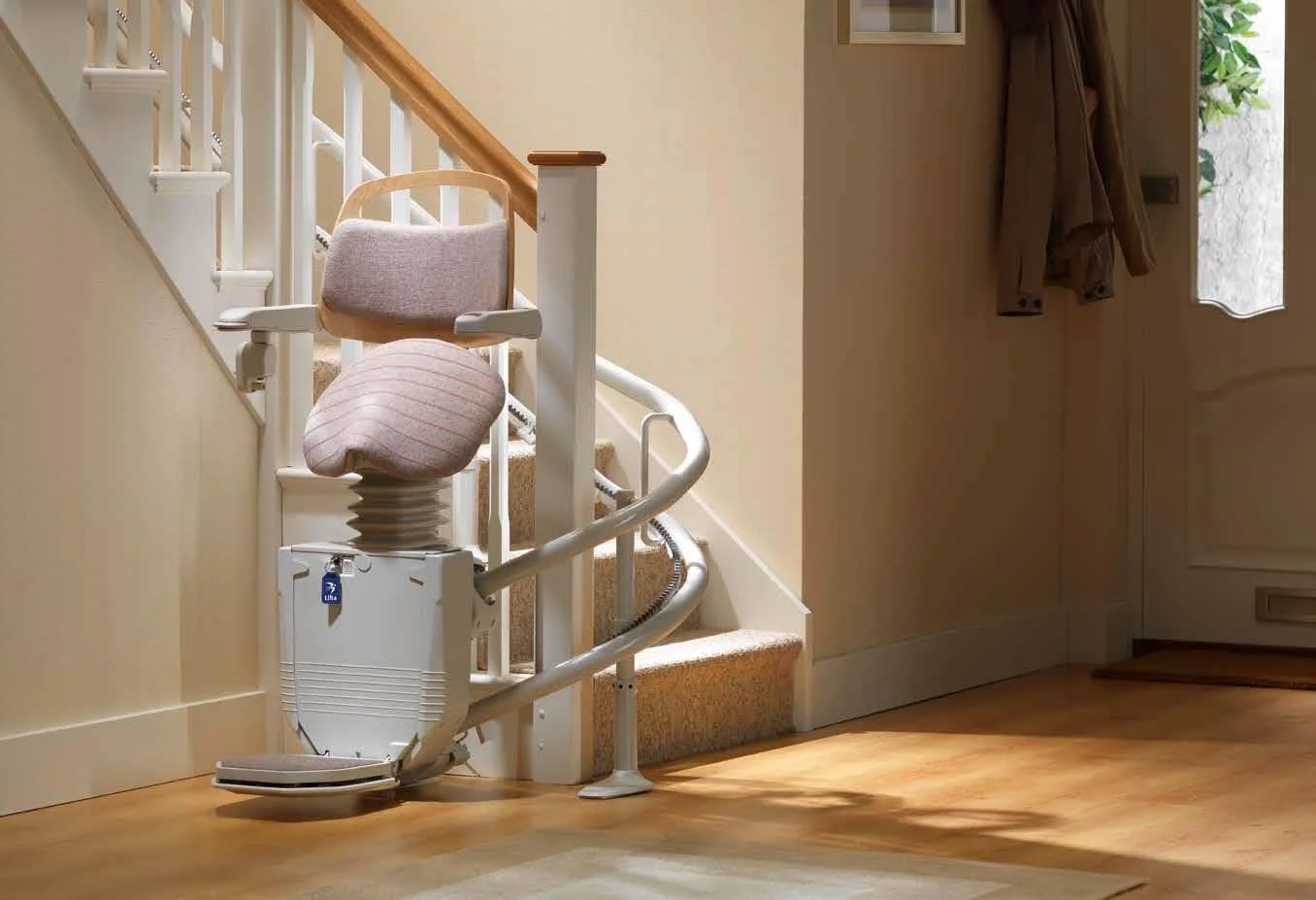
The county's housing is mostly single-family homes and detached houses, with duplexes, walk-up apartments and low-rise buildings mixed in. In the older two-story houses around Galesburg, the main staircase is often a single straight run, which is the simplest and quickest lift to fit.
Older homes can also have landings, turns or narrow back stairs. Those call for a curved rail built to the shape of the staircase. We measure the stairs in person before recommending either type.
Walk-up apartments and duplexes bring a different question: who owns the stairs. If you rent, the owner has to agree before anything is bolted to the treads.
Plenty of farmhouses and small-town homes in places like Altona, Oak Run and Rio have steps up to the front or back door. An outdoor stair lift or a platform lift can handle that first climb, and a platform lift can carry someone who uses a wheelchair.
Winters here are cold, with an average January low of 13F, and summers reach an average July high of 85F. Any lift outside has to be rated for that range and for snow and ice on the steps. Inside lifts avoid the weather entirely, which is why many households start with the indoor staircase.
About 21.8% of Knox County residents are 65 or older, and 66.6% of households own their homes. That is a lot of people aging in houses they plan to stay in.
In Galesburg, 40.7% of the city's 12,425 households are one person living alone. When there is no one else in the house to help on the stairs, a lift that runs on its own becomes a daily safety tool, not a convenience.
The Veterans Assistance Commission at 121 South Prairie Street, Suite 3, Galesburg, can be reached at (309) 345-3877 for help sorting out VA benefits.
Only one program below states outright that it covers stair lifts: the Illinois Home Modification and Assistive Technology program through IDHS/DRS, for Illinois residents with a disability. The others cover home modifications, accessibility work or in-home services, but their sources do not name stair lifts, so call and ask before you count on them.
Age changes where you start. If you are under 60, the Home Services Program and Stone-Hayes Center for Independent Living are the usual doors. At 60 and over, the Western Illinois Area Agency on Aging at (309) 793-6800 and the Community Care Program are the referral points.
Galesburg homeowners and renters with lower incomes should look at the city's Home Repair and Accessibility Program. Rural homeowners outside Galesburg may want to check USDA Section 504 eligibility for their specific address.
A statewide program for Illinois residents with a disability that lists stair lifts among its examples, along with ramps and widened doorways. Call (800) 843-6154; adults 60 and over are directed to the Department on Aging or the Western Illinois Area Agency on Aging instead.
A $4.5 million statewide grant for home modifications for people with disabilities not served by the Home Services Program, with a goal of up to 800 modifications. Stair lifts are not listed specifically; call Stone-Hayes, the local center, at (309) 344-1306.
A Medicaid waiver for Illinois residents under 60 at application with a severe disability; it lists environmental modification and assistive equipment but does not name stair lifts. Call (877) 581-3690.
In-home and community services for people 60 and older with non-exempt assets of $17,500 or less; the source does not mention home modifications or stair lifts. Call (800) 252-8966 for an in-home services assessment.
The regional aging agency for residents 60 and over, funding local providers for meals, care coordination, transportation and legal aid; none are described as a stair lift service. Call (309) 793-6800 to ask whether home-modification help is currently available.
Forgivable grants including Accessibility grants up to $50,000 for owner- or tenant-occupied homes, for households below 80% of Knox County's area median income; stair lifts are not named. Call (309) 837-2997 to confirm whether a lift qualifies.
Loans up to $40,000 at 1% and grants up to $10,000 for very low-income homeowners in eligible rural areas, with grants limited to those 62 or older; stair lifts are not named. Call (217) 403-6200 and check eligibility by address.
A VA benefit with lifetime caps of $6,800 or $2,000 for medically necessary home accessibility work. The source does not list stair lifts as covered and excludes removable equipment such as stair glides and porch lifts.
Grants for veterans with qualifying severe service-connected disabilities, up to $126,526 for SAH and $25,350 for SHA. The source mentions ramps and widened doorways but does not name stair lifts.
A local program helping veterans with critical home repairs they cannot afford, including accessibility features like wheelchair ramps; stair lifts are not named. Call (309) 343-2242 to ask.
The local Center for Independent Living in Galesburg, offering home services, assistive technology and referrals for people with disabilities; stair lifts are not itemized. Call (309) 344-1306 to ask whether a lift can be funded or referred.
Older adults
729 34th Avenue, Rock Island, 61201
Veterans
121 South Prairie Street, Suite 3, Galesburg, 61401
Yes, look first at the Illinois Home Modification and Assistive Technology program at (800) 843-6154, which names stair lifts as an example. The Home Services Program at (877) 581-3690 and Stone-Hayes Center for Independent Living at (309) 344-1306 are also worth a call.
Call the Western Illinois Area Agency on Aging at (309) 793-6800. The Community Care Program at (800) 252-8966 handles in-home service assessments for people 60 and older with non-exempt assets of $17,500 or less, though it does not list stair lifts.
The City of Galesburg Home Repair and Accessibility Program offers Accessibility grants to tenant-occupied homes as well as owner-occupied ones, for households below 80% of area median income. Call (309) 837-2997 to ask whether a stair lift counts, and get the owner's permission first.
The HISA benefit source does not list stair lifts and excludes removable equipment like stair glides, and the SAH and SHA sources do not name them either. The Veterans Assistance Commission in Galesburg at (309) 345-3877 can help a veteran work through the options.
USDA Section 504 offers repair loans and, for homeowners 62 or older, grants in eligible rural areas. Eligibility depends on your exact address, so call (217) 403-6200 to check.
Outdoor lifts and platform lifts are made for exterior steps, but with January lows averaging 13F the unit must be rated for cold and snow. We look at the steps and exposure during the home visit before recommending one.
Tell us about the stairs in your home and we will explain which lift fits, what it costs and how installation works.
