Vienna was platted in 1818, the same year Illinois became a state, and many of its home lots and core streets still follow that early layout. Around the county seat and in Goreville, Buncombe and Cypress, a lot of families live in older multi-story houses with the bedrooms and bathroom up a flight of interior stairs.
When those stairs get hard to climb, the usual choices are moving, rebuilding a downstairs room, or putting in a stair lift. This page walks through how local homes and the hilly Little Egypt terrain affect that choice, and which programs may help pay for it.
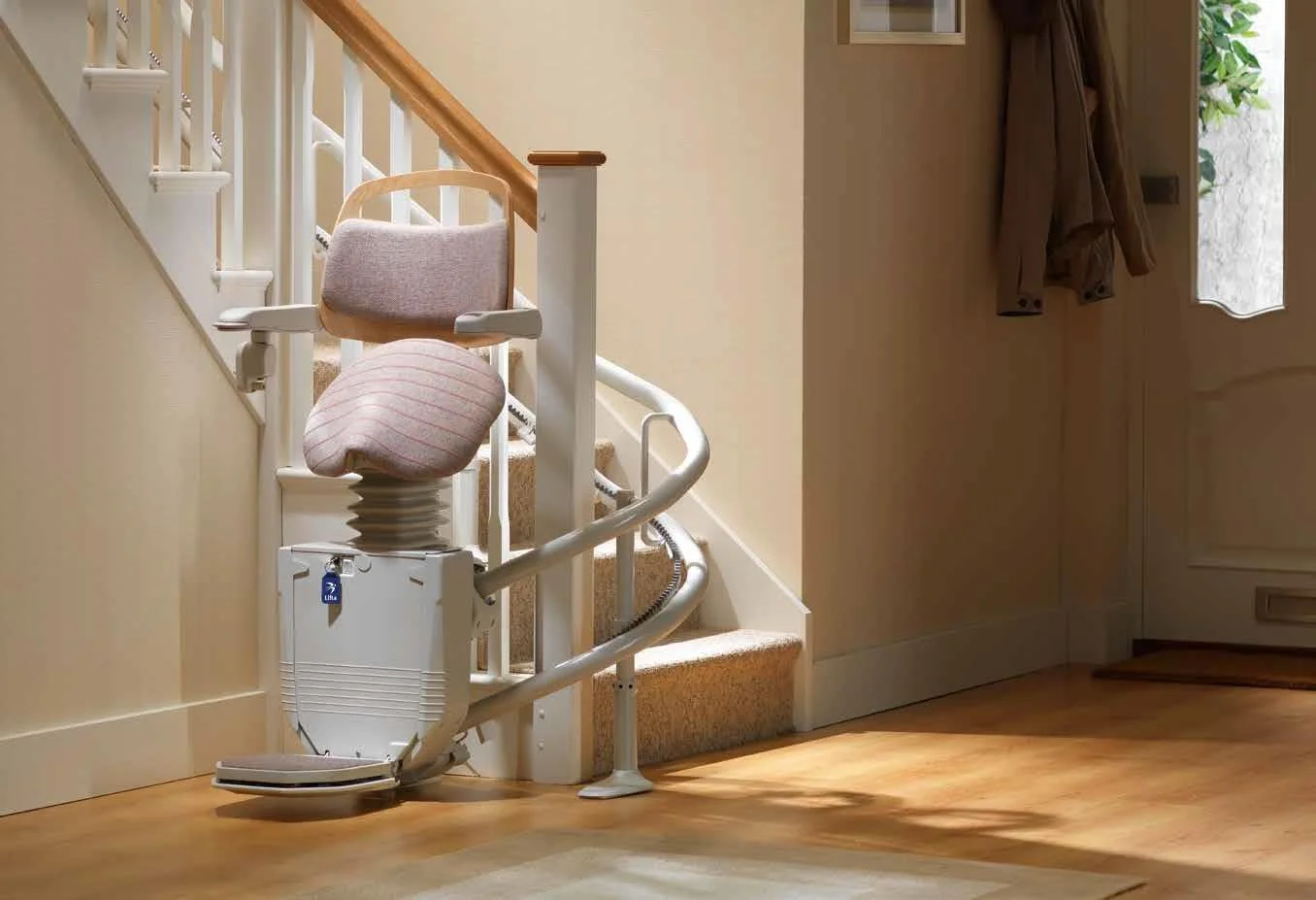
The 2020 census counted 707 housing units in Vienna, a town incorporated as a village in 1837 and as a city in 1893. That history shows in the housing: plenty of two-story homes with interior staircases, built long before single-story ranch construction became common.
If the staircase runs in one straight line from bottom to top, a straight stair lift is usually the simplest and quickest install. Stairs with a landing, a turn or a winder at the top need a curved rail built to fit that exact staircase.
Split-level homes are their own case. Each short flight may need its own lift, or a single curved rail that follows the turns, so we measure every run before suggesting anything. Ranch-style homes often have no indoor stairs at all, but a basement stairway or entry steps can still be worth a look.
Johnson County covers 349 square miles, with a large share of the Shawnee National Forest and the Cypress Creek National Wildlife Refuge inside its borders. This is forested, hilly Ozark-foothills country, not the flat farmland of central Illinois.
On a sloped lot, the trouble often starts outside: steep porch steps, a raised entry, or a driveway that climbs to the door. An outdoor stair lift with weather-resistant parts can handle exterior steps, and a platform lift can serve someone who needs to stay in a wheelchair.
Sometimes a ramp is the better fit, and sometimes a home needs both a ramp outside and a stair lift inside. We look at the whole route from the car to the bedroom before recommending one.
According to the 2020 census, 20.1% of Johnson County residents are 65 or older, and the median age is 42.8. Housing here leans strongly toward ownership, with 81.6% of homes owner-occupied.
Owning the house makes a stair lift simpler to arrange, since there is no landlord to ask. It also matters for funding, because several of the programs below require the applicant to own and live in the home.
Money is a real concern here. Per capita income of $16,402 (2010 data) was the lowest of all 102 counties in Illinois, and 13.6% of county residents live below the poverty line. That makes the public and nonprofit programs worth checking before paying out of pocket.
Age sorts most of the options. The Illinois Home Services Program and the Persons with Disabilities waiver are for people under 60 at application, and the Home Services Program names stair lifts directly. For people 60 and older, the Egyptian Area Agency on Aging in Carterville is the main local door, at (618) 985-8311.
Veterans should know that the VA HISA benefit specifically excludes stair glides, so it will not pay for a stair lift. For other VA questions, the state Veterans Affairs Office in Springfield can be reached at (217) 782-6641. Every program in the list below has its own rules, so call before you commit to an install.
A state Medicaid waiver program for Illinois residents under 60 at application with a severe, long-lasting disability who are at risk of nursing facility placement; the state lists stair lifts by name among covered modifications. Call (800) 843-6154.
This waiver covers physical modifications to a customer's home for Medicaid-eligible Illinois residents under 60 at application who have a severe disability. Call (877) 581-3690.
A statewide referral and coordination service for older adults and caregivers that includes home modification among its service categories, with priority for low-income and rural residents. Call (800) 252-8966.
Funds minor home modifications and adaptive devices for older adults in a 13-county area that includes Johnson County; stair lifts are not named on its list of examples, so ask whether one would be approved. Call (618) 985-8311.
A statewide home modification program for income-eligible households with a member who has a documented disability, including renters with landlord approval; demand is high, with 800+ on a waiting list. Stair lifts are not itemized, so confirm case by case at (217) 525-1308.
The local independent living center for Johnson County and the access point for the INCIL Home Modification Program; its directory listing does not mention stair lifts. Call (618) 457-3318.
A Medicaid waiver for Illinois residents age 60 or older that funds in-home help, adult day service, emergency home response and medication dispensers; home modifications and stair lifts are not listed. Call (800) 252-8966.
Provides in-home and related services for Illinois residents 60+ with countable assets of $17,500 or less, with the home, car and furnishings exempt; stair lifts and home modifications are not listed. Call (800) 252-8966.
Weatherization and furnace repair or replacement for low-income households in a service area that includes Johnson County; stair lifts and accessibility work are not listed. Call (618) 634-2201.
Repair loans, plus grants for homeowners 62+, for very low income households in USDA-designated rural areas; an NCOA summary lists a $40,000 loan maximum and a $10,000 lifetime grant maximum, which should be confirmed with USDA. Stair lifts are not named in the source.
A lifetime benefit of up to $6,800 or $2,000 for medically necessary home accessibility work for enrolled VA health-care patients. The VA explicitly excludes stair glides, so it does not cover stair lifts.
Grants for veterans with qualifying severe disabilities, with FY2026 caps of up to $126,526 for SAH and $25,350 for SHA, usable up to 6 times over a lifetime. Ramps and widened doorways are named as examples, but stair lifts are not listed.
Older adults
200 East Plaza Drive, Carterville, 62918
Veterans
833 S Spring Street, Springfield, 62705
Yes, possibly. The Illinois Home Services Program names stair lifts among covered modifications for people under 60 at application with a severe disability, at (800) 843-6154. The Persons with Disabilities waiver also covers home modifications, at (877) 581-3690.
Start with the Egyptian Area Agency on Aging in Carterville at (618) 985-8311. It runs a home modification service for Johnson County, though stair lifts are not on its example list, so ask directly whether one would qualify.
Not through HISA, which excludes stair glides by name. SAH and SHA grants cover home adaptations for veterans with certain severe disabilities, but stair lifts are not listed, so ask the VA about your case. The state Veterans Affairs Office number is (217) 782-6641.
Given the county's hilly terrain, this comes up often. An outdoor stair lift can handle exterior steps, a platform lift suits a wheelchair user, and some homes are better served by a ramp. We look at the full path from the driveway to the bedroom.
The INCIL Home Modification Program accepts renters who have landlord approval, along with homeowners, if a household member has a documented disability and income is under the limit. In Johnson County, the Southern Illinois Center for Independent Living at (618) 457-3318 is the local access point.
Stair lifts and home modifications are not listed among its services, which focus on in-home help, adult day service, emergency home response and medication dispensers. It can still be worth a call at (800) 252-8966 for other support at home.
Tell us about the stairs in your home and we will explain which lift fits, what it costs and how installation works.
