From Toledo, the county seat, out to Greenup, Neoga and Jewett, Cumberland County is a place of owned farmhouses and small-town homes. The 2020 Census classified the county as 100% rural, and most people here grow older in the house they already own rather than moving to an apartment or condo.
That makes the staircase a real question. Many homes here were built before universal-design standards, and narrow, steep stairs are common. This page walks through which kind of stair lift tends to fit local homes, what to expect from an in-home visit, and which programs may help with the cost.
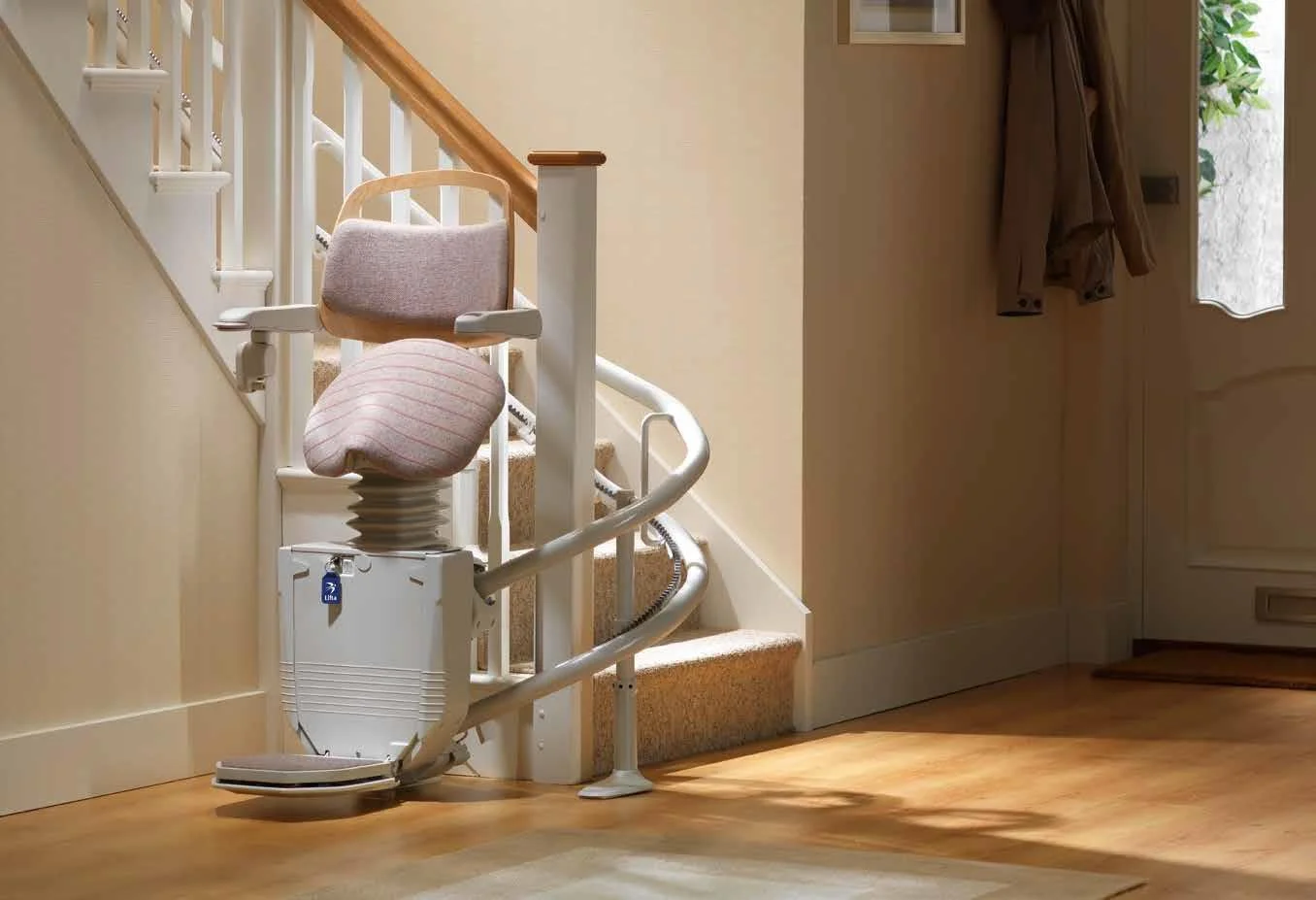
The housing here is almost entirely single-family: detached houses, ranch-style homes, split-level homes and two-story houses. A two-story house with one straight flight is usually the simplest fit, since a straight rail can run the full length of the stairs.
Split-level homes are different. They often have several short runs of stairs, and each one needs its own plan, or a curved rail that follows the turns. Ranch-style homes are worth a walk-through too, because the question is which stairs a person uses every day.
Older farmhouses and small-town homes often have narrow, steep staircases. Those need careful measurement of width, pitch and landings before anyone can say whether a straight or curved lift will work.
Cumberland County covers a flat 346 square miles in east-central Illinois, crossed by Interstate 57, Interstate 70, US Routes 40 and 45, and Illinois Routes 49, 121, and 130. Homes are spread out, many on larger lots with longer driveways.
We plan in-home visits around that layout, so it helps to tell us your town and how the house sits on the property. If a step or entry outside the home is also a problem, mention it at the start so outdoor or platform options can be looked at during the same visit.
About 21.6% of Cumberland County residents are 65 or older, and 76.2% are homeowners. Put together, that is a lot of people who own a long-held home and want to keep living in it.
For them, the Illinois Department of Veterans Affairs keeps an office at 1 Courthouse Square in Toledo, reachable at (217) 342-8493, which is a good first stop before looking at VA housing grants.
Only two of the programs below say outright that they cover assistive equipment or home modifications: the Illinois DHS Home Services Program, for people under 60 with a severe disability, and the DHS developmental disability waiver. Both are reached at (800) 843-6154.
For people 60 and older, the East Central Illinois Area Agency on Aging at (309) 829-2065 is the place to start. Its sources do not list stair lifts, but it is the intake point for state aging services and can point you to other help.
Homeowners with very low incomes may look at USDA Section 504 repair loans and grants, since the county is fully rural. Veterans with qualifying service-connected disabilities can ask about VA housing adaptation grants. In each case, confirm with the program before buying, because stair lifts are not named in their sources.
The regional aging agency for east-central Illinois and the intake and referral point for the Illinois Community Care Program for residents 60 and older. Its site does not list stair lifts or home modifications; call (309) 829-2065.
A state in-home care program for Illinois residents 60 and older with non-exempt assets of $17,500 or less, offering services such as in-home help and emergency home response. Stair lifts and home modifications are not listed; call (800) 252-8966.
A Medicaid waiver for Illinois residents under age 60 with a severe disability who need help at home, and it lists assistive equipment and environmental modification among covered services. Call (800) 843-6154.
For people with a developmental disability enrolled in a DHS waiver, it funds home modifications up to $15,000 per 5-year period on owned property, with lower caps of $5,000 and $7,500 in other cases. Prior approval and two contractor bids are required; call (800) 843-6154.
Very-low-income rural homeowners can get loans up to $40,000 at 1% interest, and grants up to a lifetime $10,000 for applicants 62 and older who cannot repay a loan. Stair lifts are not mentioned in the source.
Federal grants for veterans with qualifying service-connected disabilities, with FY2026 caps of up to $126,526 for SAH and $25,350 for SHA. Stair lifts are not specifically named, so ask the Illinois Department of Veterans Affairs office in Toledo at (217) 342-8493.
A state grant for low- and very low-income Illinois homeowners that funds health and safety repairs and accessibility improvements through regional non-profit grantees. Stair lifts are not specifically named, and waitlists are common.
A nonprofit center for independent living serving people with disabilities in Cumberland County through its Charleston office, offering advocacy, referral and peer support. It does not confirm providing stair lifts, so call (217) 345-7245 to ask about current home modification referrals.
Older adults
1003 Maple Hill Road, Bloomington, 61704
Veterans
1 Courthouse Square, Toledo, 62468
Often it can, but it depends on measurements. Many older homes in the county have narrow, steep staircases, so width, pitch and landings need to be measured in person before choosing a straight or curved lift.
The Illinois DHS Home Services Program serves residents under 60 with a severe disability and lists assistive equipment and environmental modification as covered services. Call (800) 843-6154.
Start with the East Central Illinois Area Agency on Aging at (309) 829-2065. It serves residents 60 and older and is the access point for the Illinois Community Care Program.
Cumberland County is 100% rural, so homeowners may fall in a USDA-eligible area. Section 504 grants require being 62 or older and very low income, and the source does not mention stair lifts, so confirm before planning on it.
The Illinois Department of Veterans Affairs office is at 1 Courthouse Square in Toledo, phone (217) 342-8493. Staff there can explain the VA housing adaptation grants for qualifying service-connected disabilities.
Split-level homes often have several short flights. Each flight may need its own straight lift, or one curved rail may follow the turns, which is why an in-home measurement comes first.
Tell us about the stairs in your home and we will explain which lift fits, what it costs and how installation works.
