Pennsylvania has 2,903 towns and 13,809,212 residents, spread from Philadelphia County and Allegheny County out to places like Potter County, Sullivan County and Forest County. A stair lift job in a city row of homes and one in a small borough farmhouse can look very different, so we start with the stairs you actually have.
This page covers how stair lift types match different staircases and which Pennsylvania programs can help with the cost. Each county has its own page with local details. Use this one to get your bearings first.
About 19.0% of Pennsylvanians are 65 or older, and 70.1% of households own their home. That combination matters. People who own the house they plan to stay in are the ones most likely to install a lift rather than move.
If that includes you or a parent, the VA section below is worth reading closely, because the VA splits stair lift help between two different benefits.
A straight stair lift runs on a single rail along one flight with no turns or landings. It is usually the quickest install and the simplest to fit.
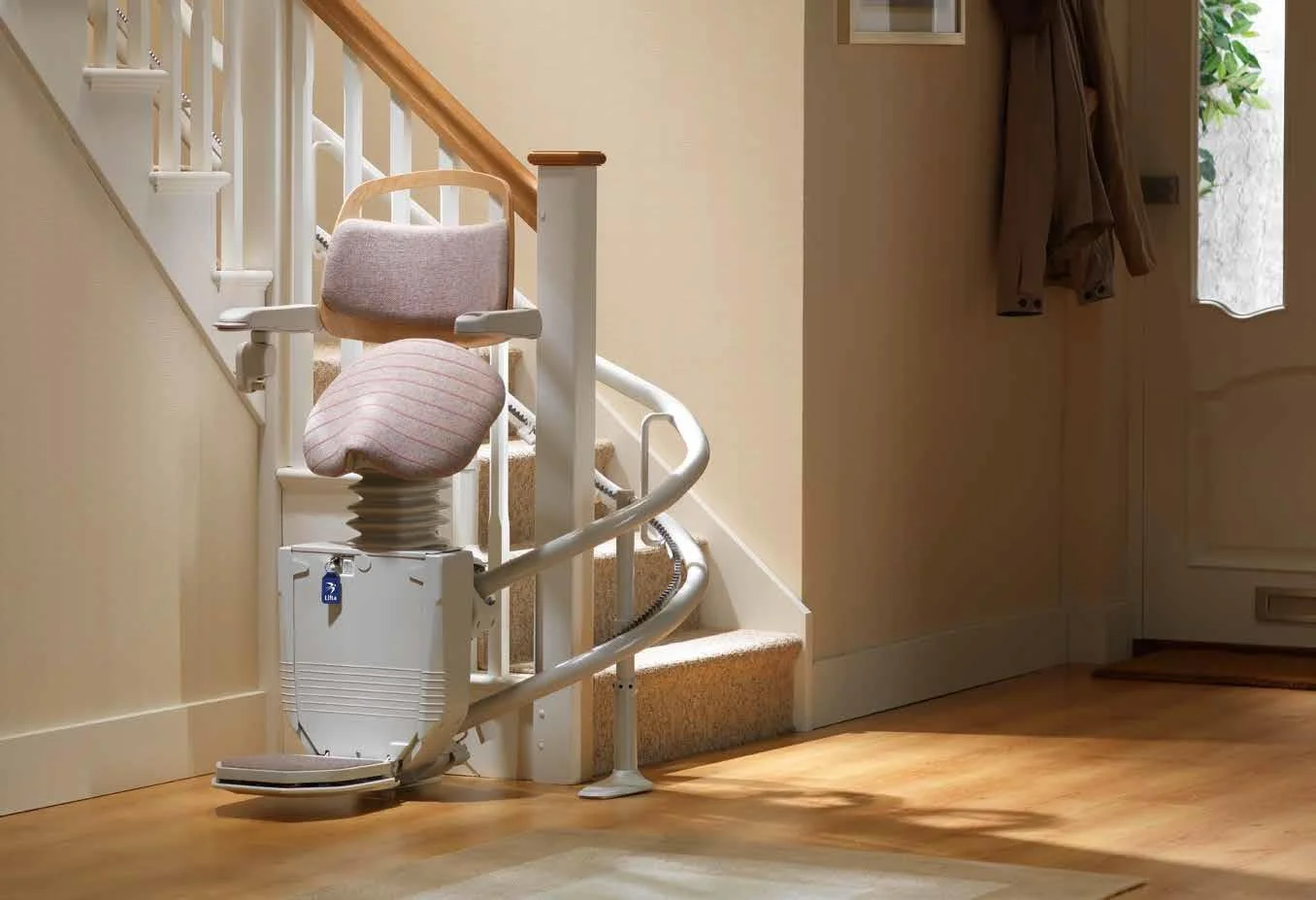
A curved lift uses a rail bent to follow turns, landings or a winding flight. Each rail is made to the measurements of that staircase, so plan for a site visit before anything is ordered.
Outdoor lifts are built for porch steps or an exterior flight into the house. Platform lifts carry a wheelchair rather than a seated rider, and they suit homes where someone can no longer transfer to a chair.
Count the steps, note any turns or landings, and check whether there is an outlet near the top or bottom of the stairs. Think about who will ride and whether they can sit and stand on their own.
If you rent, talk to the owner before planning anything. If you own, decide whether the lift is for the inside stairs, the outside entry or both, since funding programs may treat those differently.
Pennsylvania has several routes, and they fit different people. Community HealthChoices (CHC) is for people on Medicaid long-term care. The OPTIONS Program serves seniors 60 and older who are not on Medicaid, with a sliding-scale cost share.
Veterans can look to VA Prosthetics for the lift itself, while HISA grants cover ramps and structural changes. The PA Assistive Technology Foundation (PATF) offers loans with no income limit for anyone who needs to spread out the cost. Details and phone numbers are in the program list below.
Pennsylvania's Medicaid managed long-term care benefit, which pays for stair lifts as home adaptations under an approved person-centered service plan with no fixed cap. Call (800) 757-5042.
State-funded in-home services for Pennsylvania seniors 60 and older who are not on Medicaid, with a sliding-scale cost share; stair lifts are covered as a home modification, and amounts are set by the local Area Agency on Aging. Call (800) 753-8827.
The stair lift itself can be covered through VA Prosthetics (PSAS) when medically prescribed, with no set dollar cap, while HISA grants of $6,800 (service-connected) or $2,000 (non-service-connected) cover ramps and structural changes, not the lift. Call (877) 222-8387.
Loans up to $60,000 that explicitly cover stair lifts, with no income limit: Mini-Loans from $100 to $7,000 at 0% and Low-Interest Loans over $7,000 at 3.75%, plus a mini-grant option. Call (888) 744-1938.
Yes, through Community HealthChoices (CHC), which treats stair lifts as home adaptations. There is no fixed cap; coverage follows your approved person-centered service plan. Call (800) 757-5042.
The OPTIONS Program is built for that situation. It covers stair lifts as a home modification with a sliding-scale cost share, and your local Area Agency on Aging sets the amount. Call (800) 753-8827.
No. HISA covers ramps and structural changes, up to $6,800 for service-connected or $2,000 for non-service-connected veterans. The lift itself goes through VA Prosthetics (PSAS) when medically prescribed. Call (877) 222-8387.
The PA Assistive Technology Foundation (PATF) has no income limit. It offers 0% Mini-Loans from $100 to $7,000 and Low-Interest Loans over $7,000 at 3.75%, up to $60,000. Call (888) 744-1938.
If your stairs run in one flight with no turns or landings, a straight lift usually works. Any turn, landing or winding section calls for a curved rail made to your staircase, which we measure on a home visit.
Tell us about the stairs in your home and we will explain which lift fits, what it costs and how installation works.
