Walk down Penn Street in the borough of Huntingdon and you see the problem right away: tall, narrow brick and stone houses with steep original staircases and no spare room for an elevator. The same pattern repeats in the old railroad and canal towns across the county, from Mount Union to Alexandria to Orbisonia.
This page explains how those homes, and the ridge-and-valley ground they sit on, shape the kind of stair lift that works. It also lists the local and state programs that may help pay for one, with the phone numbers to call in Huntingdon County.
Much of the county's older housing is concentrated in Huntingdon and other 19th-century towns, with Italianate and Queen Anne among the styles. The oldest borough residence, at 105 Third Street, dates to 1797, and the Queen Anne Gage Mansion at 317 Penn Street was built in 1896. The county has 42 properties and districts on the National Register of Historic Places.
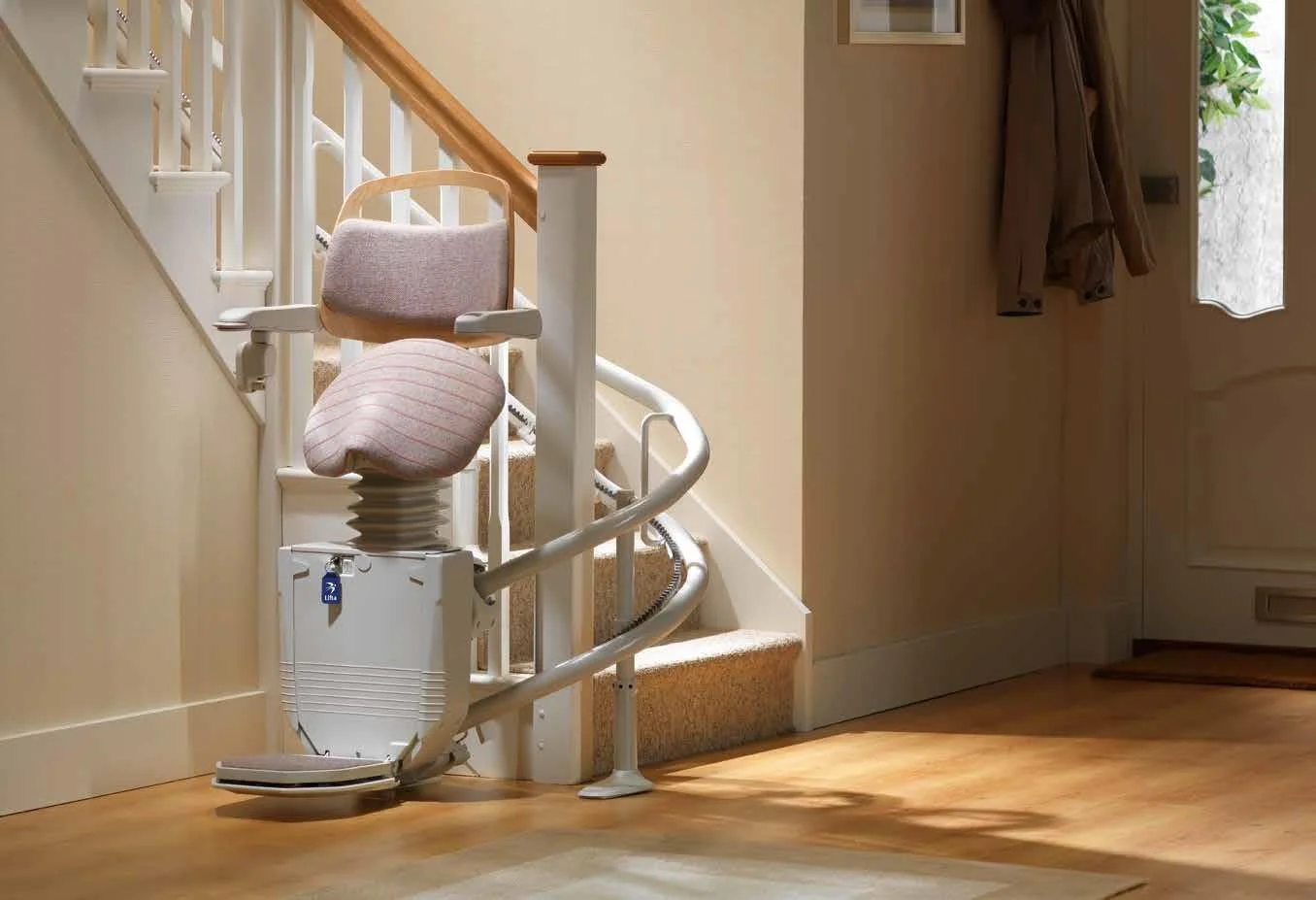
In houses like these, staircases are often steep and narrow. A straight stair lift mounts to the treads, not the wall, so it can fit a simple run without changing the plaster or woodwork. Stairs that turn at a landing or wind near the top usually need a curved rail built to that staircase.
Before we quote anything, we measure the stair width, the pitch, and the space at the top and bottom landings. In a tall house with two or more floors, we look at each flight separately.
Not every home here is a century old. The county also has single-family and detached houses, townhouses, split-level homes and walk-up apartments. A split-level often has two short flights, and each one can take its own short straight lift.
Townhouses tend to have one long straight flight, which is usually the simplest install. In a walk-up apartment, the stairs may be shared, so the building owner needs to approve any lift before work starts.
Huntingdon County sits in the Ridge-and-Valley province of the Appalachians, with long forested ridges above narrow farm valleys and Raystown Lake, at 8,300 acres, in the Raystown Branch valley. On that kind of ground, many homesites and town lots are sloped, with multi-level entries and steps up to the front door.
When the hard part is getting from the driveway into the house, an outdoor stair lift built for weather can cover the porch or entry steps. For someone who uses a wheelchair and cannot transfer to a seat, a platform lift may be the better fit. We can talk through both during the visit.
About 20.7% of the county's 39,433 residents are 65 or older, and 76.0% of households own their homes. Many of those owners want to stay put in a house they know, even when the stairs get harder.
If that includes someone in your family, the VA grants and the county veterans office listed below are worth a call early on.
The Community HealthChoices waiver is the program in this area that names stair lifts as covered, through the participant's managed care organization after a documented need. It requires Medicaid enrollment and a nursing-facility level of care.
For people who do not qualify for Medicaid, the OPTIONS program uses a sliding-scale co-pay with no income cap. Homeowners at or below 80% of Area Median Income can ask the Center for Community Action about accessibility repairs, and veterans can check the VA housing grants. Each program is summarized below.
The Huntington-Bedford-Fulton AAA office is at 230 S. Juliana St., Bedford, 15522, phone (814) 623-8149. Huntingdon County Veterans Affairs is at Courthouse Annex I, Suite 2, 205 Penn Street, Huntingdon, 16652, phone (814) 643-1360.
A Medicaid managed care waiver for Pennsylvania residents 21 and older who need a nursing-facility level of care, and stair lifts are covered case by case through the CHC managed care organization. Call (814) 643-5115 to start enrollment or an assessment.
The local Aging Waiver for people 60 and older who meet Medicaid financial rules and a nursing-facility level of care, authorizing home environment modifications case by case; the source does not mention stair lifts specifically. Call (814) 643-5115.
A state-funded in-home services program for Pennsylvanians 60 and older who may not qualify for Medicaid, with a sliding-scale co-pay and home-modification help where local rules allow; stair lifts are not mentioned in the source. Call (717) 783-1550 or apply through the local Area Agency on Aging.
Federal grants to adapt a home for veterans with severe service-connected disabilities: SAH up to $126,526 and SHA up to $25,350 (FY2026), plus HISA up to $6,800 service-connected or $2,000 non-service-connected. The source does not mention stair lifts specifically; call (800) 827-1000.
Case-by-case grants or loans for owner-occupied homes at or below 80% of Area Median Income, covering handicap accessibility along with water, sewer, electric and roof repairs; stair lifts are not named. Call (814) 623-9129.
Provides information, referral, advocacy and nursing-home transition support for people with disabilities of any age, but does not pay for stair lifts or other equipment. Call (814) 949-1905 for help reaching waiver-funded modifications.
Older adults
230 S. Juliana St., Bedford, 15522
Veterans
Courthouse Annex I, Suite 2, 205 Penn Street, Huntingdon, 16652
Yes, possibly. The Community HealthChoices waiver starts at age 21 for Pennsylvania residents on Medicaid who need a nursing-facility level of care, and it lists stair lifts as covered. Call (814) 643-5115.
A stair lift rail mounts to the stair treads rather than the walls, which suits older brick and stone homes. If the staircase turns or winds, it will need a curved rail made for that stair, so we measure first.
The OPTIONS program is designed for people 60 and older who may not qualify for Medicaid. It uses a sliding-scale co-pay with no income cap, and home-modification help depends on local Area Agency on Aging funds and rules.
Start with Huntingdon County Veterans Affairs at 205 Penn Street in Huntingdon, (814) 643-1360. They can help with the VA SAH, SHA and HISA grants, and the VA itself is at (800) 827-1000.
An outdoor stair lift can run along entry or porch steps, which are common on the sloped lots around the county. If the person cannot move from a wheelchair to a seat, a platform lift is the usual alternative.
No. CILSCPA does not pay for equipment, but it can help with referrals and advocacy toward waiver-funded modifications. Reach them at (814) 949-1905.
Tell us about the stairs in your home and we will explain which lift fits, what it costs and how installation works.
