Carbon County was built on anthracite coal, and its houses still show it. In Jim Thorpe, Lansford, Summit Hill, Nesquehoning, Lehighton and Palmerton, many families live in narrow multistory rowhouses and worker homes with the steep interior staircases common before 1940.
Out in Kidder, Penn Forest and the other Pocono-side townships, the homes are newer but the ground is not flat. Between Blue Mountain on the south and the Pocono Mountains in the northeast, a lot of houses sit on sloped lots or are built as split levels. This page walks through what that means for a stair lift and where to look for help paying for one.
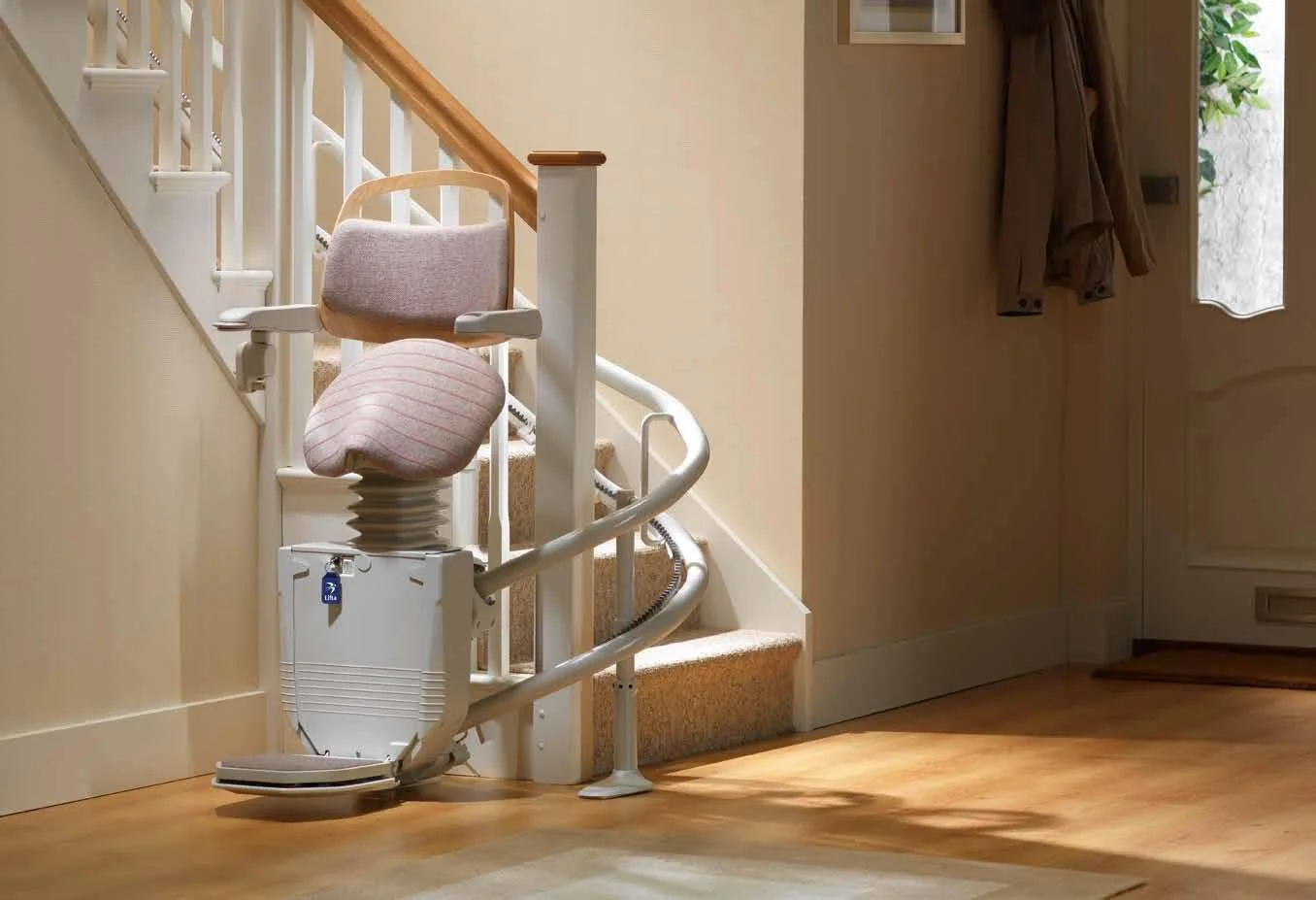
The older boroughs have some of the most affordable housing in the region, so many longtime owners stay in homes built before single-floor living was common. The bedroom and often the only full bath are upstairs, and the staircase between them is steep and tight.
A straight stair lift is usually the first thing we look at in these houses. The rail mounts to the stair treads, not the wall, so plaster walls in a pre-1940 rowhouse are not a barrier. We measure the width, the pitch and the landing space at the top and bottom before saying a unit will fit.
If the stairs turn at a landing or wind partway up, a curved rail built to that staircase is the usual answer. Those take longer because the rail is made to the measurements of your stairs.
The county covers about 387 square miles of hills and mountains, with the Lehigh River cutting through between Jim Thorpe and White Haven. On graded lots, a split-level home can mean short runs of stairs between every floor, plus steps from the driveway or garage up to the door.
Short interior runs often take a straight lift each. For the climb from a sloped yard or a back porch, an outdoor stair lift built for weather is one option, and a vertical platform lift can make sense where a wheelchair is involved. Duplexes and walk-up apartments raise a separate question: who owns the stairs, so talk with the owner or landlord before planning an install.
About 22.3 percent of residents are 65 or older, and the 2020 Census put the median age at 46.7, older than average. Roughly 77.8 percent of households own their home, which matters because owners can make permanent changes like a stair lift without asking anyone.
If that includes your parent, check the VA grants listed below and call the county veterans office in Jim Thorpe at (570) 325-3986.
Two Medicaid waivers, Community HealthChoices and the OBRA Waiver, list environmental adaptations and assistive technology as covered services. Approval is case by case and based on an assessed need, and both use the same phone line, (866) 550-4355.
For people 60 and older, the Carbon County AAA at 240 S. 3rd St. in Lehighton is the front door. It runs the OPTIONS Program, which offers home modifications and assistive devices with a sliding-scale copay based on income. Its source material does not name stair lifts specifically, so ask directly during the assessment.
Lower-income homeowners can also ask about the county housing rehabilitation program, and ARCIL can point people with disabilities of any age toward other funding sources. Each program is summarized below.
A Medicaid managed-care waiver for adults 21 and older with a physical disability who meet nursing-facility level of care; environmental adaptations and assistive technology are covered and authorized by the participant's plan (Keystone First CHC, PA Health & Wellness, or UPMC Community HealthChoices). Call (866) 550-4355.
A Medicaid waiver for people 18 and older with a developmental physical disability that began before age 22; environmental adaptations and assistive technology are covered services, approved by a supports coordinator based on need. Call (866) 550-4355.
A lottery-funded state program for Pennsylvania residents 60 and older that offers home modifications and assistive devices with a sliding-scale copay; stair lifts are not named on the source page. Call (610) 824-7830.
The county aging office provides in-home services, including assistive devices or home modifications, case by case after a clinical assessment, mainly for residents 60 and older; stair lifts are not specifically listed. Call (610) 824-7830.
A nonprofit serving people with disabilities of all ages in Carbon, Luzerne, and Schuylkill Counties with information, referral and advocacy, including help finding funding for accessibility changes; it does not list stair lifts as a direct service. Call (570) 455-9800.
Federal grants for veterans with qualifying severe service-connected disabilities to adapt a permanent home, with FY2026 maximums of $126,526 for SAH and $25,350 for SHA; whether a stair lift qualifies is not stated, so ask. Call (800) 827-1000.
A HUD-funded rehab program for low- and moderate-income owner-occupants, run by the Carbon County Office of Planning & Development (OPAD); stair lifts are not named on the source page. Call (866) 466-3972.
Older adults
240 S. 3rd St., Lehighton, 18235
Veterans
76 Susquehanna Street, 1st Floor, Jim Thorpe, 18229
Often, yes. Steep, narrow staircases are common in these pre-1940 homes, and the rail attaches to the treads rather than the wall. An in-home measurement of width, pitch and landing space settles whether a straight or curved unit fits.
Start with the Carbon County AAA in Lehighton at (610) 824-7830. After an assessment, it can offer home modifications and assistive devices through the OPTIONS Program, with a sliding-scale copay based on income.
The Community HealthChoices and OBRA waivers both list environmental adaptations and assistive technology as covered services, approved case by case. CHC is for adults 21 and older who meet nursing-facility level of care. Call (866) 550-4355.
Veterans with qualifying severe service-connected disabilities may get an SAH grant of up to $126,526 or an SHA grant of up to $25,350 for FY2026. Call (800) 827-1000, or the county veterans office in Jim Thorpe at (570) 325-3986.
Many homes here sit on graded or sloped lots, so outdoor steps are a common problem. An outdoor stair lift built for weather or a vertical platform lift are the usual options, depending on the steps and whether a wheelchair is used.
The Carbon County CDBG County-Wide Housing Rehabilitation Program serves low- and moderate-income owner-occupants at (866) 466-3972. ARCIL, at (570) 455-9800, helps people with disabilities of any age find funding for accessibility changes.
Tell us about the stairs in your home and we will explain which lift fits, what it costs and how installation works.
