In Coatesville and West Chester, many families live in brick rowhouses and duplexes built generations ago. The Coatesville Historic District alone has most of its buildings dating from 1850 to 1924, and staircases in homes of that era tend to be steep and narrow.
Out in places like Uwchlan, West Bradford and East Goshen, the picture changes to multi-level single-family homes from decades of suburban growth. This page walks through what each kind of Chester County house means for a stair lift and which local programs can help cover the cost.
The Coatesville Historic District is mostly rowhouses and duplexes, about 70% of them brick, with about 47% of buildings built from 1900 to 1924. Two homesteads there, at 544-546 Harmony Street and 102 South First Avenue, date to circa 1750. You will also find Italianate, Georgian Revival, Carpenter Gothic, Queen Anne and Gothic Revival houses across the county.
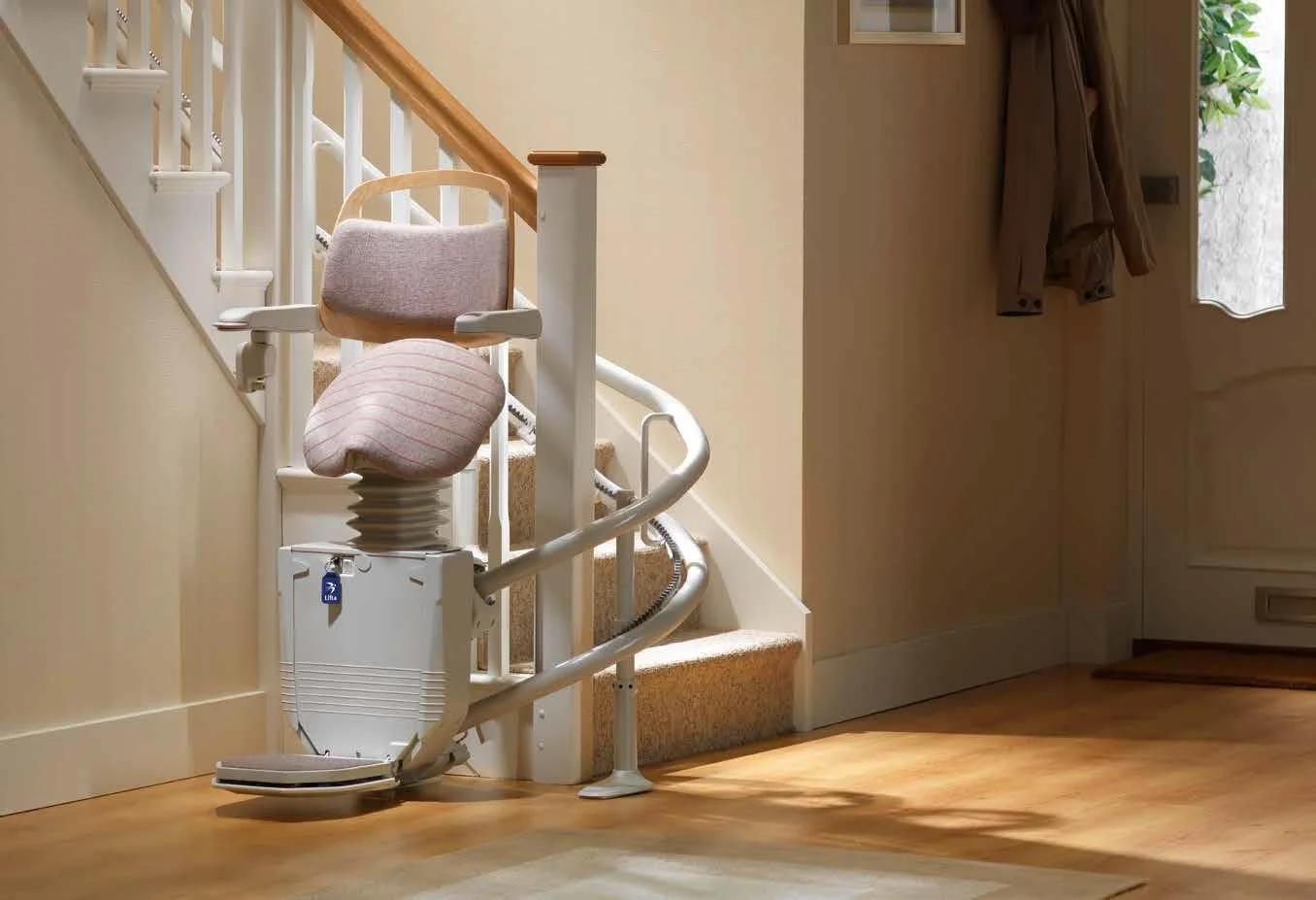
Steep, narrow stairs in these multistory homes are a common reason families call us. A straight stair lift rides on a rail fastened to the treads, not the wall, so plaster and old trim usually stay untouched. If the stair turns at a landing or winds near the top, a curved rail built to that staircase is the usual answer.
Chester County sits in the Piedmont, a region of rolling hills and valleys. Many homes are built on graded lots, which is why split-level homes show up so often in towns like Tredyffrin, Willistown and Easttown.
A split level often has two or three short flights instead of one long one. Each flight may need its own lift, or a single curved rail can sometimes connect them. Where the problem is the steps from the driveway or yard into the house, an outdoor lift or a platform lift for a wheelchair user may fit better than an indoor unit.
About 17.3% of Chester County residents are 65 or older, and 74.9% of households own their home. That means a lot of people here are aging in houses they know well and would rather not leave.
A stair lift lets someone keep using the bedroom and bathroom upstairs without moving everything to the first floor. For townhouses and walk-up apartments, renters and leaseholders should check with the owner before installation, and at least one county program below accepts leaseholders.
Many households here pay privately or split the cost among family. If that is not workable, start with Chester County Aging Services at 601 Westtown Rd. Suite 330 in West Chester, (610) 344-6350. They handle the OPTIONS Program and the Family Caregiver Support Program.
The Chester County Home Modification Program lists stair lifts as covered, with grants up to $22,000 that do not need to be repaid. Medicaid recipients who qualify for nursing-facility care can ask about Community HealthChoices, which covers removable stair glides as Home Accessibility DME.
The county Veterans' Affairs office at 601 Westtown Road, Suite 170 in West Chester, (610) 344-6375, can help with VA housing grants and other VA benefits such as HISA and Prosthetics. Statewide, the PA Assistive Technology Foundation (PATF) is another place to ask.
This Medicaid program covers stair lifts: Home Adaptations pays for permanent accessibility changes, and PA Medicaid covers removable stair glides as Home Accessibility DME for residents age 21+ who are nursing-facility clinically eligible. Work with your CHC-MCO service coordinator or call (800) 274-3258.
A state program for residents age 60+ with no income limit, offering home modifications as a supplemental service with sliding-scale co-payments; the source does not mention stair lifts specifically. Call (610) 344-6350.
Primary caregivers of someone age 60+ (or under 60 with chronic dementia) can get a one-time grant of up to $5,000 for home modifications and assistive devices, approved before work begins; whether stair lifts qualify is unknown. Call (610) 344-6350.
Grants up to $22,000 with no repayment, and stair lifts are covered, for residents with a physician-verified permanent disability and income at or below 80% of the HUD Philadelphia-area median. Call (610) 518-1522.
Federal grants for veterans with qualifying service-connected disabilities who own or will own the home: SAH up to $126,526 and SHA up to $25,350 (FY2026); stair lifts are not mentioned in the source. Call (877) 827-3702.
A nonprofit home repair and accessibility program that is currently paused and not accepting applications, with a waitlist through the Whole Home Repair Program; stair lifts are not mentioned in the source. Call (610) 384-7993.
Helps people with disabilities with assessment, referral and coordination of home modifications rather than large direct grants; whether it covers stair lifts is unknown. Call (215) 634-2000.
Older adults
601 Westtown Rd. Suite 330, West Chester, 19380
Veterans
601 Westtown Road, Suite 170, West Chester, 19380
Steep, narrow staircases are common in the county's older rowhouses and farmhouses, and they are one of the main reasons people here look at stair lifts. We measure the width, the turns and the landings before recommending a straight or curved rail.
Yes. The Chester County Home Modification Program through the Housing Partnership of Chester County covers stair lifts with grants up to $22,000 that do not need repayment. Call (610) 518-1522 to ask about eligibility.
Household income must be at or below 80% of the HUD Philadelphia-area median. The maximum is $66,850 for one person, $76,400 for two, $85,950 for three and $95,500 for four, rising to $126,100 for eight.
The OPTIONS Program has no income limit for residents age 60+, though higher earners pay sliding-scale co-payments. It offers home modifications as a supplemental service, and you can reach it through Chester County Aging Services at (610) 344-6350.
The Family Caregiver Support Program is set up for primary caregivers and offers a one-time grant of up to $5,000 for home modifications and assistive devices, if household income is within 380% of the federal poverty level. The grant must be approved before any work begins.
Habitat for Humanity of Chester County has paused its home repair program because all funding has been allocated. You can join the waitlist through the Whole Home Repair Program at goodworksinc.org/whrp.
Tell us about the stairs in your home and we will explain which lift fits, what it costs and how installation works.
