From the river towns of Charleroi, Monongahela, Donora and California to Canonsburg, Peters and McMurray, much of Washington County's housing was built on hillsides. Many older houses here date to the coal and heavy-industry era. The common company house was a plain two-story dwelling with four to six rooms, built as cheaply as possible.
In those houses the bedrooms and the full bath are usually upstairs, at the top of one straight staircase. When the stairs become hard to climb, the choices come down to moving the bedroom downstairs, moving out, or putting in a stair lift. This page explains how local homes and hills affect that choice and which programs may help with the cost.
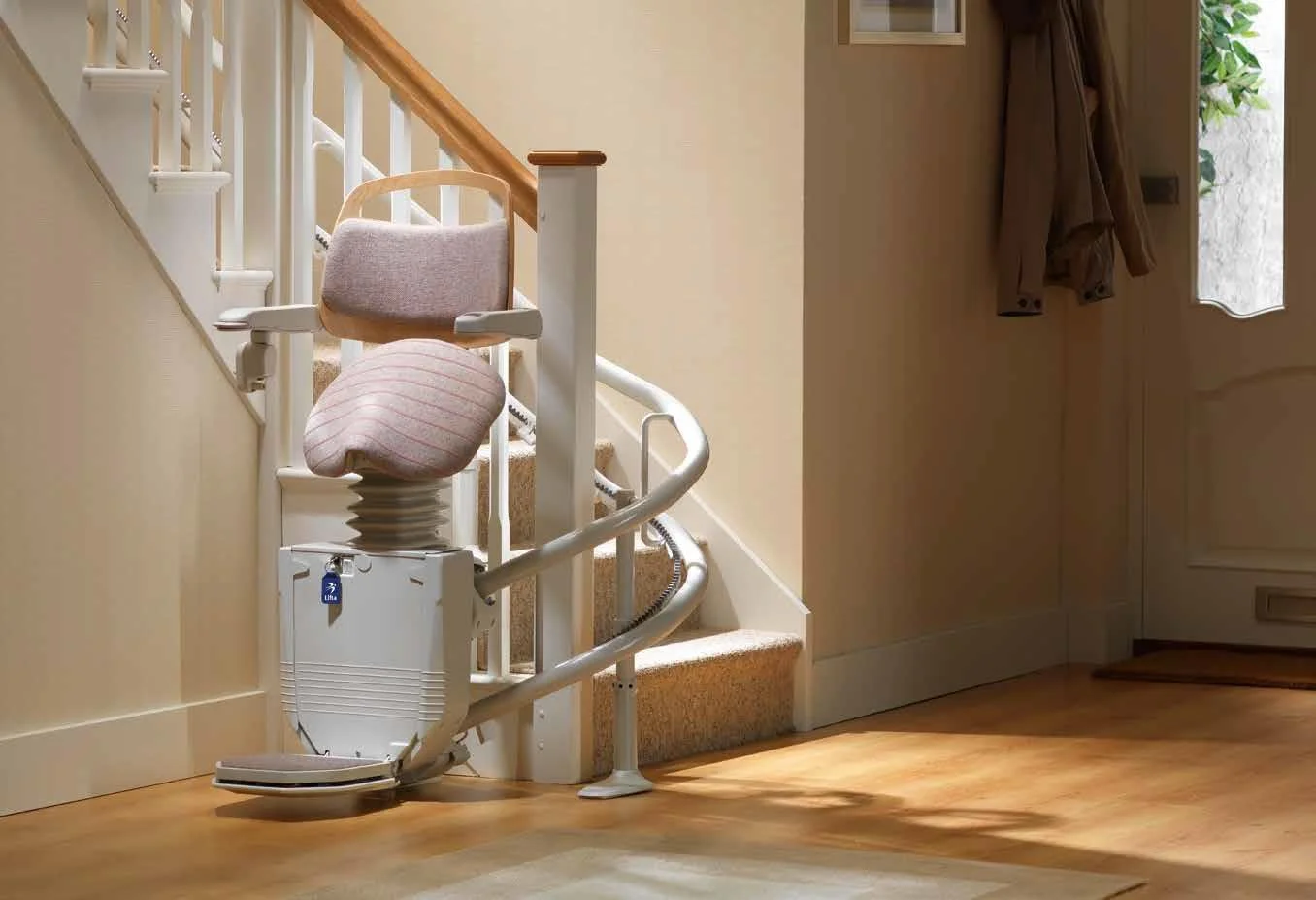
The company houses found across Western Pennsylvania were usually balloon or frame construction, with every bedroom on the second floor. A single straight run of stairs is the simplest kind of stair lift job. The rail mounts to the stair treads, not the wall, so plaster walls in an older house are left alone.
Row houses, duplexes and townhouses in the older boroughs often have the same layout in a narrower footprint. On a tight staircase we measure the width carefully and look at folding rails and seats so the stairs stay usable for everyone else in the house.
Washington County covers about 861 square miles of the Allegheny Plateau, and the Appalachian Regional Commission counts it as part of Appalachia. Flat ground is rare. Many homes sit on sloped lots, with steps up to the front door and split-level or multistory layouts inside.
That often means more than one set of stairs. A split level with a landing that turns usually needs a curved rail built to fit those exact stairs. Exterior steps up to a raised entry can take an outdoor-rated lift, and for a wheelchair user a platform lift may be the better fit. We check every set of stairs the person uses, inside and out, before suggesting anything.
About 21.4% of county residents are 65 or older, and 78.2% of households own their home. A lot of those owners have lived in the same modest house for decades and would rather adapt it than leave it.
If someone in the house served, check the veteran programs below before paying out of pocket.
Several programs serve this county, and each one has its own rules. Of the ones listed below, only Community HealthChoices is known to cover stair lifts. For the others, our source mentions home modifications or accessibility work without naming stair lifts, so ask each office directly.
For anyone 60 or older, the Area Agency on Aging is a sensible first call. Its care managers handle the OPTIONS assessment. The Fayette-Greene-Washington AAA (SW PA) office is at 305 Chamber Plaza, Charleroi, 15022, phone (724) 489-8083.
Veterans can reach the Washington County Veterans Affairs Office at 95 West Beau Street, Suite 300, Washington, 15301, phone (724) 228-6865. Statewide resources also include VA Benefits for Veterans (HISA + Prosthetics) and the PA Assistive Technology Foundation (PATF).
This Medicaid waiver lists stair lifts among covered home adaptations for adults 21 and older who are dual-eligible or nursing-facility clinically eligible, with prior approval from the member's plan (UPMC CHC, PA Health & Wellness, or Keystone First CHC). Call (877) 550-4227.
For county residents 60 and older, a care manager does an in-home assessment and builds a care plan, which is the front door to OPTIONS. Stair lifts are not named in the program description; call (724) 228-6856 to ask.
A state-funded in-home services program for Pennsylvanians 60 and older that includes home modifications for safety and accessibility, with a sliding-scale copay based on income. Stair lifts are not named specifically; the state line is (717) 783-1550.
A home accessibility modification grant for low- and moderate-income homeowners and tenants with a verified permanent physical disability; applicants go on a waiting list until funds open up. Stair lifts are not named in the listing; call (724) 228-6875.
Serves people with disabilities in Washington, Fayette, and Greene counties with assistive technology, home modifications and referral help rather than a fixed grant. Stair lifts are not named specifically; call (717) 364-1732.
Federal grants for veterans with qualifying service-connected disabilities who own or will own the home, with FY2026 maximums of $126,526 for SAH and $25,350 for SHA. Stair lifts are not named in the listing; call (800) 827-1000.
Older adults
305 Chamber Plaza, Charleroi, 15022
Veterans
95 West Beau Street, Suite 300, Washington, 15301
Yes, possibly. The Community HealthChoices waiver serves adults 21 and older who meet its medical and Medicaid rules, and the RACW Access Program and TRPIL are based on disability rather than age.
The RACW Access Program accepts both homeowners and tenants who have a verified permanent physical disability and meet the income limit. Call (724) 228-6875 to start a pre-application.
Household income cannot exceed 80% of the Pittsburgh MSA Median Family Income, which is $61,850 for a family of 1 and $88,300 for a family of 4. You must also be current on property taxes, have no municipal, state or federal liens and not be in foreclosure.
Those houses usually have a single straight staircase, which is the most common stair lift install. We measure the width and the top and bottom landings to confirm the fit and to keep the stairs usable for others.
Many county homes have raised entries because of the sloped lots. Outdoor steps can take a weather-rated lift, and a platform lift may suit someone using a wheelchair.
Call the Washington County Veterans Affairs Office in Washington at (724) 228-6865. The VA Specially Adapted Housing and Special Home Adaptation grants can be reached at (800) 827-1000.
Tell us about the stairs in your home and we will explain which lift fits, what it costs and how installation works.
