In Bedford borough, the county seat, roughly 44.8% of homes were built before 1939 and another 34.1% between 1940 and 1969. That means close to 80% of the housing there predates 1970, and many of those houses still have their narrow, steep original staircases leading to a finished second floor or basement.
Out past the borough, in places like Everett, Schellsburg, Hyndman, Saxton and Woodbury, homes sit on the ridges and valleys that run north to south across the county. This page walks through what that housing and terrain mean for a stair lift, and which local and state programs may help pay for one.
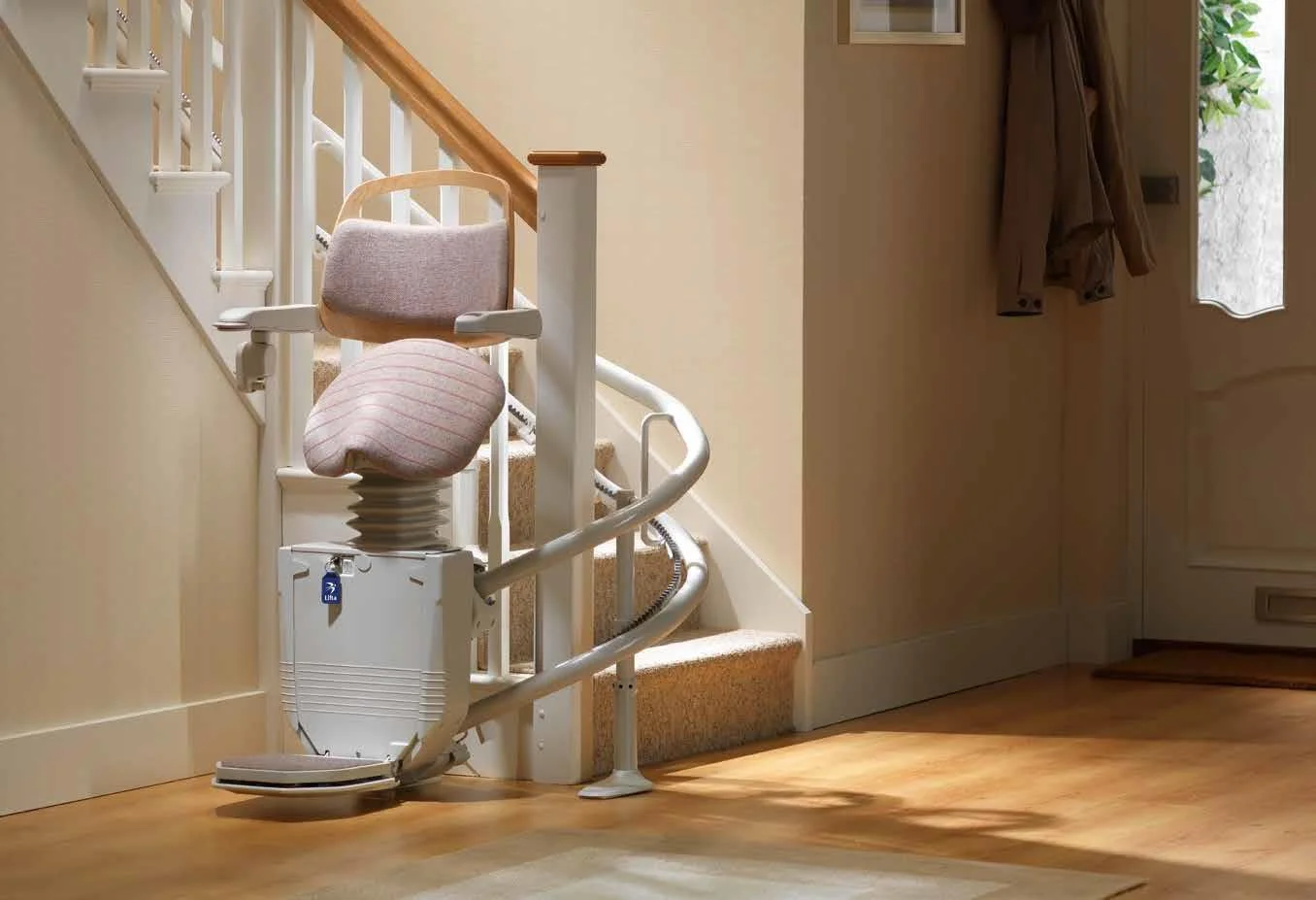
Older multistory homes are common across Bedford County, and their stairs were not built with equipment in mind. A narrow, steep run leaves less room for a seat, a folding footrest and the person climbing past it.
A straight stair lift is usually the simplest fit when the stairs run in one line from bottom to top. If the staircase turns at a landing or winds partway up, a curved rail is built to follow that shape instead.
Finished basements matter too. If laundry or a bedroom is downstairs, the basement stairs may need a lift just as much as the stairs to the second floor.
Bedford County sits where the Ridge and Valley province meets the Allegheny Plateau, with Blue Knob rising to roughly 3,120 feet. On land this sloped, many houses are built into the grade with split levels and several stories.
A split-level home often has short flights between each level, so one rail may not reach everything. Ranch-style homes can look like they have no stairs at all, yet the front or back entry may have steps outside.
Exterior steps are where outdoor stair lifts or platform lifts come in. A platform lift can make sense when someone uses a wheelchair and cannot transfer to a seat.
About 23.1% of Bedford County's 42,096 residents are 65 or older, and 80.3% of households own their home. Owning the house makes a permanent installation, like a curved rail or an outdoor lift, easier to plan.
The county is about 90.7% rural, so family members often live a drive away. A lift can mean a parent keeps using the whole house without someone there for every trip up and down.
Of the programs listed below, Pennsylvania Community HealthChoices is the one whose home adaptations benefit is shown as covering stair lifts. It is limited to people who qualify for Medicaid and a nursing-facility level of care.
The others do not list stair lifts specifically, but they handle in-home needs, health and safety repairs or accessibility, so it is worth asking directly. The Huntington-Bedford-Fulton AAA office is at 230 S. Juliana St., Bedford, PA 15522, phone (814) 623-8149.
Veterans can reach the Veterans Affairs Office at 200 South Juliana Street, Bedford, PA 15522, phone (814) 623-4848. Statewide, the PA Assistive Technology Foundation (PATF) and VA Benefits for Veterans (HISA + Prosthetics) are also options to ask about.
A Medicaid home and community-based waiver that covers stair lifts, approved case by case for adults 21+ who are 65+ or have a physical disability and meet a nursing-facility level of care. It runs through UPMC CHC, PA Health & Wellness and Keystone First CHC; call (877) 550-4227.
A state-funded in-home services program for Pennsylvanians 60 or older whose daily functioning is affected, with no income limit but a possible sliding co-pay. The source does not mention stair lifts; call (814) 623-8148 to request an assessment.
Repairs owner-occupied homes in Bedford and Fulton County to HUD Section 8 health and safety standards for households at or below 80% of Area Median Income who have lived there at least 2 years and will stay at least 5 more. Stair lifts are not listed; call (814) 623-9129.
A state-funded repair program for owner-occupied homes at or below 80% of Area Median Income that includes handicap accessibility among its health and safety repairs. Stair lifts are not named specifically; call (814) 623-9129.
Serves people of any age with any disability in Bedford and neighboring counties with information, referral and advocacy that can help reach funding, but it does not pay for equipment directly. Call (814) 949-1905.
Federal grants for veterans with specific service-connected disabilities who own or will own the home, up to $126,526 for SAH and $25,350 for SHA (FY2026), tied to an approved adaptation plan. Stair lifts are not listed in the source; call (800) 827-1000.
Older adults
230 S. Juliana St., Bedford, 15522
Veterans
200 South Juliana Street, Bedford, 15522
It can through the Community HealthChoices waiver, which covers stair lifts as a home adaptation. You must be Medicaid-eligible, 21 or older, either 65+ or physically disabled, and meet a nursing-facility level of care. Call (877) 550-4227.
The OPTIONS Program starts at age 60, but CILSCPA serves people with disabilities of any age, and Community HealthChoices covers adults 21 and older with a physical disability who qualify. CILSCPA's number is (814) 949-1905.
Many older homes here have narrow, steep original staircases, and the right rail depends on the exact measurements and any turns. An in-home assessment is the way to know what will fit.
Yes for both Center for Community Action programs, which serve owner-occupied homes at or below 80% of Area Median Income. The Housing Rehabilitation Program also requires 2 years in the home before and 5 years after the work.
Homes built on a grade often have exterior steps at the entry. An outdoor stair lift or a platform lift is designed for that, and a platform lift suits someone who stays in a wheelchair.
The Veterans Affairs Office at 200 South Juliana Street in Bedford, (814) 623-4848, can help. Veterans with qualifying service-connected disabilities can also ask about SAH and SHA grants at (800) 827-1000.
Tell us about the stairs in your home and we will explain which lift fits, what it costs and how installation works.
