Walk any older block in Wilkes-Barre, Pittston, Hazleton or Nanticoke and you see the coal boom still standing. These cities filled in fast during the 19th century, when by 1875 Luzerne County alone produced about half of Pennsylvania's anthracite. What they left behind is a large stock of narrow, multi-story homes with steep interior staircases.
Those stairs are often the first thing to become a problem for someone who wants to stay put. This page walks through how the homes and hills across the county's 89 towns affect which kind of stair lift makes sense, and which programs in Luzerne County and Pennsylvania can help cover the cost.
Row houses, walk-up apartments and older single-family homes in places like Plymouth, Kingston, Swoyersville and Duryea tend to have tight, steep staircases. Many run straight from the front hall to the second floor. A straight stair lift is usually the simplest fit for that kind of run.
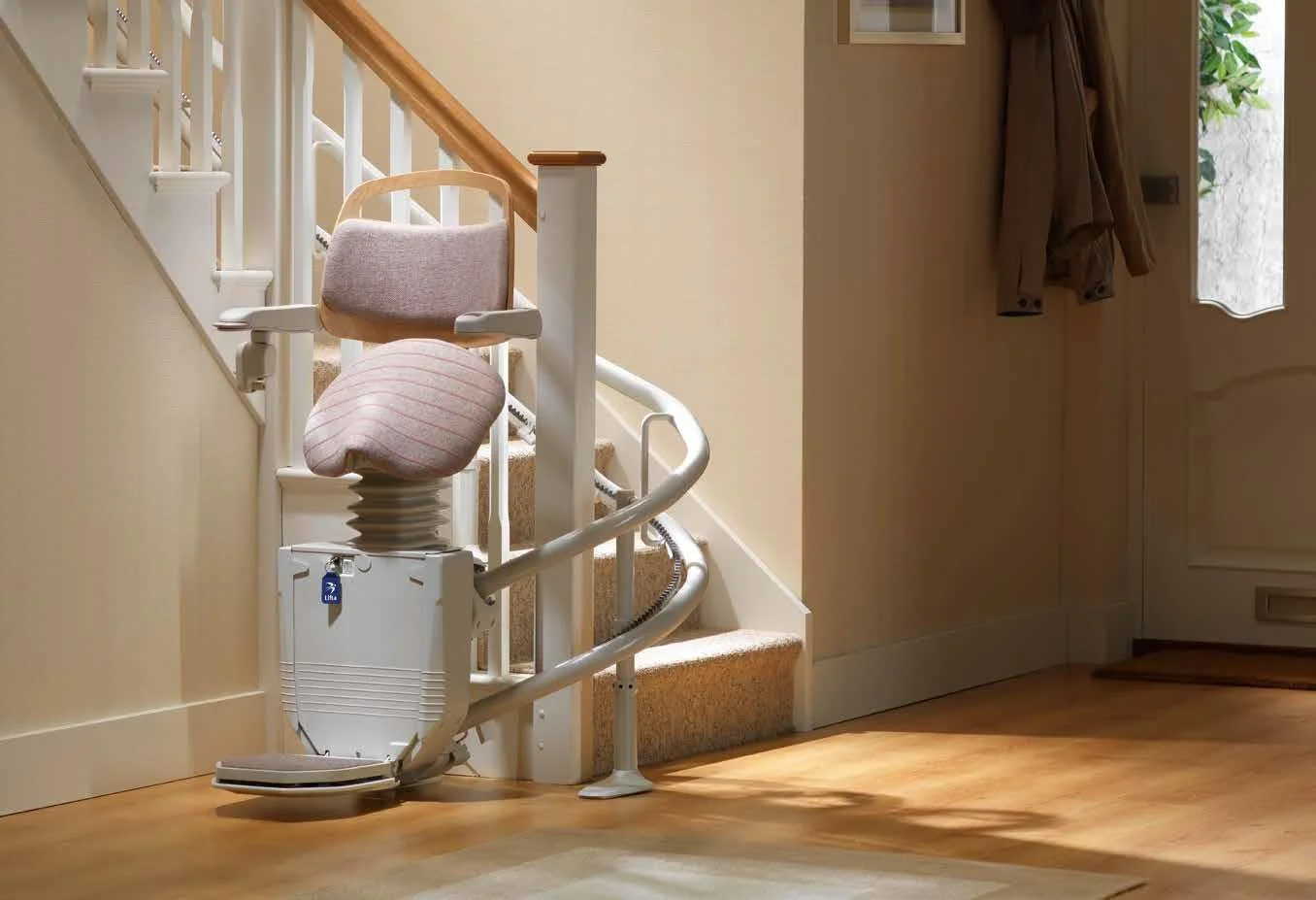
Where a staircase turns at a landing or winds near the top, a straight rail will not work. That calls for a curved stair lift, built to follow the exact shape of your stairs. We measure in the home before recommending either one, since two houses on the same street can have very different stairs.
Luzerne County covers about 906 square miles of ridge-and-valley country. The land is flat along the North Branch of the Susquehanna River, around 512 ft near Shickshinny, then climbs to wooded ridges as high as 2,460 ft at Cherry Ridge in Fairmount Township. Homes on that kind of ground often have extra levels and steps.
Split-level homes and townhouses can have several short flights instead of one long one. Each flight may need its own lift, or a curved rail that links them. Hillside lots in towns like Mountain Top, Dallas or West Hazleton can also put steps between the driveway and the door, where an outdoor stair lift or, for a wheelchair user, a platform lift may be the better answer.
About 20.0% of the county's 334,761 residents are 65 or older, and the median age is about 42. Many families have lived in the same former coal towns for generations and want to stay there.
Roughly 68.3% of households own their home. That matters because several funding programs require the home to be owned, or require landlord consent and proof of ownership before any modification. If a parent rents a row house or walk-up apartment, talk with the landlord early.
The best first call for most families is the Luzerne-Wyoming Counties AAA at 111 N. Pennsylvania Ave., Wilkes-Barre, (570) 822-1158. They assess needs for adults 60 and older and can help with enrollment in the OPTIONS Program or Community HealthChoices (CHC).
Two VA grants list stair or platform lifts as a possible use, and Luzerne County Veteran Affairs at 61-63 Water St., Wilkes-Barre, (570) 706-3960 can help with the paperwork. Statewide, you can also ask about VA Benefits for Veterans (HISA + Prosthetics) and the PA Assistive Technology Foundation (PATF).
A Medicaid waiver that covers stair lifts and other home adaptations when they are medically necessary and written into the participant's service plan, with no published dollar cap. It serves people dually eligible for Medicare and Medicaid, or Medicaid-eligible adults 21 and older who need a nursing-facility level of care; call (800) 274-3258.
A state-funded, lottery-funded in-home services program for Pennsylvanians 60 and older, with a sliding-scale co-payment based on income. The program description does not mention stair lifts, so ask what supplemental services the local agency offers; call (717) 783-1550.
The local door for adults 60 and older in Luzerne or Wyoming County, handling assessments, OPTIONS, care management and waiver enrollment help. It does not list stair lift funding itself, but funding flows through the programs it administers; call (570) 822-1158.
A federal grant for veterans with certain permanent service-connected disabilities to buy, build or modify a home, including managing stairs, with an FY2026 maximum of $126,526. Call (800) 827-1000.
A federal grant for veterans with qualifying service-connected disabilities that can pay for accessibility changes, including a platform or stair lift, with an FY2026 maximum of $25,350. Call (800) 827-1000.
A nonprofit serving people with disabilities and seniors in northeastern PA, including Luzerne County, with information and referral on accessibility and waiver service coordination. It does not list a direct stair lift grant; call (570) 344-7211.
Older adults
111 N. Pennsylvania Ave., Wilkes-Barre, 18711
Veterans
61-63 Water St., Wilkes-Barre, 18711
Call the Luzerne-Wyoming Counties AAA in Wilkes-Barre at (570) 822-1158. They run assessments for adults 60 and older and can point you to OPTIONS or the CHC waiver.
Through the Community HealthChoices (CHC) waiver, yes, when the lift is medically necessary and included in the participant's person-centered service plan. There is no published per-person dollar cap. The CHC line is (800) 274-3258.
The CHC waiver covers Medicaid-eligible adults age 21 and older who need a nursing-facility level of care, as well as people dually eligible for Medicare and Medicaid. MyCIL at (570) 344-7211 also works with people with disabilities.
Possibly. Under the CHC waiver, a rented home needs landlord consent plus proof of ownership before any modification. Get the landlord on board first.
For FY2026, the Specially Adapted Housing grant goes up to $126,526 and the Special Home Adaptation grant up to $25,350, for veterans with qualifying service-connected disabilities. Luzerne County Veteran Affairs at (570) 706-3960 can help you apply.
Tell us about the stairs in your home and we will explain which lift fits, what it costs and how installation works.
