Drive through Sharon, Farrell or Hermitage and you see the Shenango Valley's steel-era houses: two stories, a front porch, and a staircase that has carried the same family up to bed for decades. Many of these homes date to the early-to-mid 20th century, and they were built for people who never gave the stairs a second thought.
This page is for Mercer County homeowners, and their grown children, who are starting to think about those stairs. We cover how local homes and hills shape the kind of lift that fits, and which county, state and federal programs may help pay for one.
The county has roughly 51,065 housing units, with a median owner-occupied value of about $184,700. That points to modest, aging homes where the original two-story layout is still in place. In older houses in Greenville, Grove City or Sharpsville, the main staircase often runs in one direction from bottom to top, which is the simplest case for a straight stair lift rail.
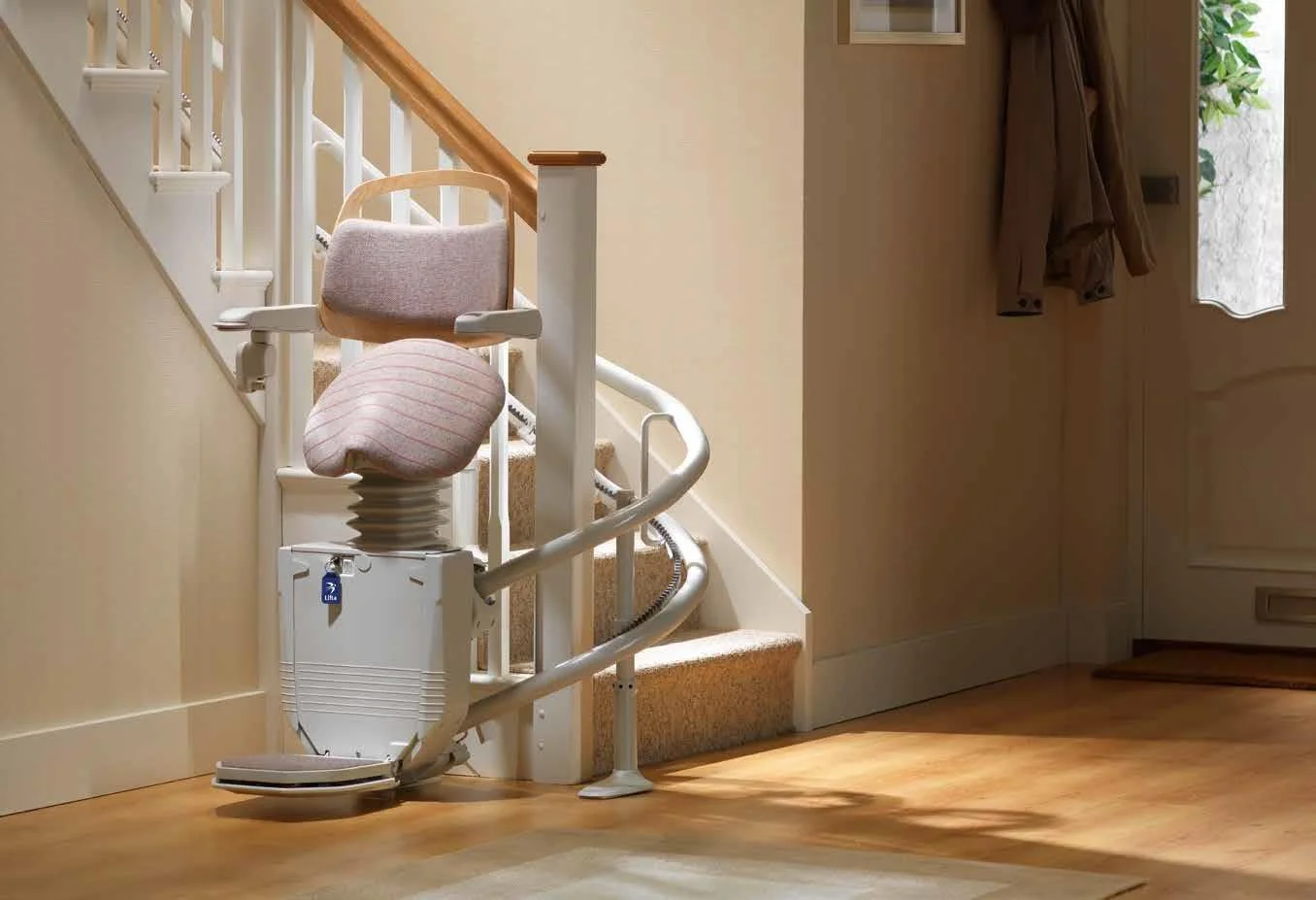
Not every house is that simple. Stairs with a landing, a turn or a winder at the top need a curved rail built to that staircase. We measure on site before recommending either type, because the shape of the stairs decides the lift, not the age of the house.
Mercer County housing also includes split-level homes, townhouses, walk-up apartments and low-rise buildings. A split-level can have several short flights between floors, and each one may need its own lift or a rail that handles the change in direction.
Townhouses often have narrow stairs, so we check the width the rail and folded seat will take up. In a walk-up apartment or low-rise building, the owner or landlord usually has to agree before anything is mounted to the stairs.
Mercer County covers about 683 square miles of rolling Appalachian-plateau terrain along the Shenango River valley. Homes on a slope often have entry steps, a raised porch or a set of stairs down to a lower level, so the trouble does not always start inside the front door.
An outdoor stair lift is built for weather and can handle porch or deck steps. When someone uses a wheelchair and cannot transfer to a seat, a platform lift may be the better fit. We will tell you plainly which one your entry can take.
Out of a population of 99,277, about 22.5% of Mercer County residents are 65 or older, and 72.7% of households own their homes. That combination matters, because owners can usually approve an installation themselves, and most funding programs require proof of ownership or a landlord's consent.
For them, Mercer County Veterans Services at 125 S. Diamond Street, Suite 114, in Mercer can help sort out VA options. Call (724) 662-7511.
Two Pennsylvania Medicaid waivers, Community HealthChoices and the OLTL waivers, list stair lifts among the home modifications they can fund. Amounts are set case by case after an assessment, with no fixed published cap.
If you are 60 or older and not on Medicaid, start with the Mercer County AAA at 133 N. Pitt St. in Mercer, (724) 662-6222. Lower-income owners may also qualify for county housing rehab money that covers removal of architectural barriers. Each program is listed below with its phone number.
A Medicaid waiver for Pennsylvania residents 21 or older who need a nursing-facility level of care (or are dually eligible for Medicare and Medicaid), and stair lifts are on its list of accessibility modifications. Coverage is decided case by case and requires proof of home ownership or a landlord Letter of Consent; call (833) 735-4416.
These Office of Long-Term Living Medicaid waivers offer the same environmental-modification services as CHC, including stair lifts, for residents who meet the clinical and financial criteria. A service coordinator authorizes work based on assessed need; call (800) 757-5042.
A non-Medicaid program for Mercer County residents 60 and older that includes home modifications, medical equipment and assistive devices after a care-manager assessment, sometimes with income-based cost-sharing. The source does not mention stair lifts specifically; call (724) 662-6222 to ask.
Federal grants for veterans and servicemembers with specific severe service-connected disabilities who own or will own the home, with SAH up to $126,526 and SHA up to $25,350 (FY2026). Stair lifts are not itemized but may be funded as part of an approved home-adaptation plan; call (877) 827-3702.
A HUD-funded grant and deferred-loan rehab program for low- and moderate-income owner-occupants that includes removal of architectural barriers, subject to funding and a wait list; stair lifts are not named in the source. Sharon and Hermitage may run separate programs, so confirm your municipality by calling (724) 981-2412.
A Center for Independent Living that does not pay for equipment itself but helps people with disabilities reach home-modification funding through Medicaid waivers and other programs. It is not known whether it handles stair lifts directly; call (724) 652-5144.
Older adults
133 N. Pitt St., Mercer, 16137
Veterans
125 S. Diamond Street, Suite 114, Mercer, 16137
It can, through a waiver. Community HealthChoices and the OLTL Independence, OBRA and Aging waivers both list stair lifts as an accessibility modification, approved case by case based on assessed need. CHC is reached at (833) 735-4416 and OLTL at (800) 757-5042.
Yes, the Mercer County AAA runs OPTIONS in-home services for residents 60 and older, which include home modifications and medical equipment after a care-manager assessment. There may be income-based cost-sharing. Call (724) 662-6222.
Possibly not through the county. MCRPC administers CDBG for Mercer County plus Farrell, Greenville, Grove City, Sharpsville and Pine Township, while larger municipalities such as Sharon and Hermitage may run their own programs. Call MCRPC at (724) 981-2412 to confirm.
Mercer County Veterans Services in Mercer, at (724) 662-7511, is a good first stop. Veterans with qualifying severe service-connected disabilities may apply for SAH or SHA grants at (877) 827-3702, and a stair lift can be included when it is part of an approved adaptation plan.
For most programs, yes. The CHC waiver requires proof of home ownership or a landlord Letter of Consent, the CDBG rehab program serves owner-occupants, and the VA grants require that the veteran own or will own the home.
Usually. Split-level homes may need a lift for each short flight or a curved rail, and porch or entry steps can take an outdoor model. If a seat will not work for the person, we look at a platform lift instead.
Tell us about the stairs in your home and we will explain which lift fits, what it costs and how installation works.
