Tacoma sits anywhere from sea level up to roughly 500 feet, and neighborhoods like Hilltop and North Slope make that climb obvious. Many of the city's older houses were built with multi-story layouts and interior staircases, which become harder to use as owners age in place. Out past the city, places like Puyallup, Bonney Lake, Graham and Orting add newer subdivisions and more rural, hillier lots.
This page walks through how Pierce County's homes and terrain affect which stair lift makes sense, from straight rails in a townhouse to curved rails in a split-level. It also lists the county, state, nonprofit and veteran programs that may help with the cost, and who to call for each.
Tacoma's historic preservation program oversees 165 city landmarks and more than 1,000 historic properties across five overlay zones. That is a lot of early-to-mid-20th-century housing, much of it shaped by architects like Everett Phipps Babcock and Frederick Heath. These homes often put bedrooms and the main bathroom upstairs.
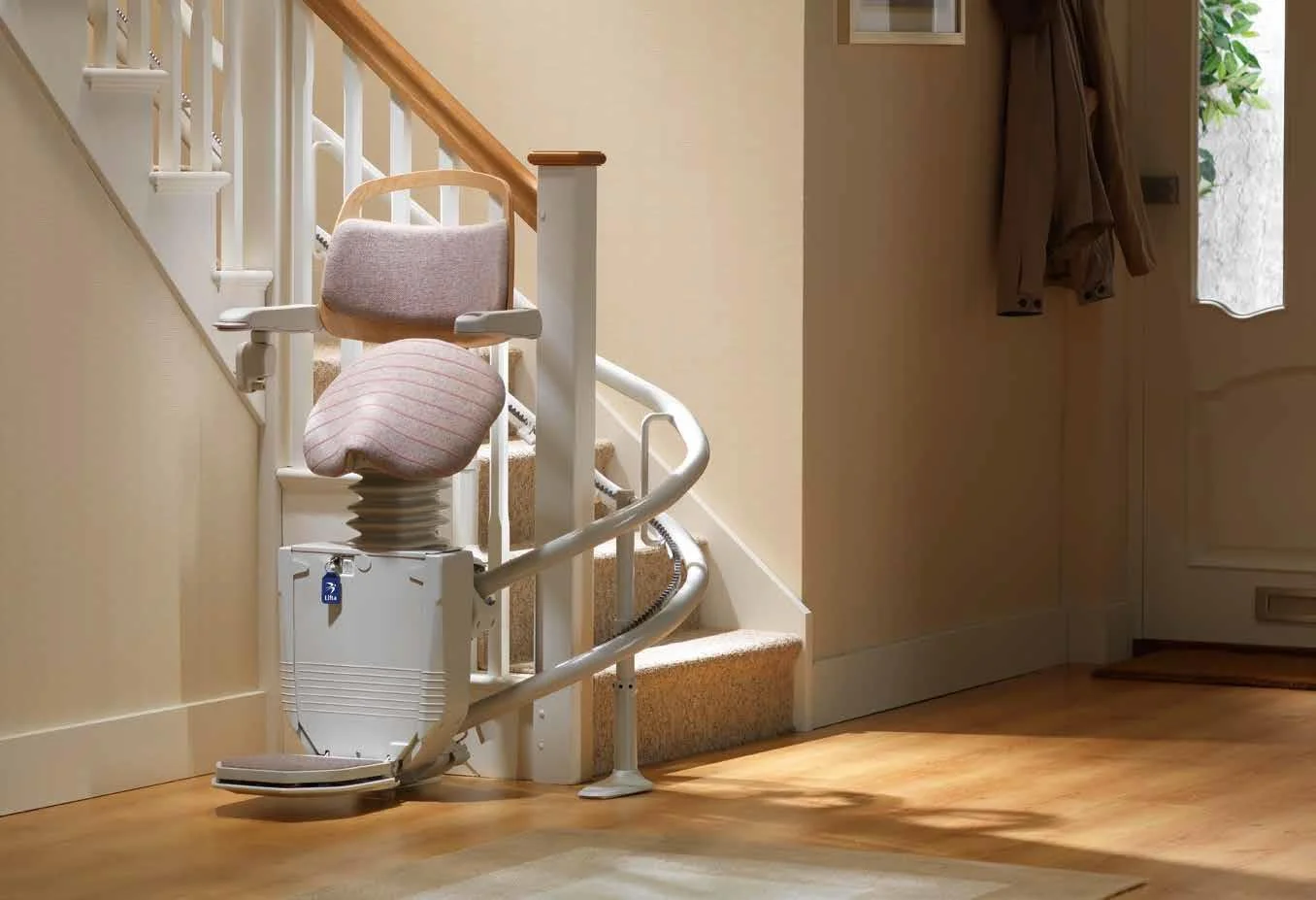
If the staircase runs in one straight flight, a straight stair lift is usually the simplest fit. Older homes often have turns, winders or a landing partway up, and those call for a curved rail built to the exact shape of the stairs. We measure the stairs in person before recommending either one.
Across the county you will find single-family homes, townhouses, walk-up apartments, low-rise buildings and split-level homes. Split-levels are a special case: they have several short flights instead of one long one. Sometimes one short straight lift covers the flight that matters most, and sometimes a curved rail is needed to link two flights.
Townhouses tend to have straight, narrow staircases, which suit a straight lift with a folding seat and footrest. In a walk-up apartment or low-rise building, the stairs are often shared, so the building owner has to approve any installation before work starts.
Pierce County covers 1,805.5 square miles, running from Puget Sound in the west to Mount Rainier, at 14,410 feet, in the east. Homes in the Cascade foothills and on sloped lots often have exterior steps to the front door or a deck, and an outdoor stair lift can handle those. For someone who uses a wheelchair, a platform lift may be the better answer than a seat.
The county's size matters for planning too. Outlying rural areas can add travel time and cost for home-modification contractors, so if you live toward the mountains, ask about this up front when you request a quote.
About 14.8% of Pierce County residents are 65 or older, and 64.4% of households own their homes. Owning the home matters because most funding programs and most installations assume the owner can approve permanent changes.
Those families may be able to combine VA benefits with county, state or nonprofit home-modification help.
No single program here pays for every stair lift, so most families piece together options. The Northwest Access Fund is the one program in this list that names home modifications as a funded category, and it is a low-interest loan, not a grant. Other programs, like the COPES waiver and the VA grants, cover home adaptations but do not name stair lifts, so approval depends on your case.
A good first call is the Pierce County Aging & Disability Resource Center at (253) 798-4600, which can point you to the programs that fit. Veterans can also reach the Pierce County Veterans Program at (253) 798-7449. The full list of programs is below.
A Medicaid in-home services waiver for adults who qualify for nursing-facility-level care but want to stay home; it covers minor home adaptations needed for health and safety, and stair lifts are not named but can be approved case by case by a case manager. Apply through your local Home and Community Services office, which you can find with the DSHS office locator.
A free information and referral service for adults 60 and older, Tribal members 55 and older, people with disabilities and family helping them; it does not fund stair lifts directly but connects you to programs that might. Call (253) 798-4600.
A county grant for low-income homeowners making health-and-safety repairs outside the cities of Tacoma and Lakewood; the source does not mention stair lifts. New applications reopen July 1, 2026.
A state grant for low-income homeowners in eligible rural areas that includes improvements for households experiencing disabilities, though stair lifts are not named. Applicants work through approved rehab agencies, with priority for seniors, people with disabilities and veterans.
A nonprofit that offers low-interest Home Modification Loans to seniors and people with disabilities in Washington, Oregon and Idaho; this is financing that must be repaid. Call (206) 328-5116.
A University of Washington program that lends and demonstrates assistive devices and offers consultation; it does not mention stair lifts or home-modification funding. It is most useful for trying equipment before you decide.
A federal grant of up to $126,526 (FY2026) for veterans with qualifying severe service-connected disabilities to buy, build or modify a permanent home; stair lifts are not named. A Temporary Residence Adaptation of up to $50,961 is also available to those who qualify.
A federal grant of up to $25,350 (FY2026) to help veterans with qualifying service-connected disabilities adapt a permanent home, which can be owned by the veteran or a family member; stair lifts are not named. A Temporary Residence Adaptation of up to $9,100 is available to those who qualify.
Federal loans up to $40,000 and grants up to $10,000 for very-low-income homeowners in USDA-eligible rural areas, with grants limited to those age 62 or older removing health and safety hazards; stair lifts are not named. Check your address on USDA's Rural Development eligibility map.
Older adults
4301 S Pine St., Suite 446, Tacoma, 98409
Veterans
3602 Pacific Ave, Suite 200, Tacoma, 98418
Not always. Split-levels have several short flights, and if the one you use most is straight, a straight lift may work. If you need to connect two flights with a turn, a curved rail is usually required.
The Pierce County Aging & Disability Resource Center serves adults 60 and older, but also people with disabilities of any age and Tribal members 55 and older. The Northwest Access Fund lends to people with disabilities as well as seniors. Call the ADRC at (253) 798-4600 to sort out options.
No. That program serves areas outside the cities of Tacoma and Lakewood, which run their own separate home-repair programs. New county applications reopen July 1, 2026.
The VA SAH and SHA grants help veterans with qualifying service-connected disabilities adapt their homes, though the VA source does not name stair lifts. The Pierce County Veterans Program at (253) 798-7449 can help you check eligibility.
Yes, outdoor stair lifts are built for exterior steps to a door or deck. If you live in a rural part of the county, expect that travel time may add to the cost, and ask about it when you request a quote.
The COPES waiver covers minor home adaptations needed for health and safety, and a case manager can approve a stair lift case by case. You must be Medicaid-eligible and qualify for nursing-facility-level care, and you apply through your local Home and Community Services office.
Tell us about the stairs in your home and we will explain which lift fits, what it costs and how installation works.
