Bertie County has some of the oldest houses in North Carolina. The county was formed in 1722 from Chowan County, and its plantation-era homes, such as Hope Plantation, the 1763 King-Bazemore House and the 1858 'Windsor Castle' house in Windsor, sit alongside newer rural housing across Aulander, Lewiston Woodville, Roxobel, Colerain and Kelford.
That mix matters when someone in the family starts having trouble with the stairs. An original staircase in an older home, a split-level house and a manufactured home on a rural lot each call for a different kind of lift and a different way of mounting it. This page walks through what to expect in Bertie County homes and where to look for help paying for the work.
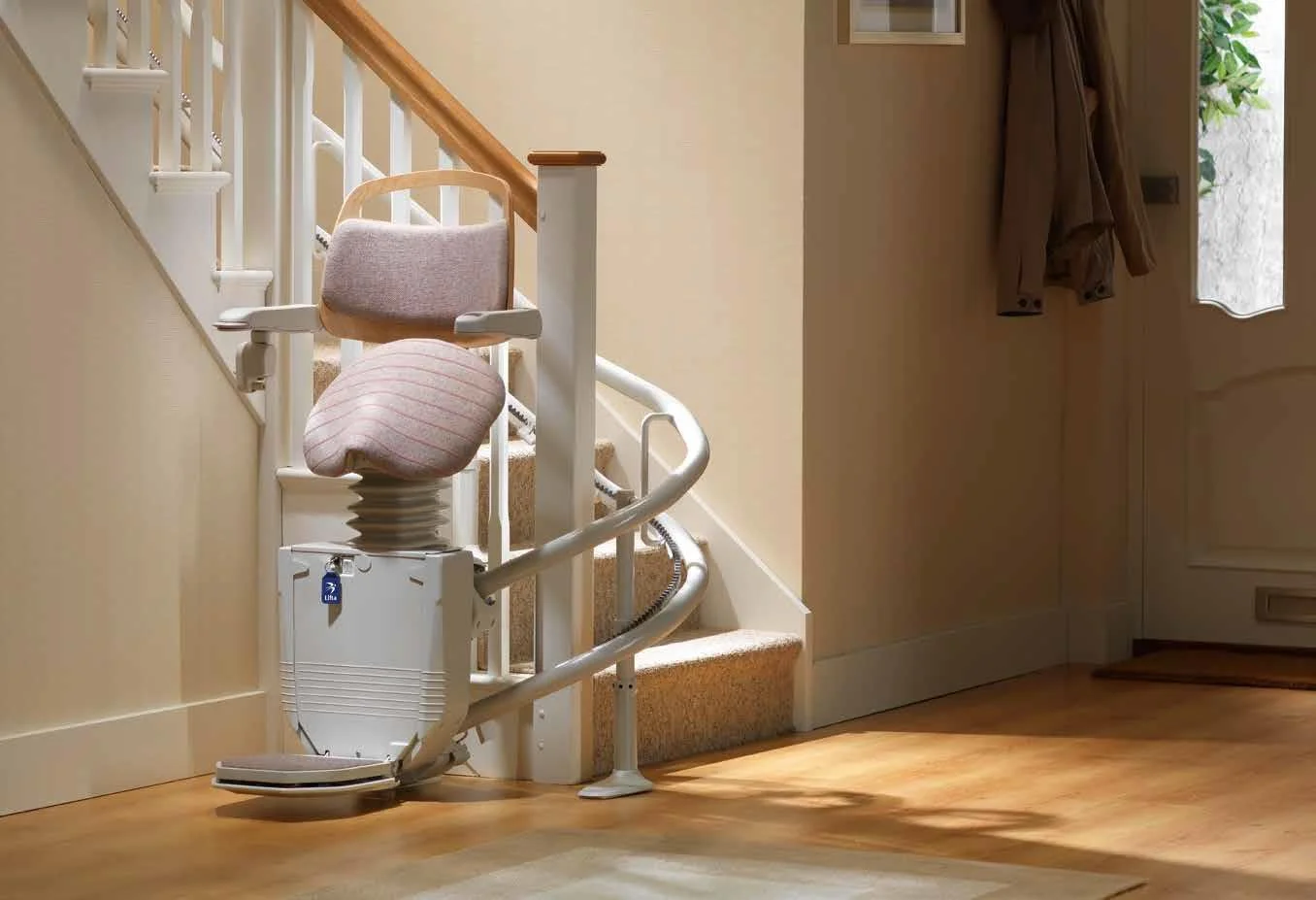
Historic homes with their original stairways are the ones most likely to need a stair lift retrofit here. Older staircases are often narrow, steep or turn partway up, so a straight rail may not fit. In those cases a curved lift, built to follow that specific staircase, is usually the answer.
Before quoting anything, we measure the stair width, the turns and the landings at the top and bottom. If the stairs run straight from floor to floor, a straight lift is simpler and faster to install.
Much of the county's housing is single-family and detached, including ranch-style and split-level homes. A ranch house may only have steps at the entry or down to a basement, while a split-level often has short flights between levels. Each short flight can be looked at on its own to see if a lift makes sense there.
Manufactured and mobile homes are common in Bertie County's rural housing mix. These usually need a different mounting approach than site-built homes, such as a reinforced installation or an outdoor-rated stair lift on the entry steps. We check how the steps are built and attached before recommending a model.
Bertie County sits on flat, low-lying ground in the northeastern Coastal Plain, bordered by the Roanoke, Chowan and Cashie Rivers. Flat terrain generally makes it easier to build an exterior ramp, so for a few entry steps a ramp is worth comparing with an outdoor stair lift or a platform lift.
The county covers about 699 square miles, and homes are spread out. That dispersed pattern affects how far installers and aging-services staff travel to reach people, so it helps to plan the home visit and any follow-up service ahead of time.
About 22.4 percent of residents are 65 or older, and the median age is 46.6. About 64.1 percent of residents own their homes, and some VA grants require home ownership.
Median household income was $48,750 in 2024, with a poverty rate of 16.1 percent. For many families, that makes no-cost or low-cost programs an important first step before paying out of pocket.
None of the programs below names stair lifts in its official materials, and one, the VA HISA grant, specifically excludes stair glides. Some do cover home accessibility work in general, so it is worth asking each one directly how they would handle a stair lift request.
For local guidance, the Region Q - Mid-East Commission AAA in Washington can be reached at (252) 974-1835. Veterans can start with the Bertie County Veterans Service Office at 106 Dundee Street in Windsor, (252) 794-5304. North Carolina also offers the Elderly or Disabled Property Tax Homestead Exclusion (G.S. 105-277.1), which is separate from modification funding but may ease household costs.
A Medicaid waiver for adults 18 and older who meet a nursing-facility level of care and want to stay in their home; it lists 'Home accessibility and adaptation' as a covered service but does not name stair lifts, and new requests may go on a statewide waitlist. Call (888) 245-0179, or NCLIFTSS at 833-522-5429 to check a waitlist position.
A lifetime grant of up to $6,800 or $2,000, depending on disability status, for veterans enrolled in VA health care with a VA prescription for home alterations. It does not fund stair lifts, since the VA excludes stair glides, but it can cover permanent changes like ramps, bathroom modifications and widened doorways.
Grants for homeowners with qualifying severe service-connected disabilities, up to $126,526 for SAH and $25,350 for SHA in FY2026; the VA page gives ramps and wider doorways as examples and does not name stair lifts. Call (800) 827-1000.
A services-based program for North Carolina residents with a permanent physical disability that covers home modifications such as ramps, accessible bathrooms and wider doors, decided case by case; stair lifts are not named. Call (800) 662-7030.
Older adults
1502 N. Market St., Suite A, Washington, 27889
Veterans
106 Dundee Street, Windsor, 27983
Often, yes. Older stairways that turn or have landings usually need a curved lift built to fit, while a straight run can take a standard straight lift. A measurement at the home settles which one works.
Manufactured and mobile homes typically need a different mounting approach than site-built homes, such as a reinforced installation or an outdoor-rated lift on the entry steps. We look at how the steps are built before recommending anything.
The VA HISA grant does not, because it lists stair glides as excluded equipment. The SAH and SHA grants do not name stair lifts either. The Bertie County Veterans Service Office in Windsor, (252) 794-5304, can help a veteran sort out which benefits apply.
The CAP/DA waiver covers 'Home accessibility and adaptation' for adults 18 and older who meet a nursing-facility level of care, though stair lifts are not named and there may be a waitlist. Call (888) 245-0179 to ask.
Bertie County's flat terrain generally makes exterior ramps easier to build, so for a few entry steps a ramp is worth comparing with an outdoor stair lift or platform lift. Some programs, such as VA HISA, fund ramps even though they do not fund stair lifts.
The Region Q - Mid-East Commission AAA, at 1502 N. Market St., Suite A in Washington, serves the area. Their number is (252) 974-1835.
Tell us about the stairs in your home and we will explain which lift fits, what it costs and how installation works.
