Wake County covers 12 towns, from Raleigh and Cary out to Wendell, Rolesville and Zebulon. Much of the housing came with the suburban growth that spread outward from Raleigh, so many families live in single-family homes, townhouses and split-level homes where the bedrooms sit up a flight or two of stairs.
This page walks through how those homes and the county's rolling Piedmont ground affect the kind of stair lift that makes sense. It also lists the county, state, nonprofit and federal programs that Wake County homeowners can ask about when it comes time to pay.
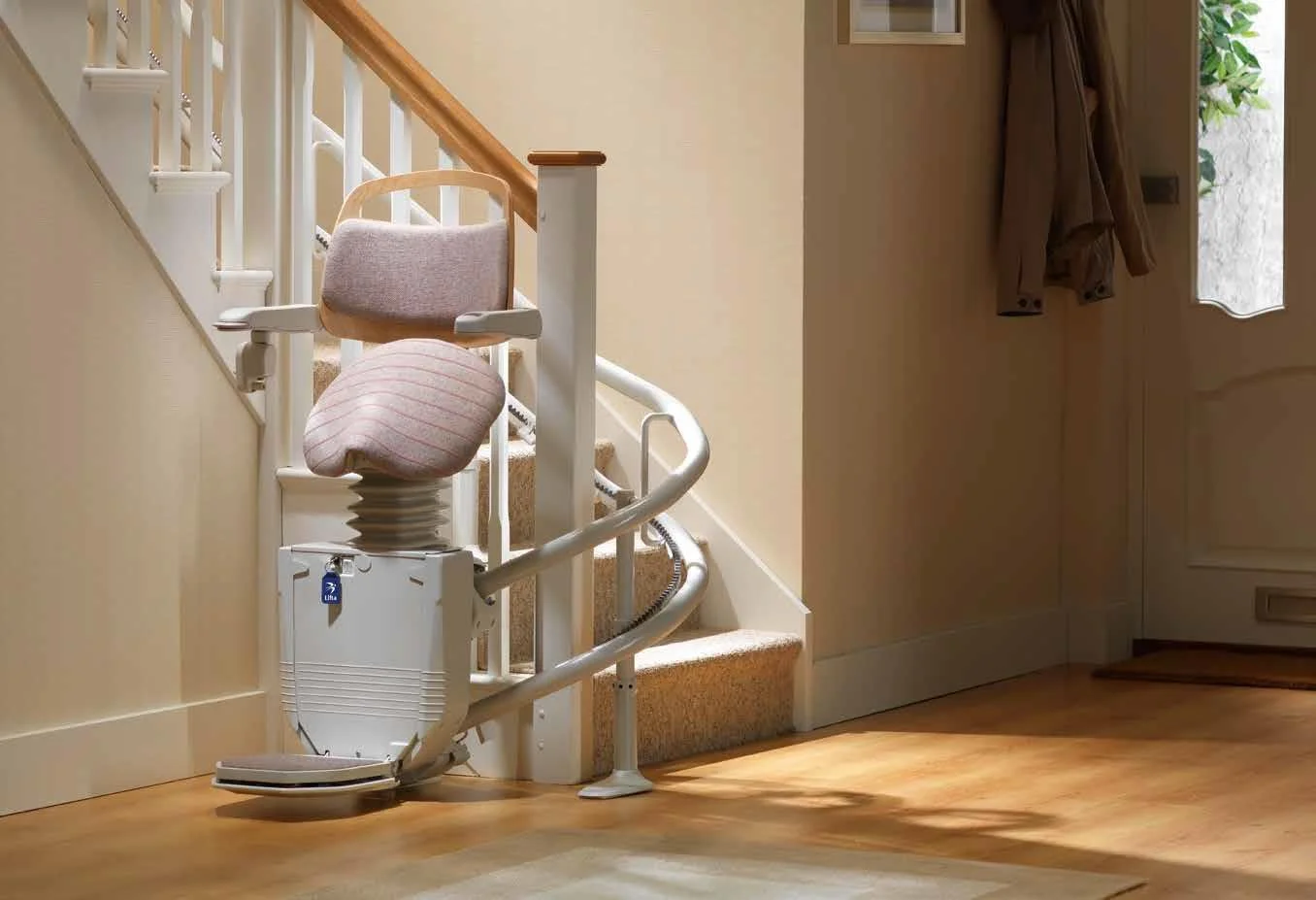
Split-level homes are common here, and they often have short runs of stairs between levels. Each run may need its own lift, so we measure every flight you actually use day to day rather than just the main staircase.
Townhouses in places like Morrisville, Apex and Holly Springs tend to stack living space on several floors. A straight stair lift fits many of these staircases, while a stair with a landing or turn calls for a curved rail built to that exact shape.
Walk-up apartments and low-rise buildings are a different case. Shared stairways usually belong to the building owner, so any lift there starts with a conversation with the landlord or association.
Wake County sits in the Piedmont, with gently rolling hills that slope east toward the coastal plain. On sloped lots, the trouble spot is often the front or back steps outside, not the stairs inside.
Winters bring about 7 inches of snow a year and occasional damaging ice storms in most winters. If outdoor steps are the problem, an outdoor-rated stair lift or a platform lift built for the weather is worth discussing, since icy steps are a real fall risk for anyone aging in place.
Roughly 60.7% of households own their homes, and the 2020 Census counted 61.6% of the county's 462,582 housing units as owner-occupied.
The county's own housing materials describe Wake as one of the fastest growing communities in the United States, with affordable housing not keeping pace. That is part of why local repair programs focus on keeping existing homeowners safe in the homes they already have.
None of the local or state programs below name stair lifts on their program pages, and one VA grant rules them out. Several do cover mobility upgrades, accessibility improvements or modifications that help you remain in your home, so it is worth calling and asking directly.
A good first call for anyone 60 or older is Resources for Seniors at (919) 872-7933 or the Wake County Housing Affordability and Community Revitalization office at (919) 856-5906. Veterans can start with the Wake County Veterans Service Office at (919) 212-8387, 4401 Bland Road in Raleigh.
Statewide, North Carolina also offers the Elderly or Disabled Property Tax Homestead Exclusion (G.S. 105-277.1), the NC Innovations Waiver and the Community Alternatives Program for Children (CAP/C). These are not stair lift programs, but they may help a household's overall budget or care plan.
A one-time grant up to $20,000 for homeowners age 62+ and/or disabled with income at or under 50% of area median income, covering repairs like ramps, wider doorways and other modifications to help you stay home; stair lifts are not named. Call (919) 856-5906.
A no-interest deferred loan up to $90,000, forgiven at 10% per year over 10 years, for owners with a 640+ credit score and income at or under 50% of area median income; it covers mobility upgrades generally but does not name stair lifts. Call (919) 856-5906.
A Medicaid waiver for adults 18+ who need nursing-facility level of care, with an 'Equipment, modification and technology' service category, though stair lifts are not named and Wake County has a waitlist for slots. Call (833) 522-5429.
Up to $7,000 per person per program year for residents 60+ with no one able to do the work for them, including mobility and accessibility improvements; stair lifts are not named. Call (800) 662-7030.
A Wake County nonprofit at 1110 Navaho Drive, 4th Floor, Raleigh, that handles ramps, grab bars and minor safety repairs for residents 60+, with cost shared based on income; stair lifts are not mentioned. Call (919) 872-7933.
Grants up to $10,000 for owners 62+ and loans up to $40,000 for low-income owners in rural areas, which excludes Raleigh, Cary, Garner and Apex but may include towns like Wendell and Zebulon; stair lifts are not named. Call the Smithfield Sub Area Office at (919) 934-7156.
An interest-free deferred loan, forgiven at $5,000 per year, for elderly or special-needs owners at or under 50% of area median income facing a life-safety emergency; it can pay for accessibility modifications, though stair lifts are not named. Call (919) 877-5700.
A lifetime benefit of $6,800 or $2,000 for medically justified home changes, but the VA explicitly excludes stair glides and porch lifts, so it does not pay for a stair lift. Apply through your local VA Prosthetic and Sensory Aids Service.
Up to $126,526 (FY2026 maximum) for veterans with certain severe service-connected disabilities to buy, build or modify a permanent home; stair lifts are not listed. The Wake County Veterans Service Office at (919) 212-8387 can help with applications.
Up to $25,350 (FY2026 maximum) for veterans with qualifying disabilities such as loss of use of both hands or severe burns; stair lifts are not named. A related Temporary Residence Adaptation grant can help modify a family member's home.
An information, referral and options counseling office for older adults and caregivers in the seven-county region including Wake County; it does not fund stair lifts directly but points residents to local providers. Call (800) 310-9777 or locally (919) 558-2708.
An interest-free deferred loan, typically up to $30,000 and forgiven after 5 years, run by Preserving Home for owners of 10+ years in targeted Raleigh areas with income between $60,385 and $113,880; it installs accessibility measures but does not name stair lifts. Call (919) 336-5200.
Older adults
1307 Glenwood Ave., Suite 200, Raleigh, 27605
Veterans
4401 Bland Road, Raleigh, 27609
The HISA grant does not; its official page excludes stair glides and porch lifts. The SAH and SHA grants cover home modifications but do not list stair lifts, so call the Wake County Veterans Service Office at (919) 212-8387 to talk through your situation.
Yes, some. NC Medicaid CAP/DA serves adults 18 and older, USDA Section 504 loans have no age minimum, and the Wake County Major Repair Loan does not list an age requirement.
They may. USDA Section 504 is limited to rural areas under 35,000 people, which excludes Raleigh, Cary, Garner and Apex, but smaller towns such as Wendell and Zebulon may qualify. Call the Smithfield office at (919) 934-7156 to check your address.
If the steps you struggle with are outside, an outdoor-rated stair lift or platform lift is worth considering. Wake County gets about 7 inches of snow a year and occasional damaging ice storms, which makes exterior steps a common hazard.
Usually, yes. Split-levels may need a lift on more than one short flight, and townhouse stairs with a turn or landing need a curved rail instead of a straight one.
If you are 60 or older, Resources for Seniors at (919) 872-7933 handles home repairs and can refer you to larger programs. The Central Pines Area Agency on Aging at (800) 310-9777 can also point you to the right local provider.
Tell us about the stairs in your home and we will explain which lift fits, what it costs and how installation works.
