Walk the historic districts in the City of Wilson, along West Nash Street or through East Wilson, and you see the two-story Queen Anne and Colonial Revival houses built during the tobacco boom of the 1900s-1930s. Many of them put every bedroom and the main bathroom upstairs, reached by a single interior staircase. The story-and-a-half bungalows from the same era often work the same way.
Out past the city, in Elm City, Lucama, Stantonsburg, Black Creek, Sims and Saratoga, the homes and the distances change. This page explains how Wilson County's houses and layout affect the kind of stair lift that fits, and which programs may help with the cost.
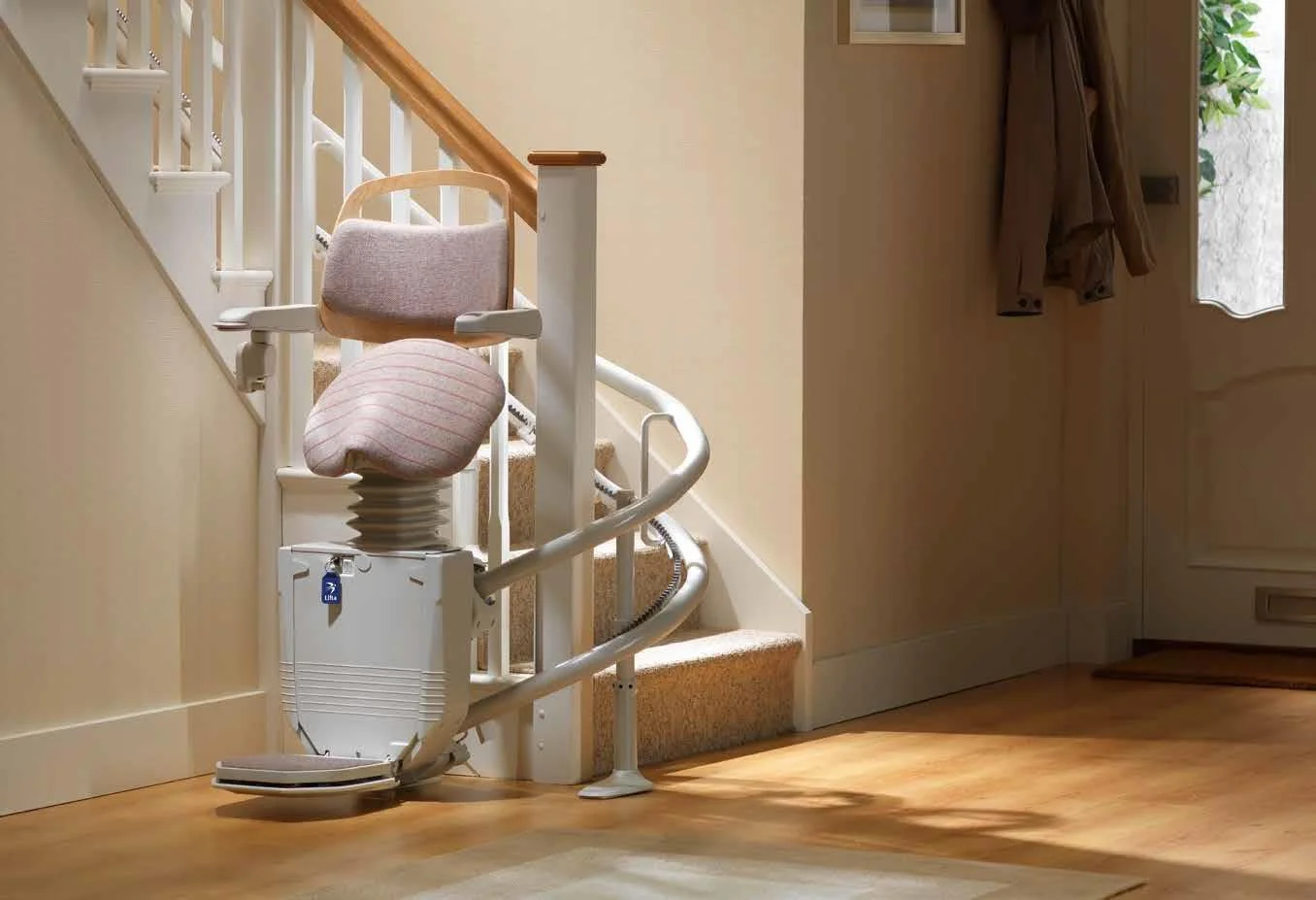
In a tobacco-era Queen Anne or Colonial Revival house, the staircase is often the only way to reach the bedrooms. If climbing it has become hard, the choice is usually between moving downstairs for good or adding a lift.
A straight stair lift fits a staircase that runs in one line from bottom to top. Many older houses have a landing, a turn or winder steps partway up, and those need a curved rail built to the exact shape of the stairs. Story-and-a-half bungalows can have steep, narrow stairs, so we measure the width and pitch before recommending a model.
After World War II, Wilson grew with one-story brick-veneer Ranch houses, like those in the Montclair neighborhood. A Ranch house may not need an indoor lift at all, but a few steps at the front or back door can still be a daily obstacle. An outdoor lift or a platform lift can handle that.
Split-level homes put short flights of stairs between each level, so a person may face stairs several times a day. Townhouses usually have one main staircase that suits a straight or curved lift. Walk-up apartments have shared stairwells, so the building owner has to approve any installation.
About 52,378 people live in the county, and 17.8% are 65 or older. That is a large share of households where stairs start to matter, especially in the older two-story homes.
Just under half of residents, 49.8%, own their homes. Renters should talk with the landlord early, since an owner's permission is needed for a lift.
Wilson County sits in the Coastal Plain of eastern North Carolina, with generally flat land drained by Contentnea Creek and Black Creek. Flat ground means outdoor lifts usually deal with porch and entry steps rather than long hillside runs.
The county covers 367.57 square miles of land. In the 2020 Census, 62.1% of residents lived in urban areas, mostly the City of Wilson, and 37.9% in rural areas. For rural households, it helps to plan service and follow-up visits ahead of time, because contractors and in-home providers cover a lot of ground.
Most programs listed below do not name stair lifts directly. They fund home modifications, accessibility repairs or referrals, and whether a lift qualifies is decided case by case. The VA HISA grant is the one exception that is clear: it does not cover stair glides.
A good first call is the Upper Coastal Plain Area Agency on Aging, which serves Wilson County and can point you toward Medicaid waiver and home-repair referrals. Veterans can start with the Wilson County Veteran Service Office at 1901 Tarboro Street SW, Suite 202, Wilson, phone (919) 664-1185. North Carolina also has the Elderly or Disabled Property Tax Homestead Exclusion (G.S. 105-277.1), which is a property tax program rather than a lift fund.
This NC Medicaid home and community-based waiver serves Medicaid-eligible adults 18 and older who need a nursing-facility level of care, and it includes an Equipment, Modification and Technology category. Stair lifts are not listed by name, so ask a case manager to confirm coverage at (888) 245-0179.
Wilson County's Area Agency on Aging connects older adults, caregivers and people with disabilities to mobility, housing and in-home service programs; it does not list stair lift funding. Call (252) 234-5952.
Very-low-income homeowners in USDA-eligible rural areas can get loans and grants combined up to $50,000, with grants of up to $10,000 lifetime limited to homeowners 62 and older who cannot repay a loan. It funds health, safety and accessibility repairs but does not name stair lifts, and eligibility depends on the specific address.
HISA pays up to $6,800 or $2,000 lifetime for medically necessary home changes for enrolled VA patients, but the VA explicitly excludes stair glides. Call (919) 286-0411 with questions about other modifications.
These grants fund larger structural adaptations for veterans with specific severe service-connected disabilities, up to $126,526 for SAH and $25,350 for SHA in FY2026. Stair lifts are not mentioned specifically; call (919) 286-0411.
This Raleigh-based Center for Independent Living offers advocacy and help navigating services for people with disabilities in Wilson County, which can include home-modification referrals. No stair lift fund is listed; call (919) 833-1117.
Older adults
121 W. Main St., Williamston, 27892
Veterans
1901 Tarboro Street SW, Suite 202, Wilson, 27893
Usually, yes. A staircase with a landing or turn needs a curved rail made to fit those exact stairs, rather than a straight lift. A measurement at the home tells us which option works.
The VA HISA grant does not, because the VA excludes stair glides from it. The SAH and SHA grants fund broader adaptations for veterans with certain severe service-connected disabilities and do not mention stair lifts, so ask the Wilson County Veteran Service Office at (919) 664-1185 about your situation.
The USDA Section 504 program offers grants up to $10,000 lifetime to very-low-income homeowners 62 and older in eligible rural areas, plus loans. It does not name stair lifts, so check your address and ask whether your project qualifies.
The CAP/DA waiver covers equipment, modifications and technology for eligible adults, but stair lifts are not itemized. Coverage is confirmed case by case with a case manager; the number is (888) 245-0179.
The Upper Coastal Plain Area Agency on Aging serves Wilson County and can advise on waivers and home-repair referrals at (252) 234-5952. The Region L office is at 121 W. Main St., Williamston, phone (252) 234-5955.
Many one-story Ranch houses only have steps at the entry. In that case an outdoor lift or platform lift at the porch may be the better fit than an indoor stair lift.
Tell us about the stairs in your home and we will explain which lift fits, what it costs and how installation works.
