Sedgwick County sits in the far northeastern corner of Colorado along the Nebraska border, with the South Platte River running through about 548 square miles of flat plains. Most homes are clustered in Julesburg, the county seat, and in Ovid and Sedgwick, and the Census Bureau counts the whole county as 100.0% rural.
Much of the housing here is older farmhouses and single-story ranch homes built in the plains style. A one-level layout helps, but it rarely removes every step. Basement stairs, a split-level half flight, or porch steps at the back door can still stand between a parent and the laundry, the freezer, or the car.
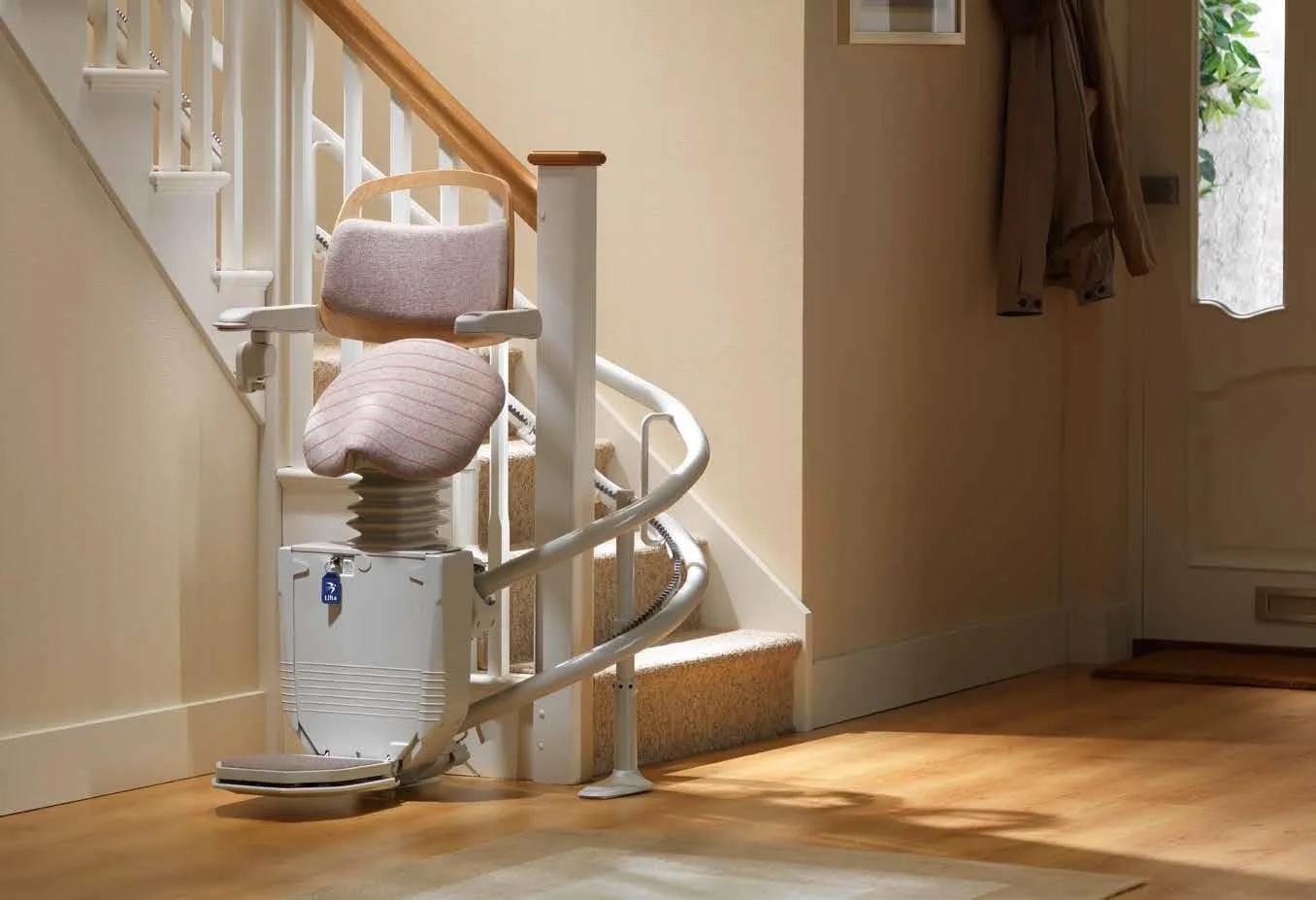
The county has 1,214 housing units, and a lot of them are ranch-style homes, split-level homes and older farmhouses. Each one tends to lead to a different kind of lift.
A ranch home with a straight basement staircase is usually the simplest job. A straight rail mounts to the stair treads, not the wall, so plaster and old paneling stay as they are.
Split-level homes often have short flights in two directions. Sometimes two straight lifts work; sometimes a single curved rail that follows the turn is the better fit. Older farmhouses can have narrow or turning stairs that call for a curved lift built to the exact measurements of that staircase.
Out here the problem is often outside the house. Steps up to a porch or a raised entry can be harder to manage than anything indoors, especially in wind, rain or snow.
Outdoor stair lifts are built with weather-resistant parts and covers for that reason. Where a wheelchair needs to come along, a vertical platform lift can be an option instead of a long ramp across the yard. We look at the entry, the ground and the path to the driveway before recommending either.
About 22.8% of Sedgwick County residents are 65 or older, and 66.1% of households own their homes. For homeowners planning to stay put, a lift is often a way to keep using the whole house rather than moving.
If that includes someone in your family, the Sedgwick County Veteran Service Officer at 118 W 3rd St in Julesburg, (719) 691-5445, can help sort out which VA benefits apply.
Agriculture and ranching drive the local economy, and median household income is about $52,386, roughly half the Colorado figure. With a poverty rate near 13.1%, many families here look for outside help before paying out of pocket.
None of the programs below names stair lifts as a covered item, and one VA program specifically excludes them. Several do fund accessibility work for rural homeowners, so it is worth calling before any work starts and asking directly whether a lift can be approved.
The Northeastern Colorado AAA in Fort Morgan, (970) 867-9409, is a good first call for older residents. Statewide, you can also ask about the Assistive Technology Act Program of Colorado (AT Partners) and the Colorado Senior Property Tax Exemption (Senior Homestead Exemption).
A Medicaid waiver benefit that pays for medically necessary modifications such as ramps, grab bars, walk-in shower conversions and doorway widening for people who need a nursing-facility level of care. Stair lifts are not listed, so confirm coverage and the current cap with your Case Management Agency; call (800) 221-3943.
Offers very-low-income rural homeowners loans up to $40,000 at 1% for 20 years, and grants up to $10,000 for those age 62+, for repairs and accessibility improvements. Stair lifts are not named in the source, so ask the northeast Colorado Rural Development office at (970) 399-8198.
Pays for medically needed home improvements for eligible veterans, up to $6,800 or $2,000 lifetime depending on disability status. This program explicitly excludes stair glides, so it will not pay for a stair lift.
Grants of up to $126,526 (SAH) or $25,350 (SHA) in 2026 for veterans with qualifying severe service-connected disabilities to make permanent home adaptations. Stair lifts are not named among covered adaptations, so check eligibility through the county Veteran Service Officer.
A regional nonprofit serving low-income homeowners in Sedgwick County and five neighboring counties with home rehabilitation loans, and a listed provider for Medicaid home modifications. Stair lifts are not specifically named; call (970) 542-1221 to ask.
Older adults
231 Main St., Suite 211, Fort Morgan, 80701
Veterans
118 W 3rd St, Julesburg, 80737
Often, yes. Many ranch homes in Sedgwick County still have basement stairs or steps at the entry, and those are common places for a straight or outdoor lift.
Not through HISA, which explicitly excludes stair glides. The SAH and SHA grants do not name stair lifts either, so talk with the Sedgwick County Veteran Service Officer at (719) 691-5445 about your specific case.
The USDA Section 504 program offers grants up to $10,000 for very-low-income homeowners age 62+ in rural areas, and Sedgwick County qualifies. Stair lifts are not named, so ask the field office at (970) 399-8198 before starting work.
The Health First Colorado home modification benefit lists ramps, grab bars, shower conversions and doorway widening, not stair lifts. Coverage is decided case by case through your Case Management Agency, so confirm before any installation.
The Northeastern Colorado AAA in Fort Morgan at (970) 867-9409 can point you toward local aging services. Northeast Colorado Housing, Inc. at (970) 542-1221 also serves Sedgwick County homeowners.
Tell us about the stairs in your home and we will explain which lift fits, what it costs and how installation works.
