Boulder County is really two places. Most people live on the eastern plains and foothills in cities like Boulder, Longmont, Lafayette, Louisville and Superior, while the western mountain region around Nederland, Lyons, Allenspark, Jamestown and Gold Hill has only 24.1 people per square mile, compared with 414.5 countywide. The stairs we see in a Gunbarrel townhouse and the stairs we see in a Sugarloaf or Pine Brook Hill home are rarely the same job.
About 15.1% of the county's 294,289 residents are 65 or older, and many of them plan to stay in the homes they already own. This page walks through how local housing affects which stair lift fits, and which state, federal and county programs can help with the cost.
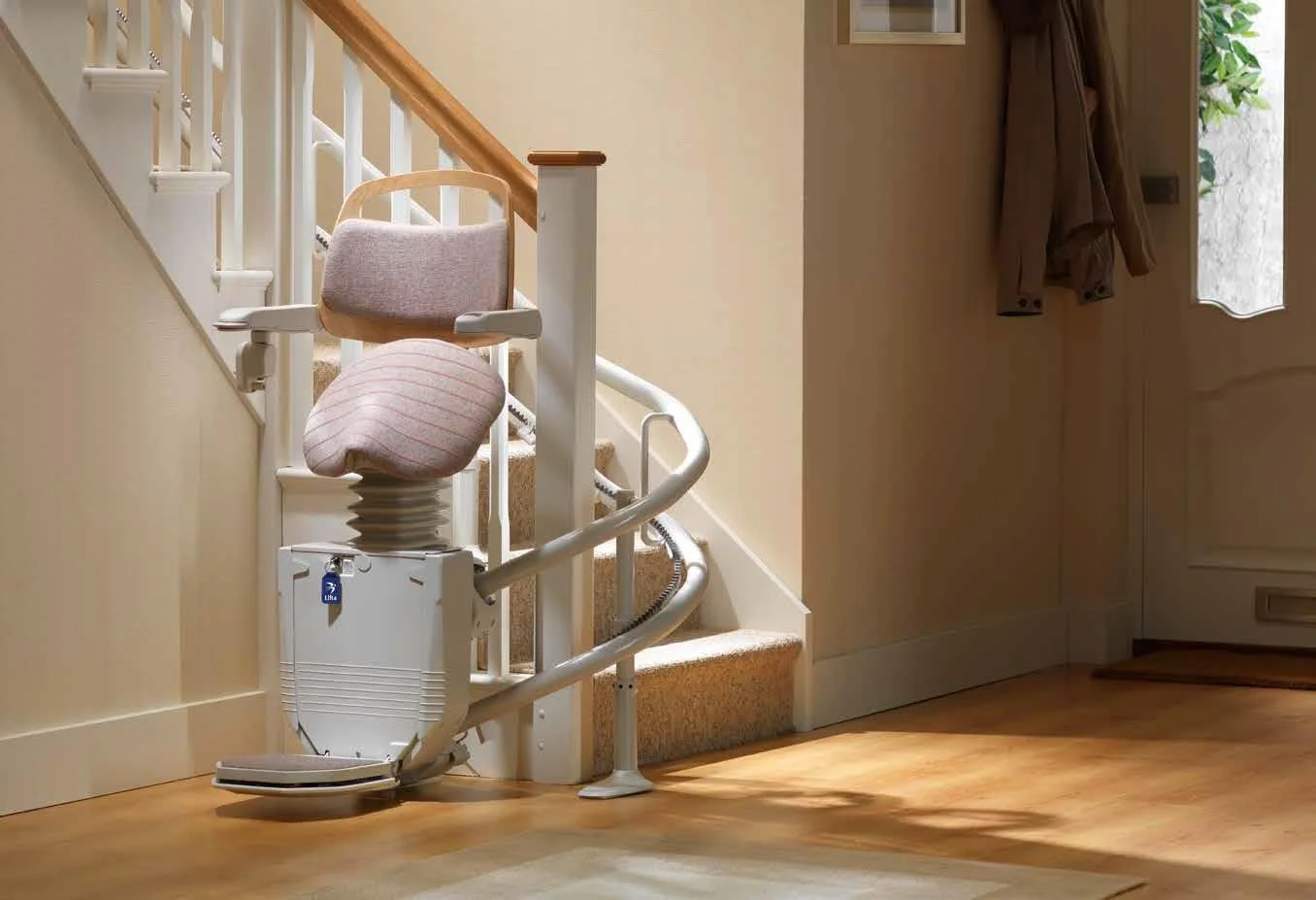
In the eastern cities, most stairs are indoors and run between two floors of a single-family home or townhouse. A straight stair with no turns usually takes a straight rail lift, which is the simplest and quickest kind to install.
Mountain communities add complications. Homes are spread out, weather is unpredictable, and getting from the driveway to the front door can mean exterior steps. An outdoor-rated lift or a platform lift may make more sense there than an indoor model alone.
Distance matters too. Among mountain residents 65 and older, 34.4% live alone and 21.1% have a disability, and 25.6% of mountain-area survey participants named transportation as their top safety concern. A lift that lets someone use the whole house without help is often part of a bigger plan to stay put safely.
Split-level homes are common here, and they are tricky. Instead of one long flight, you often have two or three short runs of steps between levels. Depending on the layout, that can mean a curved rail that follows the turns or more than one straight lift.
Townhouses often have narrow stairs between floors, so we measure width and clearance carefully before recommending a model. Walk-up apartments and low-rise buildings raise a different question: who owns the stairs. About 59.1% of county households own their homes, so many residents will need the building owner's approval before any lift goes in.
Most existing homes in the county were not built for aging in place. A 2018 Harvard University report cited in local reporting found that fewer than 1% of American single-family homes have a zero-step entry, single-floor living, and wide hallways and doors.
Adding wider doorways, zero-step entries, ramps or barrier-free showers after a home is built can cost thousands of dollars. Housing is already expensive here: Boulder's 2023 housing cost index is 148.7 against a national baseline of 100, above Denver-Aurora-Lakewood at 146.1 and Colorado statewide at 130.5. For many families, a stair lift that keeps the upstairs bedroom usable is a smaller project than reworking the house.
That makes VA benefits worth checking early.
Be aware that the VA HISA grant specifically excludes stair glides. The VA instead provides a stair lift through its Prosthetic and Sensory Aids Service (PSAS) when one is clinically prescribed. Boulder County Veterans Services at 3460 Broadway Street, Boulder, 80304, can help you start that process: call (303) 441-3890.
No single program here is guaranteed to pay for a stair lift, but several are worth asking about. Colorado Medicaid's EBD waiver has a $14,000 lifetime Home Modification Benefit, and the Colorado Home Modification Tax Credit Program offers up to $5,000 back on qualifying modifications. Neither source names stair lifts, so ask directly before you buy.
If you live in an unincorporated mountain area, the USDA Section 504 program may apply, but you must check your address against the USDA eligibility map. For help sorting out options, the Boulder County Area Agency on Aging resource line at (303) 441-1617 is a good first call. Full details on each program are listed below.
A Medicaid waiver benefit with a $14,000 lifetime maximum for home modifications, for people 65+ with functional impairment or 18-64 with a qualifying disability who meet Medicaid financial and Nursing Facility Level of Care criteria. The source does not mention stair lifts; call (800) 221-3943.
A VA grant of up to $6,800 or $2,000 lifetime for medically necessary home alterations, open to homeowners and renters with owner authorization. Stair lifts are not covered: the VA explicitly excludes stair glides and provides them through PSAS when clinically prescribed.
Up to $126,526 (FY2026 maximum) for veterans with severe service-connected disabilities who own or will own the home. The VA gives ramps and doorway widening as examples and does not mention stair lifts either way.
Up to $25,350 (FY2026 maximum) for veterans or qualifying family members with certain service-connected disabilities who own or will own the home. Stair lifts are not named as a covered item.
Loans up to $20,000 at 1% over 20 years, and grants up to $7,500 for homeowners 62+ who cannot repay a loan, for rural owner-occupants at or below 50% of area median income. Repairs must remove a health or safety hazard, stair lifts are not itemized, and you must confirm your address is in an eligible rural area.
A non-refundable state income tax credit of up to $5,000 per household for disability-related modifications completed in tax years 2019 through 2028, with a credit certificate required first. Stair lifts are not named; call (720) 527-0836.
A free, confidential line for older adults, people with disabilities and caregivers offering information, referral, Medicare counseling and veterans services. It does not fund stair lifts itself but can point you to resources; call (303) 441-1617.
A program for income- and asset-qualified homeowners within Boulder city limits, run under contract with the City of Longmont, which has said it is not able to continue operating the program. Stair lifts are not mentioned.
Skilled volunteers do simple home repairs, wheelchair and walker repairs and grab bar installations at no labor fee, with the client paying for supplies. Stair lifts are not mentioned; call (303) 443-1933.
Provides accessibility modifications for people affected by disabilities in eight Denver metro counties including Boulder, based on available funds; it excludes home repairs, elevators and walk-in tubs. Stair lifts are not named either way; call (303) 551-6721.
A Boulder-based independent living center offering information and referral, peer support, skills training and a Veterans Independence Program for people with disabilities of any age. It does not list home modification or stair lift funding; call (303) 442-8662.
Offers device demonstrations, short-term equipment loans and the AT Funding $ources referral database statewide. Stair lifts are not mentioned; call (303) 315-1288.
Older adults
1001 17th Street, Suite 700, Denver, 80202
Veterans
3460 Broadway Street, Boulder, 80304
The EBD waiver's Home Modification Benefit has a $14,000 lifetime maximum, but the source does not list stair lifts as covered or excluded. Ask your Case Management Agency or call (800) 221-3943 before you commit.
Not through the HISA grant, which excludes stair glides. The VA provides stair lifts through its Prosthetic and Sensory Aids Service when clinically prescribed. Boulder County Veterans Services at (303) 441-3890 can help you start.
Unincorporated mountain areas may qualify for USDA Section 504 repair loans and grants, though most of incorporated Boulder County falls outside the eligible boundaries. Check your address on the current USDA eligibility map.
Yes, possibly. The EBD waiver includes adults 18-64 with a physical disability, blindness or HIV/AIDS, and the Center for People With Disabilities serves people of any age at (303) 442-8662.
The credit is up to $5,000 and non-refundable, and the source does not name stair lifts. You need a credit certificate through a prequalification survey before claiming it; call (720) 527-0836 to ask.
The Boulder County Area Agency on Aging resource line at (303) 441-1617 is free and confidential. The Denver Regional Council of Governments AAA is also available at (303) 455-1000.
Tell us about the stairs in your home and we will explain which lift fits, what it costs and how installation works.
