Newark sits where the forks of the Licking River meet, about 40 miles east of Columbus, and its older neighborhoods still show the town's canal and railroad growth. Many homes near the historic downtown and along the Hudson Avenue Historic District were built in the 19th and early 20th centuries, long before single-story ranch houses were common. Out in Pataskala, Johnstown, Etna and the other suburban edges, the homes are newer but often built on more than one level.
That mix is what we see across the county's 22 towns, from Granville and Heath to Utica, Hebron and Buckeye Lake. A stair lift in a tall Newark house with a vintage staircase is a different job from one in a split-level near the Columbus side of the county. This page walks through how local homes affect the choice of lift and which agencies to call about paying for one.
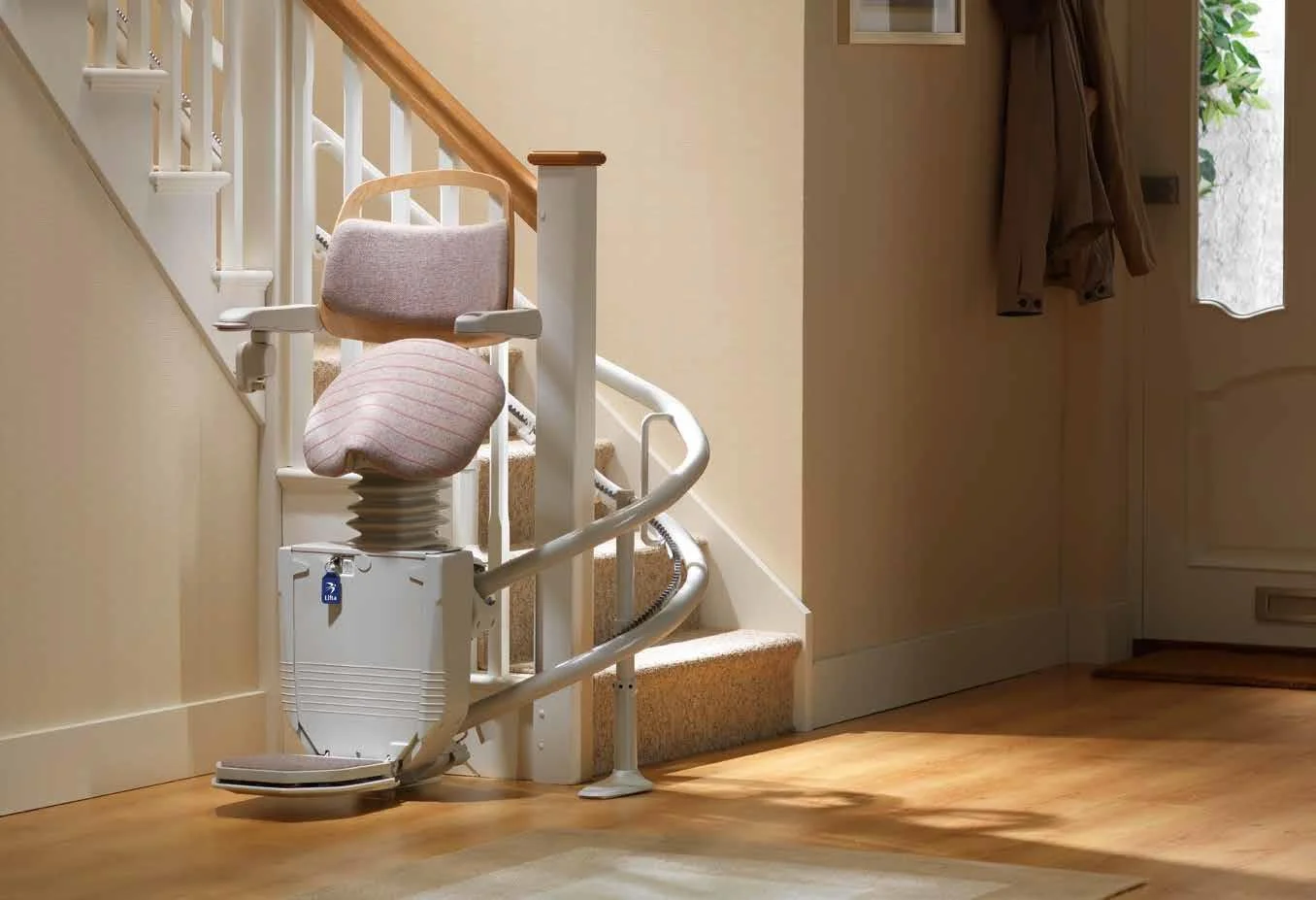
The multi-story houses around Newark's core were built when bedrooms went upstairs as a matter of course. Their staircases can turn at a landing, wind near the top, or have trim and railings that owners want to keep. A straight stair lift only works when the run goes from bottom to top without a bend.
When the stairs turn, a curved lift with a rail made to fit that staircase is usually the answer. We measure the full run, the landings and the space at the top and bottom before suggesting anything, because an older staircase rarely matches a standard size.
Growth in places like Pataskala and New Albany, part of the Columbus Metropolitan Statistical Area, brought newer multi-level homes and townhouses. Many of these have a single straight flight, which is the simplest and usually the quickest lift to install.
Split-level homes are different. They often have two or more short flights, so a family may need to decide which level matters most for daily living, or plan for more than one lift. Townhouse stairs can be narrow, which affects how the seat folds and where the rail sits.
Licking County covers 687 square miles and is the third-largest county in Ohio by land area, with 25 townships and 10 villages. In the rural parts of the county, getting into the house can be as hard as getting upstairs.
An outdoor stair lift is built for weather and can handle porch or deck steps. Where someone uses a wheelchair, a platform lift may make more sense than a seat. We look at the entry steps along with the indoor stairs so nothing gets missed.
About 17.5% of the county's 108,822 residents are 65 or older, and 65.2% of households own their home. Owners can usually install a lift on their own schedule, while renters in walk-up apartments or low-rise buildings will need the landlord's permission first.
If that includes your parent or spouse, the VA programs below are worth a look, though they work very differently from one another.
None of the local or state programs below name stair lifts as a covered item in the sources we reviewed. Several do cover home repairs, disability modifications or safety installations, so it is worth calling and asking directly about a stair lift.
Start with Licking County Aging Partners or LEADS for local help, and the Central Ohio Area Agency on Aging for PASSPORT. Statewide, Ohio also runs the Ohio Home Care Waiver and Ohio HOME Choice (Money Follows the Person), which the aging agency can explain. Veterans can begin at the Licking County Veterans' Service Office at 935 Buckeye Avenue in Newark.
A Medicaid waiver for people 60 and older who need a nursing-home level of care but can stay safely at home, run in Licking County by the Central Ohio Area Agency on Aging. Its listed home modifications include grab bars and ramps, but stair lifts are not named, so ask the care manager; call (614) 645-7250.
In-home help for older adults in the county, including routine maintenance and safety installations such as grab bars. Stair lifts are not listed, but you can ask about a referral or larger modification at (740) 345-0821.
Home repairs at no cost for most income-eligible homeowners, serving seniors 60 and older and LEADS Weatherization households, with disability (ADA) modifications among its categories. Stair lifts are not itemized, so confirm with LEADS at (740) 349-8606.
A countywide housing rehabilitation program for low- and moderate-income homeowners, funded by State of Ohio CHIP and federal CDBG dollars. Accessibility work is not itemized; call (740) 670-5200 for current repair categories and income limits.
Loans up to $40,000 at 1% and grants up to $10,000 for very-low-income homeowners age 62 or older in eligible rural areas, with combined help up to $50,000. Stair lifts are not named, and parts of Newark may fall outside the rural map, so check your address.
A VA health benefit for home improvements tied to a covered disability, with lifetime caps of $6,800 or $2,000. It explicitly excludes stair glides, so it will not pay for a stair lift.
Up to $126,526 (FY2026) for veterans with certain severe service-connected disabilities who own or will own the home. Stair lifts are not named, but the grant funds approved structural adaptations; call (800) 827-1000.
Up to $25,350 (FY2026) for veterans with qualifying disabilities such as loss of use of both hands or certain breathing injuries. Stair lifts are not specifically mentioned; call (800) 827-1000 to ask.
The county office in Newark that helps veterans with VA claims, temporary financial assistance and rides to VA Medical Centers. It does not fund stair lifts directly but can help with SAH and SHA claims; call (740) 670-5430.
A free nonprofit offering information and referral, advocacy, peer support and skills training for any age and any disability in Franklin, Delaware, Union and Licking counties. Home modifications are not listed; contact [email protected].
Older adults
3776 S. High St., Columbus, 43207
Veterans
935 Buckeye Avenue, Newark, 43055
Usually, yes. Stairs that turn at a landing or wind near the top need a curved lift with a rail made to fit that staircase. We measure the whole run before recommending one.
PASSPORT and the LEADS Home Repair Program both name people 60 and older. The Center for Disability Empowerment serves any age and any disability with information and referral, so it is a good place to ask about other options.
Not through HISA, which explicitly excludes stair glides. The SAH and SHA grants fund approved home adaptations for qualifying disabilities and do not rule stair lifts out. The Licking County Veterans' Service Office at (740) 670-5430 can help with those claims.
It may, since Section 504 is limited to eligible rural areas and many rural parts of the county could qualify. Grants are for homeowners 62 or older, and you should confirm your specific address on the USDA map.
None of the sources reviewed name stair lifts specifically. LEADS lists disability (ADA) modifications and LCAP lists safety installations, so call each one and ask whether a stair lift would qualify.
Sometimes. Each separate flight may need its own lift, so it helps to decide which levels matter most for daily living. We can look at the layout and talk through the choices.
Tell us about the stairs in your home and we will explain which lift fits, what it costs and how installation works.
