Drive from the flat tract neighborhoods of central Tucson up into Catalina Foothills or Oro Valley and the houses change. Down in the valley, most homes are single-story ranch or Southwest and adobe-style builds from the desert suburban growth of the mid-20th century. Up on the slopes, split-level and two-story custom homes are common, and that is where most in-home stair lift calls in Pima County come from.
The county stretches across about 9,189 square miles, from Marana and Sahuarita to Green Valley, Vail, Ajo and Sells. This page walks through what local homes and terrain mean for a stair lift, and which programs can help pay for one.
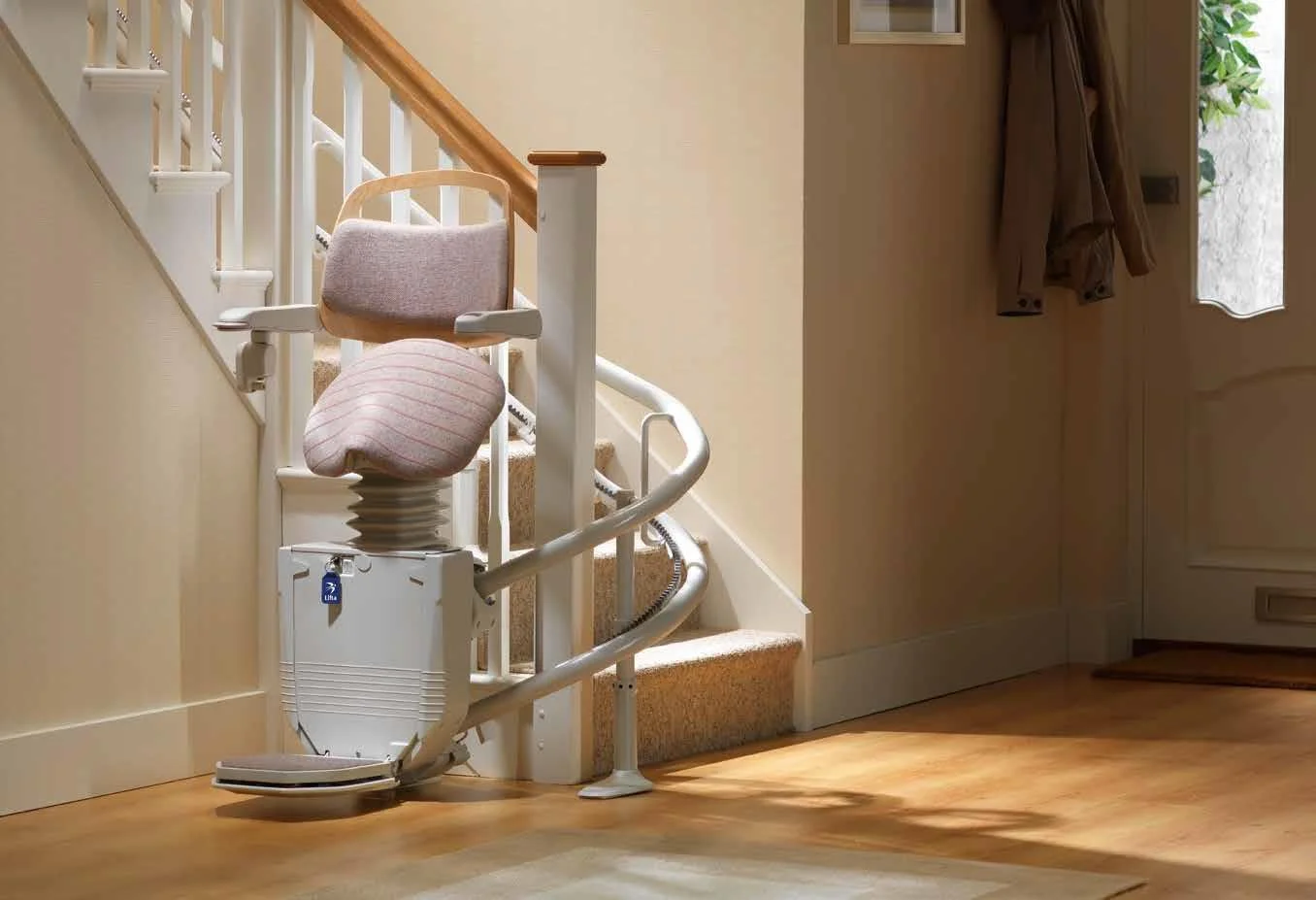
If a parent lives in a single-story ranch in Flowing Wells or Drexel Heights, there may be no indoor stairs at all. The need tends to show up in split-level and two-story custom homes in places like Catalina Foothills and Oro Valley.
A split-level often has a short, straight run of steps between floors, and a straight rail is usually the simplest fit. When a staircase turns or has a landing partway up, a curved rail built to that staircase is the usual answer. We measure first, because the shape of the stairs decides the type of lift.
Pima County runs from roughly 1,200 feet on the desert floor to 9,159 feet at Mount Lemmon in the Santa Catalina Mountains. Tucson sits in a hot desert climate at valley elevation, while the surrounding sky-island ranges can see real winter cold and snow.
Homes on hillside lots in the foothills sometimes have exterior steps from the driveway or patio to the front door. An outdoor stair lift there should be chosen and installed with those elevation-driven temperature swings in mind, from summer heat to colder nights higher up.
Not everyone in the county lives in a detached house. Townhouses, walk-up apartments and low-rise buildings are part of the local mix too, and each raises different questions about shared stairs and who has to approve the work.
About 64.4% of residents own their homes, so many families can make the decision on their own. Renters and owners in shared buildings should check with the landlord or building management before planning an install. Where steps are few but a wheelchair is involved, a platform lift may make more sense than a seat-style lift.
The VA HISA grant pays for ramps and structural changes, not the removable stair lift itself. The lift is covered through VA Prosthetics (PSAS) or the SAH/SHA grant.
For help sorting out benefits, the Kino Veterans' Workforce Center (Pima County Veteran Services / ARIZONA@WORK) is at 2801 E. Ajo Way in Tucson and can be reached at (520) 724-2646.
The program most likely to pay for a stair lift here is the ALTCS Elderly and Physically Disabled (EPD) Waiver, which lists stair lifts as a covered home modification for people who qualify for long-term care. There is no fixed cap; each case is decided under the member's plan.
The Pima Council on Aging home repair program helps lower-income homeowners age 60 and up with items like grab bars, wheelchair ramps and shower chairs, but stair lifts are not named in its materials. Statewide, it is also worth asking about Arizona Loans for Assistive Technology (AzLAT) and the Senior Property Valuation Protection Option (Senior Freeze, AZ Form 104). Details on each county program are listed below.
A statewide Medicaid waiver that covers stair lifts as a home modification to an existing structure for ALTCS-eligible residents who meet nursing-facility level of care and income and asset limits. Amounts are set case by case; call (855) 432-7587.
Minor repair and adaptation help for lower-income Pima County homeowners age 60 and up, with grab bars, wheelchair ramps and shower chairs named as covered. Stair lifts are not listed in its materials, so confirm directly with PCOA at (520) 790-7262.
A federal VA grant for medically needed ramps and structural changes, with a lifetime max of $6,800 or $2,000 depending on service connection. It does not cover the stair lift itself, which goes through VA Prosthetics (PSAS) or the SAH/SHA grant; call (520) 792-1450.
Older adults
8467 E. Broadway Blvd., Tucson, 85710
Veterans
2801 E. Ajo Way, Tucson, 85713
Usually, yes. These split-level and two-story custom homes are where most indoor stair lift requests in Pima County come from. A straight run takes a straight rail, and stairs with a turn or landing need a curved rail.
Yes, outdoor models exist for exterior steps. In the foothills, the install should account for elevation-driven temperature swings, since the ranges around Tucson can get real winter cold and even snow.
The ALTCS Elderly and Physically Disabled (EPD) Waiver lists stair lifts as a covered home modification for eligible members. There is no fixed cap; coverage is decided case by case. Call (855) 432-7587.
The Pima Council on Aging serves lower-income homeowners age 60 and up through its Home Repair and Adaptation Program, though stair lifts are not named in its materials. Its office is at 8467 E. Broadway Blvd., Tucson, and the phone is (520) 790-7262.
No. HISA covers ramps and structural changes. For the lift itself, veterans should ask about VA Prosthetics (PSAS) or the SAH/SHA grant through the Southern Arizona VA Health Care System.
Often it is possible, but get written permission from the owner or management first. In townhouses, walk-ups and low-rise buildings, shared stairs may need extra approval.
Tell us about the stairs in your home and we will explain which lift fits, what it costs and how installation works.
