Tennessee has 449 towns spread across counties as different as Shelby County, Davidson County, Knox County and Sullivan County. That means we walk into every kind of house: city homes, small-town places, and farmhouses at the end of county roads. The staircase in each one is different, and so is the stair lift that fits it.
This page is for a Tennessee homeowner who is finding the stairs harder, or for a grown son or daughter trying to keep a parent safe at home. It covers how we match a lift to your stairs and which Tennessee and federal programs may help with the cost.
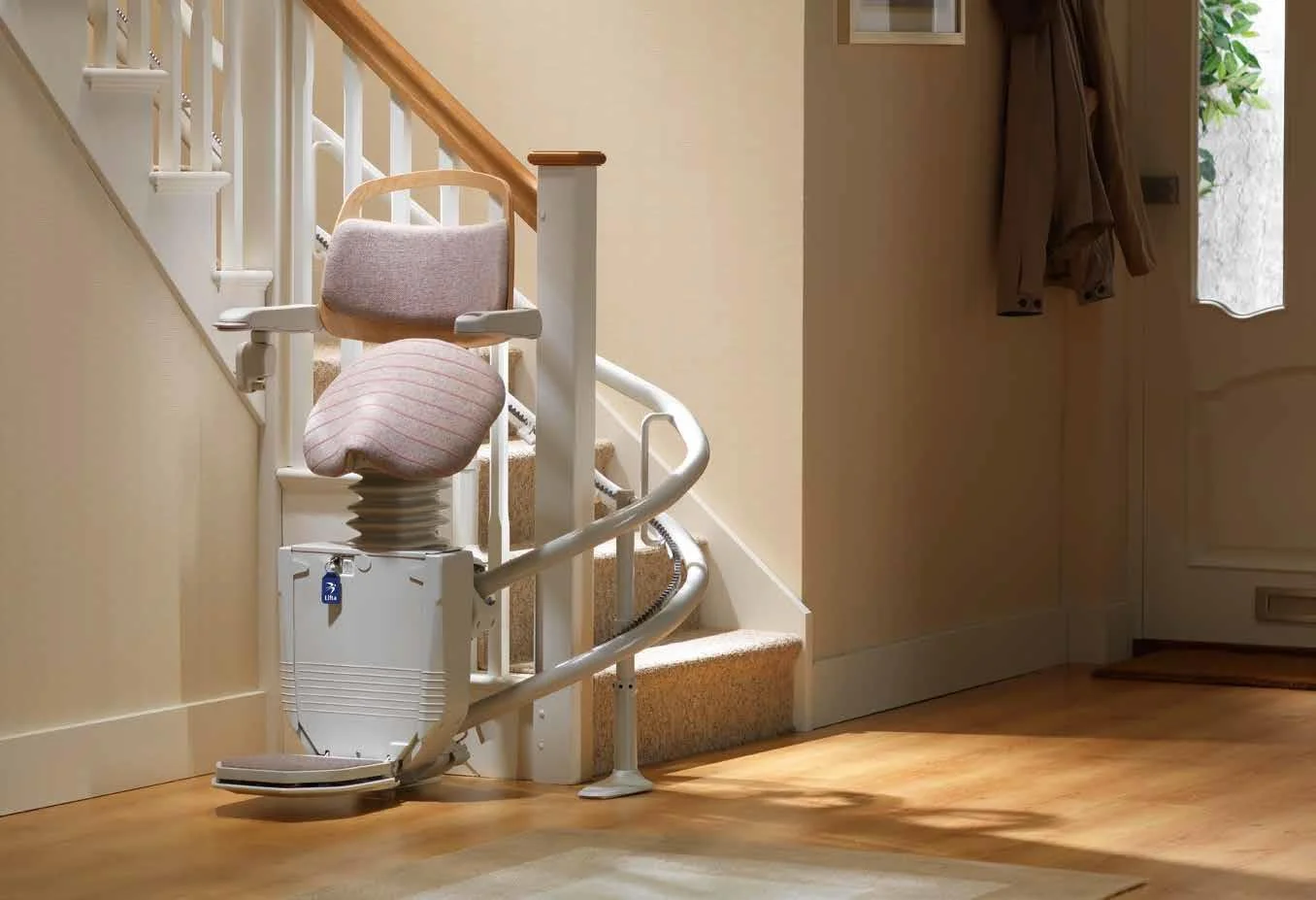
The first thing we look at is the staircase itself. A straight run from bottom to top with no turns can usually take a straight stair lift, which is the simplest type to install and the quickest to get in place.
Stairs that turn at a landing, curve, or split into two flights need a curved lift. The rail is built to follow your exact steps, so it takes careful measuring and more time to make. We measure in person so the rail matches your home and not a guess.
Plenty of Tennessee homes have the hard steps outside: a front porch, a back deck, or a set of steps down to the drive. An outdoor stair lift is built to handle weather and can make those steps usable again.
If the person can no longer move from a wheelchair to a seat, a regular stair lift is the wrong tool. A platform lift carries the wheelchair itself, and it needs more room, so we check the space before recommending one.
About 15.5 percent of Tennesseans are 65 or older, and many of them want to stay in the homes they know. Often it is an adult child who calls us first, after a parent has a close call on the stairs.
And with 59.3 percent of Tennesseans owning their homes, most families can make the change on their own. Renters should get the landlord's written approval before anything is mounted to the stairs.
Tennessee has several programs that may help. TennCare CHOICES and ECF CHOICES are Medicaid benefits that cover home modifications up to set limits per project and per year. The THDA Home Modifications and Ramps Program looks at low-income disabled homeowners case by case.
Veterans should look at VA Prosthetics, which can pay for the stair lift itself when it is medically prescribed. The Tennessee Technology Access Program (TTAP) does not pay for lifts directly but helps with funding help, device loans and reuse. Each program is listed below with its phone number. Call before you buy, since most programs want approval first.
A TennCare Medicaid benefit that covers minor home modifications up to $6,000 per project, $10,000 per year and $20,000 lifetime. Call (877) 224-0219 to ask how it applies to a stair lift in your plan.
A TennCare Medicaid benefit that funds home modifications for Tennesseans with I/DD, up to $6,000 per project and $10,000 per year. Call (877) 224-0219.
State-funded accessibility modifications for low-income disabled homeowners, with no fixed cap and coverage decided case by case under an approved plan. Call (800) 228-8432.
Tennessee's assistive technology program, offering funding help, device loans, reuse and financing referrals; it helps with stair lifts indirectly rather than paying for them. Call (833) 772-8347.
VA Prosthetics (PSAS) can cover the stair lift itself when medically prescribed, with no set dollar cap, while HISA grants of $6,800 (service-connected) or $2,000 (non-service-connected) cover ramps and structural changes, not the lift. Call (877) 222-8387.
TennCare CHOICES covers minor home modifications up to $6,000 per project, $10,000 per year and $20,000 lifetime. Call (877) 224-0219 to ask whether a stair lift is approved under your plan before installation.
It can. VA Prosthetics (PSAS) covers a stair lift when it is medically prescribed, with no set dollar cap. HISA grants pay for ramps and structural changes, not the lift itself. Call (877) 222-8387 to start.
The THDA Home Modifications and Ramps Program serves low-income disabled homeowners. It has no fixed cap and decides coverage case by case. Call (800) 228-8432.
Yes. ECF CHOICES funds home modifications for Tennesseans with I/DD, up to $6,000 per project and $10,000 per year. The number is (877) 224-0219.
The Tennessee Technology Access Program (TTAP) offers device loans, reuse of assistive technology and help finding funding. Call (833) 772-8347 to see what is available.
Our Tennessee list runs from Anderson County to Wilson County, including Shelby County, Davidson County, Knox County and Hamilton County. Separate county pages are not up yet, so contact us and tell us where you live.
Tell us about the stairs in your home and we will explain which lift fits, what it costs and how installation works.
