From the Levittown-style streets of Bowie to the New Deal-era planned community in Greenbelt and the early 20th-century houses of Hyattsville, Prince George's County was built in waves of suburban growth around Washington, D.C. Many of those homes were designed with entry steps and several interior levels, which is exactly where stair trouble shows up as the original owners get older.
We install stair lifts across the county's 81 towns, including Laurel, Clinton, Fort Washington, Suitland, Camp Springs, Oxon Hill, Beltsville and Upper Marlboro area homes. This page explains how local house styles affect the kind of lift you need and which county, state and VA programs may help with the cost.
Split-level homes are common here, especially in mid-century neighborhoods like those in Bowie, where William Levitt built traditional and California-contemporary designs in the 1960s. A split-level usually has short flights of stairs between levels. Each straight flight can often take its own straight stair lift, which tends to be simpler to fit than one long curved rail.
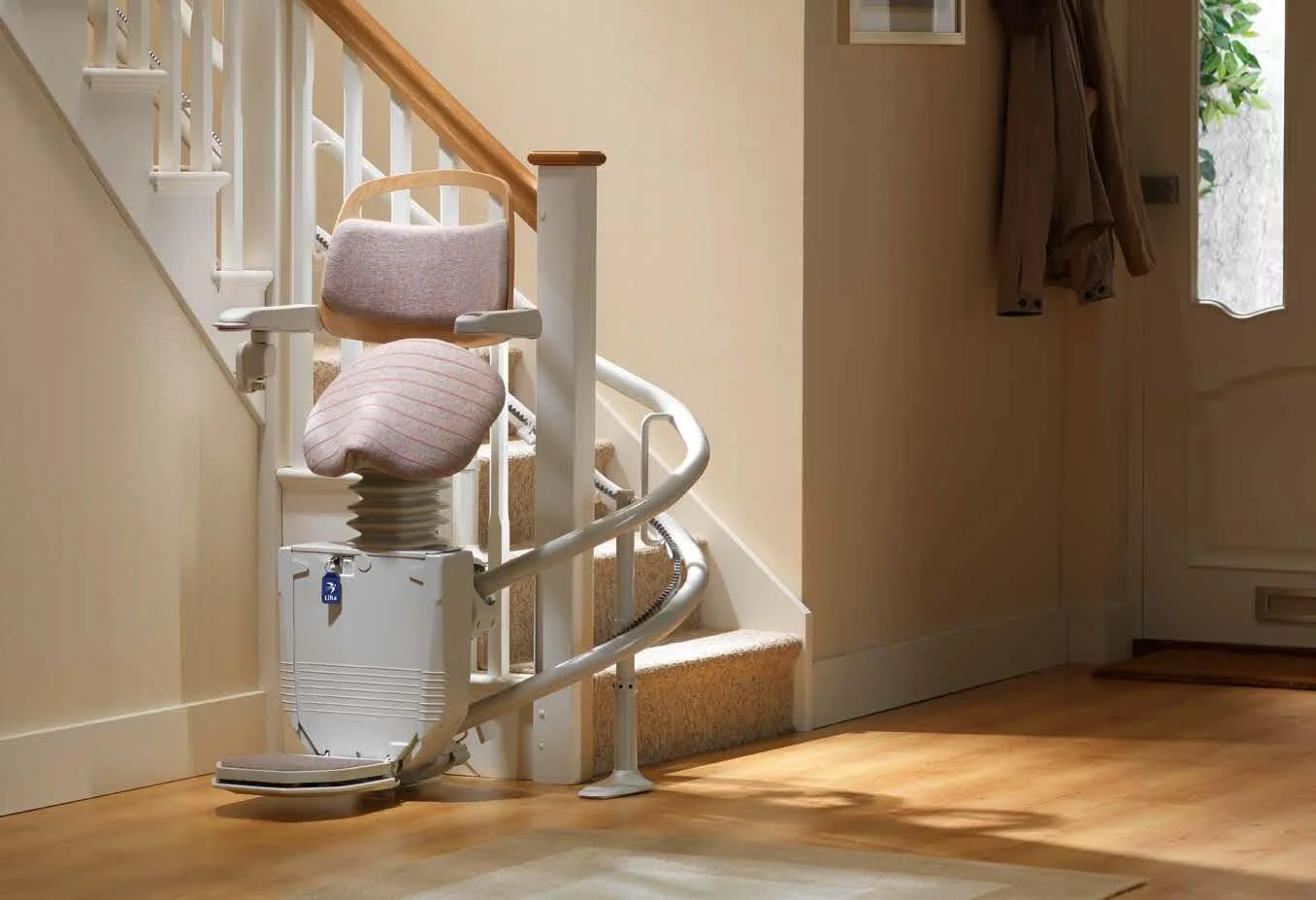
Colonials and older early 20th-century homes, like many in Hyattsville, often have a single main staircase. If it runs straight from bottom to top, a straight lift is usually the answer. If it turns at a landing or curves, you will need a curved rail built to match that staircase.
Townhouses stack living space over two or three floors, so the question is often which flight matters most. In mid-century inner-Beltway communities such as District Heights and Capitol Heights, we look at stair width and where the lift will park so it does not block the bottom step.
The county sits on the Atlantic coastal plain, with gently rolling hills and valleys and ground rising over 300 feet along the western border. On sloped lots, a house can end up with several steps from the driveway or sidewalk to the front door.
When those outside steps are the real barrier, an outdoor stair lift built for weather exposure may make more sense than an indoor unit. If someone needs to stay in a wheelchair, a platform lift is the option to discuss, since a seated stair lift requires a transfer to the chair.
Around 63.1% of households own their homes, which matters because most repair grants below are for homeowners.
If a parent rents, for example in a walk-up apartment or low-rise building, the landlord has to approve any installation. Owners have more freedom to install, and they are also the ones who qualify for the county repair programs.
Two local programs name stair lifts directly: the county's Homeownership Preservation Program (PG HOPP) and Habitat for Humanity Metro Maryland's RAMP. Both serve income-qualified homeowners and share the phone number (301) 990-0014. Start there if income is a concern.
Other sources, including Housing Initiative Partnership's HRAP loan, Maryland Medicaid programs and VA housing grants, do not list stair lifts on their pages. They may still be worth a call, but do not count on them without confirmation. The VA HISA grant specifically excludes stair glides.
Because the county is mostly built-out suburban land, USDA's Section 504 rural home-repair program has only limited use here. Eligibility has to be checked address by address against USDA's rural-area map.
For help sorting through options, the Prince George's County Dept of Family Services at 6420 Allentown Road in Camp Springs can be reached at (301) 265-8450. Veterans can contact the Prince George's County Office of Veterans Affairs in Upper Marlboro at (301) 952-3904.
A county grant with no repayment, run by Habitat for Humanity Metro Maryland, that lists stair lifts and other accessibility equipment as covered repairs for homeowners under 80% of Area Median Income who have lived in the home at least 1 year. Call (301) 990-0014.
A nonprofit program serving Montgomery and Prince George's Counties that names stair lifts among eligible services, with an Occupational Therapist assessment and a small income-based cost share of 1% or 5% of project cost (minimum $125). Call (301) 990-0014.
A 0% interest loan with $0 monthly payment, up to $60,000, for homeowners who have lived in their Prince George's County home at least 7 years; its accessibility list names ramps, grab bars and railings but not stair lifts, and the waitlist was closed as of Jan 2025. Call (240) 388-9629 to check status.
A Maryland Medicaid personal-care benefit for people who need an institutional level of care and choose to live at home; it has an Environmental Adaptations / Technology category, but stair lifts are not listed by name. Call (410) 767-6500.
A Medicaid waiver for adults 18 and older who need nursing-facility level of care, with income and asset limits; its listed services do not include stair lifts or home modifications. Call (410) 767-1739.
A state assistive-technology loan and device-loan program for Maryland residents with a disability; stair lifts are not named and loan terms require a direct inquiry. Call (800) 832-4827.
A lifetime VA grant of up to $6,800 or $2,000 for medically necessary structural changes, but it explicitly excludes porch lifts and stair glides, so it does not cover stair lifts. Call (800) 698-2411.
VA grants for veterans with severe service-connected disabilities, up to $126,526 (SAH) or $25,350 (SHA) lifetime for FY2026; examples include ramps and wider doorways, and stair lifts are not listed. Call (800) 698-2411 to confirm.
A free counseling and referral service for county older adults, adults with disabilities and caregivers; it is not a funding source and does not list a stair lift fund. Call (301) 265-8450.
Older adults
6420 Allentown Road, Camp Springs, 20748
Veterans
14741 Governor Oden Bowie Drive, Suite L-023, Upper Marlboro, 20772
Yes. PG HOPP and Habitat for Humanity Metro Maryland's RAMP both list stair lifts as covered work for income-qualified homeowners. PG HOPP is a grant with no repayment, and RAMP asks for a small cost share of 1% or 5% of the project. Both can be reached at (301) 990-0014.
Not through the HISA grant, which explicitly excludes stair glides and porch lifts. The SAH and SHA grants do not list stair lifts either, so a veteran would need to confirm directly with the VA at (800) 698-2411. The county Office of Veterans Affairs at (301) 952-3904 can also help.
Often it does, one straight lift for each flight that the person needs to use. Short straight flights are usually simpler to fit than one long curved rail, so we look at which levels matter day to day before recommending anything.
Only in limited cases. Most of the county is built-out suburban land, so the USDA Section 504 program applies to few addresses. Eligibility has to be checked against USDA's rural-area map for your specific address.
The Community Options Waiver does not list them. Community First Choice has an Environmental Adaptations / Technology category, but stair lifts are not named on its page, so call (410) 767-6500 to ask about your situation.
Maryland Access Point, through the Prince George's County Dept of Family Services in Camp Springs, offers free options counseling for older adults and caregivers. Call (301) 265-8450.
Tell us about the stairs in your home and we will explain which lift fits, what it costs and how installation works.
