From Huntington and Smithtown to Brookhaven, Islip and out past Riverhead to Southold and East Hampton, a lot of Suffolk County living happens on split levels. Many of these houses went up between 1955 and 1968, when developers worked floor plans into Long Island's glacial moraine terrain. The result is a home where getting from the front door to the bedroom can mean two or three short staircases.
Suffolk covers 2,373 square miles across the eastern two-thirds of Long Island, and it grew fast after the war. That growth left the county with a mix of split-levels, colonials, two-story homes, townhouses and walk-up apartments. This page walks through how each layout affects a stair lift and where Suffolk residents can look for help paying for one.
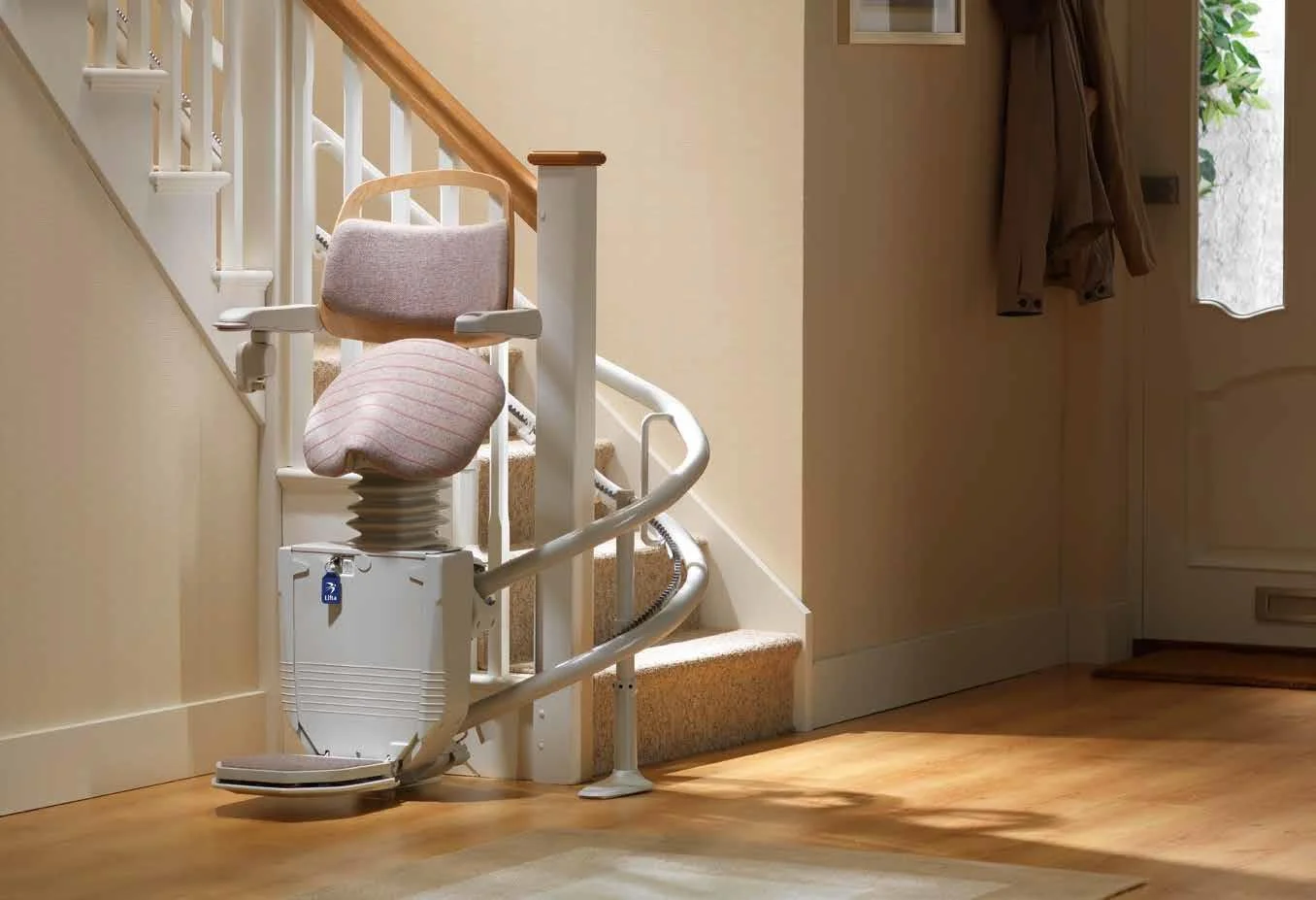
A typical Suffolk split-level connects its entry, living area, bedrooms and garage level with half-flights of about four to seven steps each. Few steps per flight sounds easy, but it adds up when someone has to climb several of them many times a day.
For a stair lift, each half-flight is usually its own run. We measure every flight separately and look at which ones the person actually uses daily, such as the climb to the bedrooms. Sometimes one lift on the most-used flight solves most of the problem, and sometimes two short runs make more sense.
Colonials and two-story homes across the county tend to have a single full staircase between floors. If that staircase runs straight from bottom to top, a straight rail is the simpler fit and usually the fastest to install.
Stairs with a landing, a turn or a winder need a curved rail built to the exact shape of the staircase. Townhouses often fall into this group, so plan on a detailed measurement before anyone can say which type fits. Walk-up apartments and low-rise buildings raise a separate question about shared stairs, which should be settled with the building owner first.
Suffolk is mostly flat to gently rolling, with the highest point at Jayne's Hill reaching only 401 feet. That means long outdoor stair runs are less common here than in hillier places, but front stoops and entry steps still stop many people at the door.
An outdoor-rated lift can handle exterior steps, and the split-level garage level is often where a short run matters most for getting in and out of the car. If a wheelchair is involved, a platform lift may be the better tool for a short rise than a seated stair lift.
About 17.4% of Suffolk County residents are 65 or older, and 82.1% of households own their homes. Owners generally have more freedom to install a lift without asking a landlord, which is one reason staying in place with a stair lift is a common choice here.
If that includes someone in your family, the VA and county veterans programs below are worth a call, though not every VA grant pays for a stair lift.
The clearest public funding path in the sources we have is the NHTD Medicaid waiver, which names mechanical lifts between floors as a covered modification. Its Long Island intake runs through SILO in Medford, but the waiver was at capacity in the source reviewed, so confirm before counting on it.
Most other programs listed below cover home repairs or modifications without naming stair lifts, so ask each one directly. For a starting point, the Suffolk County Office for the Aging in Hauppauge at (631) 853-8200 can steer seniors toward the right program, and veterans can call the Suffolk County Veterans Service Agency at (631) 853-8387.
A New York State Medicaid waiver for people with a physical disability leaving or avoiding a nursing facility, and it does cover lifts that help people move between floors when they cannot use stairs. On Long Island it was at capacity and not taking new referrals in the source reviewed, so call (631) 320-1662 to confirm current intake.
A New York State Medicaid waiver for people with a qualifying traumatic brain injury that lists environmental modifications such as ramps and accessible bathrooms; stair lifts are not listed by name. Ask SILO at (631) 880-7929 whether a stair lift request can be considered.
A state home-modification grant for low- and moderate-income people with disabilities at or below 80% of Area Median Income (120% for certain disabled veterans), applied for through a Local Program Administrator rather than the state. It lists ramps, lifts, handrails and doorway widening, but stair lifts are not listed by name.
An emergency home-repair grant of up to $20,000 for homeowners age 60 or older at or below 100% of Area Median Income, handled through a Local Program Administrator. It covers health and safety repairs; stair lifts are not listed.
Federal repair loans up to $40,000 at 1% and grants up to $10,000 for very-low-income homeowners age 62 or older, limited to USDA-designated rural areas, which in Suffolk are typically the more rural eastern towns. Stair lifts are not listed, and you should check the USDA map for your address.
A VA grant of up to $6,800 (or $2,000 for some non-service-connected conditions) for home modifications with VA medical justification. It does not cover stair lifts, because the VA treats stair glides as equipment rather than a structural change.
VA grants for veterans with specific severe service-connected disabilities, up to $126,526 for SAH and $25,350 for SHA in FY2026. The VA describes ramps and wider doorways; stair lifts are not listed by name.
The county's information, referral and care-coordination office for seniors and people with disabilities, at 100 Veterans Memorial Highway in Hauppauge. It does not fund stair lifts itself; call (631) 853-8200 for help finding a program.
A Medford non-profit independent living center that also handles Long Island intake for the NHTD and TBI waivers, with services including housing assistance and medical equipment information. It is a referral point rather than a stair lift funder; call (631) 880-7929.
A repair program for income-eligible households in Nassau and Suffolk that covers items such as handrails, stoops, walkways and health and safety measures; stair lifts are not listed. Expect a waitlist of about 2 years, and call (631) 648-5083.
Free volunteer labor for Town of Babylon residents age 60 or older, owners or renters, who cannot maintain their home; the participant pays for materials. Listed services include handicapped modifications, handrails and grab bars, not stair lifts; call (631) 789-3309.
The county office in Hauppauge that helps veterans and families file claims and connect with VA benefits such as HISA and SAH/SHA. It does not fund stair lifts directly; call (631) 853-8387.
Older adults
100 Vet. Mem. Hwy 3rd Fl., Hauppauge, 11788
Veterans
H. Lee Dennison Building, 100 Veterans Memorial Highway, 3rd Floor, Hauppauge, 11788-0099
Usually not, because each half-flight of four to seven steps is its own run. We measure each flight and focus on the ones used most, which is often just the climb to the bedrooms or the garage level.
The HISA grant specifically excludes stair glides. SAH and SHA grants do not name stair lifts either, so ask the Suffolk County Veterans Service Agency at (631) 853-8387 about SAH/SHA or VA Prosthetics channels.
In the source reviewed, the Long Island NHTD waiver was at capacity and not accepting new referrals. Call (631) 320-1662 or SILO at (631) 880-7929 to check the current status.
RESTORE and the Town of Babylon program start at age 60, and USDA grants start at 62. The NHTD and TBI waivers and the Access to Home Program are based on disability and income rather than age, so they may be options for younger people.
Possibly. USDA Section 504 loans and grants only apply in USDA-designated rural areas, which in Suffolk are typically the more rural eastern towns, so check the USDA eligibility map for your address.
Call the Suffolk County Office for the Aging at (631) 853-8200. It serves county seniors and people with disabilities and refers callers to the state and federal programs listed on this page.
Tell us about the stairs in your home and we will explain which lift fits, what it costs and how installation works.
