Nebraska spreads 356 towns across counties as different as Douglas County and Sarpy County in the east, Lancaster County and Hall County through the middle, and Scotts Bluff County, Cherry County and Kimball County out west. That is a lot of ground, and a lot of different staircases, for a state of 1,563,567 people.
This page covers the basics: which kind of stair lift fits which kind of staircase, who in Nebraska tends to look into one, and the state and federal programs that can help pay. If a parent is starting to struggle with the steps, it is a good place to start the conversation.
A straight stair lift runs on a single rail up a staircase with no turns or landings. It is usually the simplest install and can often go in quickly because the rail is a standard piece cut to length.
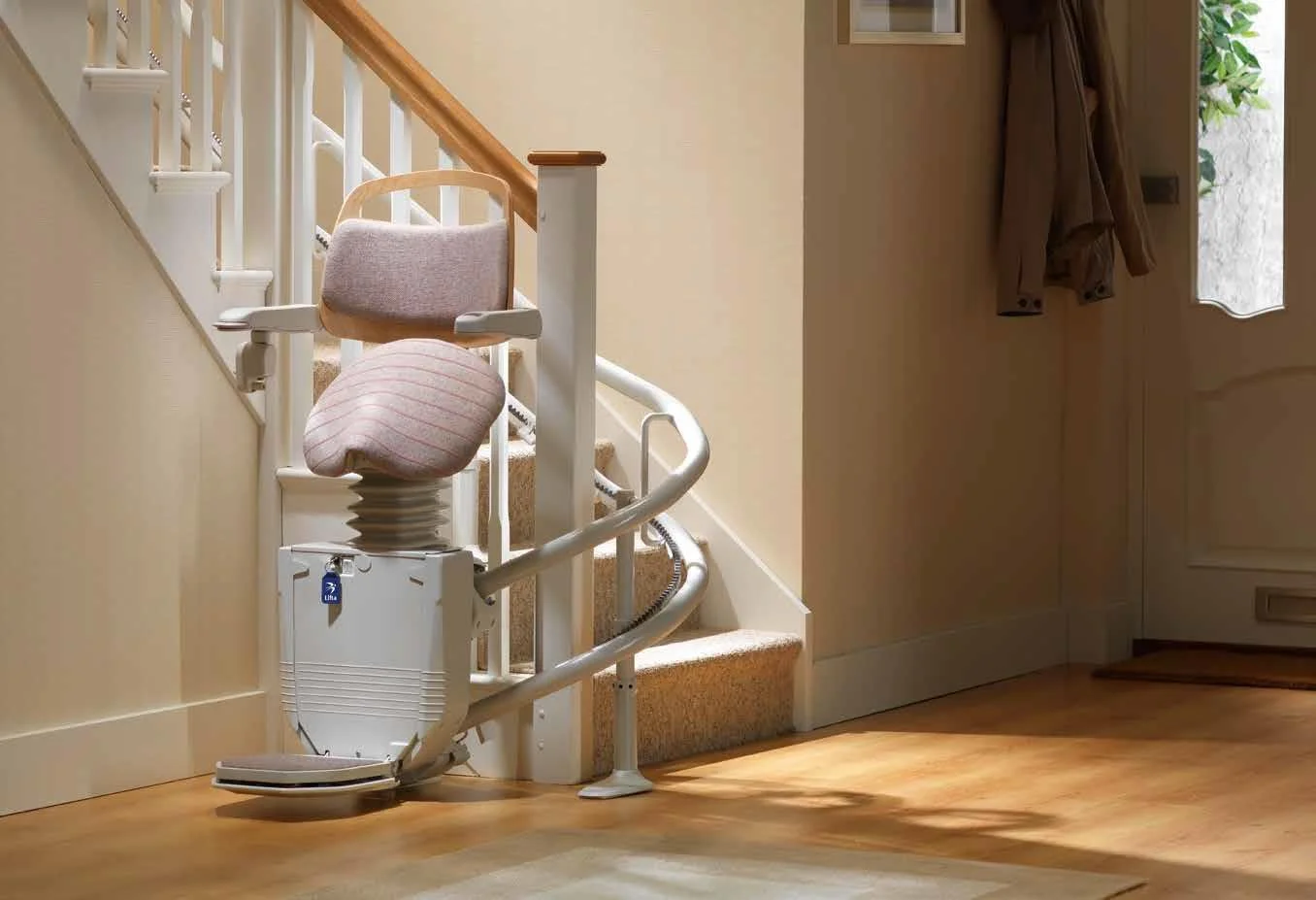
A curved stair lift is built for stairs that turn, wrap around a landing or change direction. The rail is made to fit that one staircase, so we measure carefully before anything is ordered.
Outdoor lifts handle steps up to a porch or entry and are built to take weather. A platform lift is the choice when someone uses a wheelchair and needs to stay in the chair instead of transferring to a seat.
About 16.0% of Nebraskans are 65 or older. For many of them, the bedroom or the only full bathroom sits up a flight of stairs, and a lift lets them keep using the whole house.
Roughly 62.1% of Nebraska households own their home. Owners can generally decide on a lift themselves, while renters should talk with the property owner before planning an install, since the rail mounts to the stair treads.
The key point is that the VA splits stair access into two separate benefits.
HISA grants pay for structural changes such as ramps, not the lift itself. The stair lift is handled through VA Prosthetics (PSAS) when it is medically prescribed, and that route has no set dollar cap.
Nebraska families have several places to turn. The Nebraska Aged & Disabled (AD) Medicaid Waiver can cover stair access as an approved home modification, with no fixed cap beyond the approved plan of care.
If you plan to pay yourself, the Nebraska Assistive Technology Partnership (ATP) offers low-interest loans, and stair lifts are eligible. Veterans should check VA Prosthetics first. The Nebraska Homestead Exemption does not pay for a lift, but lower property taxes can free up cash for one. Details and phone numbers for each are listed below.
We list counties statewide, from Adams County, Buffalo County and Cass County to Platte County, Red Willow County and York County. Individual county pages are not posted yet, so use this page as your starting point for now.
When you reach out, tell us your county and town and a little about the staircase, including whether it is straight, turns or sits outside.
A Medicaid 1915(c) home and community based services waiver that covers stair access as an approved home modification, with no fixed cap beyond the approved plan of care. Call (855) 632-7633.
Low-interest loans of up to $35,000 on a traditional loan, or a mini-loan of $100 to $1,999, and stair lifts and chair lifts are eligible. Call (877) 713-4002.
HISA grants of $6,800 (service-connected) or $2,000 (non-service-connected) cover ramps and structural changes, while the stair lift itself is covered through VA Prosthetics (PSAS) when medically prescribed, with no set dollar cap. Call (877) 222-8387.
Property-tax relief based on income that reduces a percentage of assessed value; it makes no cash payment and does not cover stair lifts directly. Call (402) 471-5984.
It can through the Nebraska Aged & Disabled (AD) Medicaid Waiver, which covers stair access as an approved home modification. There is no fixed cap; the amount follows the approved plan of care. Call (855) 632-7633 to ask about eligibility.
Both can be covered, but by different benefits. HISA covers ramps and structural changes, up to $6,800 for service-connected or $2,000 for non-service-connected needs. The stair lift itself goes through VA Prosthetics (PSAS) with a medical prescription. Call (877) 222-8387.
Yes. The Nebraska Assistive Technology Partnership (ATP) offers traditional loans up to $35,000 and mini-loans of $100 to $1,999, and stair lifts are eligible. Call (877) 713-4002.
No. It lowers property taxes by a percentage of assessed value based on income and makes no cash payment. The savings can help a household budget for a lift. Call (402) 471-5984.
Yes. A curved stair lift uses a rail built to fit your staircase, including turns and landings. We measure first so the rail fits correctly.
County pages are not posted yet. We list counties statewide, from Adams County to York County, so get in touch and tell us where you live.
Tell us about the stairs in your home and we will explain which lift fits, what it costs and how installation works.
