From Garrett County and Allegany County in the west to Worcester County and Somerset County in the east, Maryland covers 440 towns and 5,171,047 residents. We have pages for counties across the state, including Baltimore County, Montgomery County, Prince George's County, Frederick County and St. Mary's County.
About 15.7% of Marylanders are 65 or older, and 65.0% of households own their home. For many of those owners, the question is simple: can the stairs keep working for us, or do we have to move? A stair lift is often the answer, and Maryland has several programs that can help cover the cost.
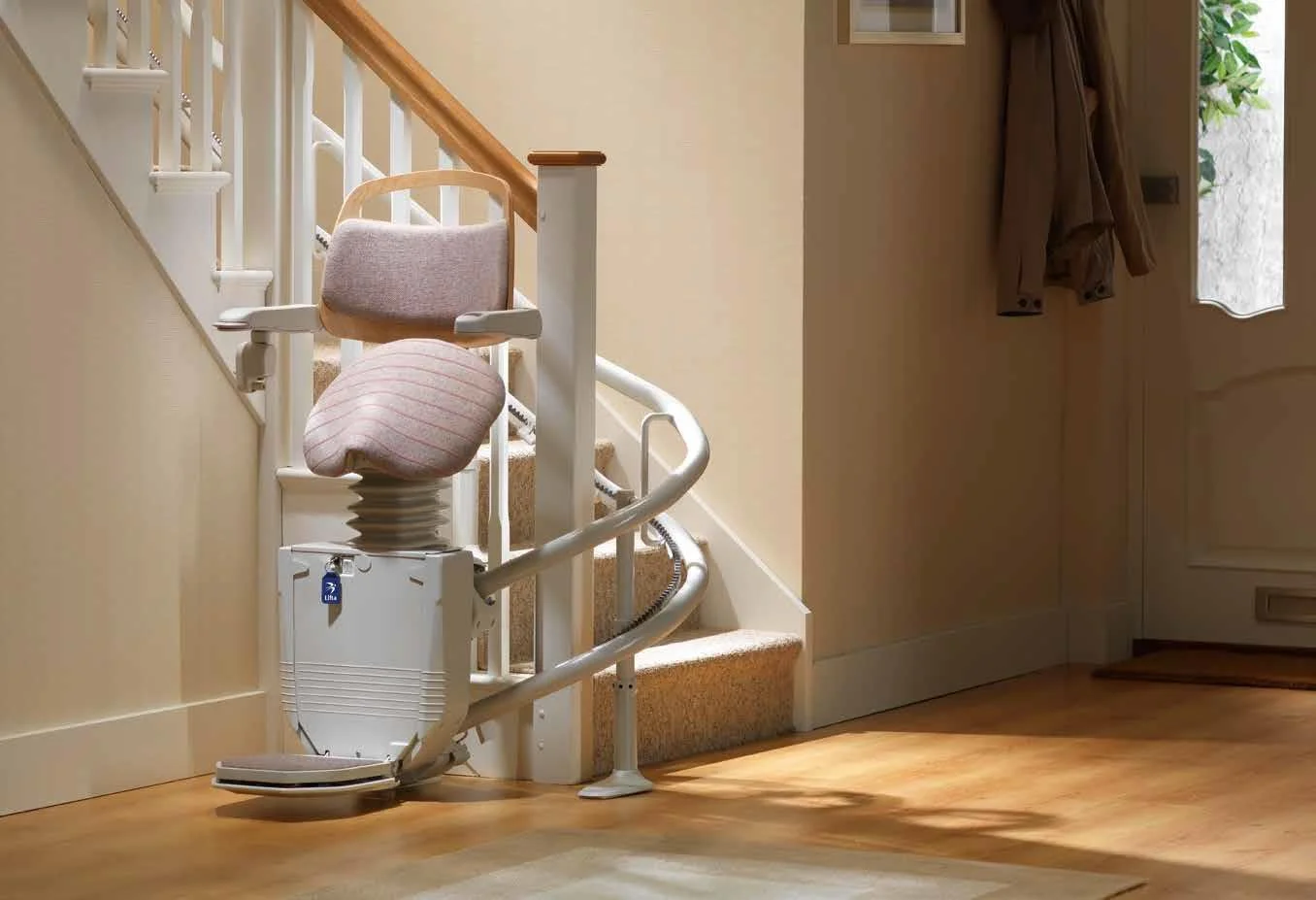
The first thing we look at is the shape of the stairs. A straight run with no turns or landings takes a straight stair lift, which is the simplest to fit and usually goes in fastest.
If the staircase turns, has a landing partway up, or curves, the rail has to be built to that exact shape. That is a curved stair lift, and it takes careful measuring before anything is ordered.
Some homes have the hard part outside: a run of steps from the driveway or up to the front porch. Outdoor stair lifts are built to handle weather and can solve that first climb.
For someone who uses a wheelchair and cannot transfer to a seat, a platform lift is usually the better fit. It carries the person and the chair together, and it needs more room, so we check the space during the home visit.
With 65.0% of Maryland households owning their home, most families can make the decision without asking a landlord. A stair lift mounts to the stair treads, not the wall, so it can usually be removed later if needs change.
Renters can still get a lift, but it is wise to talk with the property owner before scheduling an install.
The key detail is that two VA paths do different jobs.
The HISA grant pays for structural changes like ramps, not the lift itself. The stair lift comes through VA Prosthetics when it is medically prescribed.
Maryland offers more than one route. Accessible Homes for Seniors provides 0% deferred loans or grants up to $25,000. Community First Choice, part of Maryland Medicaid, covers stair lifts as accessibility adaptations under an approved plan.
If a grant or Medicaid is not a fit, the Maryland Assistive Technology Loan Program offers below-market loans from $500 to $70,000. Veterans should also call the VA. Each program and its phone number is listed below.
A Maryland program offering 0% deferred loans (up to 110% of property value, 30-year term) or grants up to $25,000 for senior home accessibility, and it covers stair lifts. Call (844) 627-5465.
A Medicaid 1915(k) state plan benefit that covers stair lifts as accessibility adaptations, with no fixed cap; the amount depends on your approved plan. Call (410) 767-1739.
Low-interest installment loans from $500 to $70,000 for stair lifts and home modifications, with home modifications typically up to $20,000 unsecured. Call (800) 832-4827.
VA Prosthetics (PSAS) can cover a medically prescribed stair lift with no set dollar cap, while the HISA grant ($6,800 service-connected, $2,000 non-service-connected) covers ramps and structural changes, not the lift. Call (877) 222-8387.
Yes. Community First Choice (Maryland Medicaid) covers stair lifts as accessibility adaptations. There is no fixed cap; coverage follows your approved plan. Call (410) 767-1739 to ask about eligibility.
Accessible Homes for Seniors offers both: grants up to $25,000 or 0% deferred loans up to 110% of property value over a 30-year term. Their number is (844) 627-5465.
No. HISA covers ramps and structural changes. The stair lift comes through VA Prosthetics (PSAS) when it is medically prescribed, and that path has no set dollar cap. Call (877) 222-8387.
The Maryland Assistive Technology Loan Program offers below-market installment loans from $500 to $70,000 for stair lifts and home modifications. Reach them at (800) 832-4827.
We have pages for counties statewide, from Garrett County and Washington County to Anne Arundel County, Howard County, Talbot County and Wicomico County. Find your county page or contact us to set up a home visit.
Tell us about the stairs in your home and we will explain which lift fits, what it costs and how installation works.
