From the older colonials and split-levels of Bethesda, Chevy Chase and Takoma Park to the newer townhomes in Germantown and Clarksburg, Montgomery County has a wide spread of house types. Many of them share one thing: the bedroom is up a flight of stairs, or a split-level puts a landing halfway up.
This page walks through how the county's homes and rolling ground affect which stair lift makes sense, and which local, state and federal programs may help pay for one. It covers all 57 towns, from Silver Spring and Rockville up to Damascus and Olney.
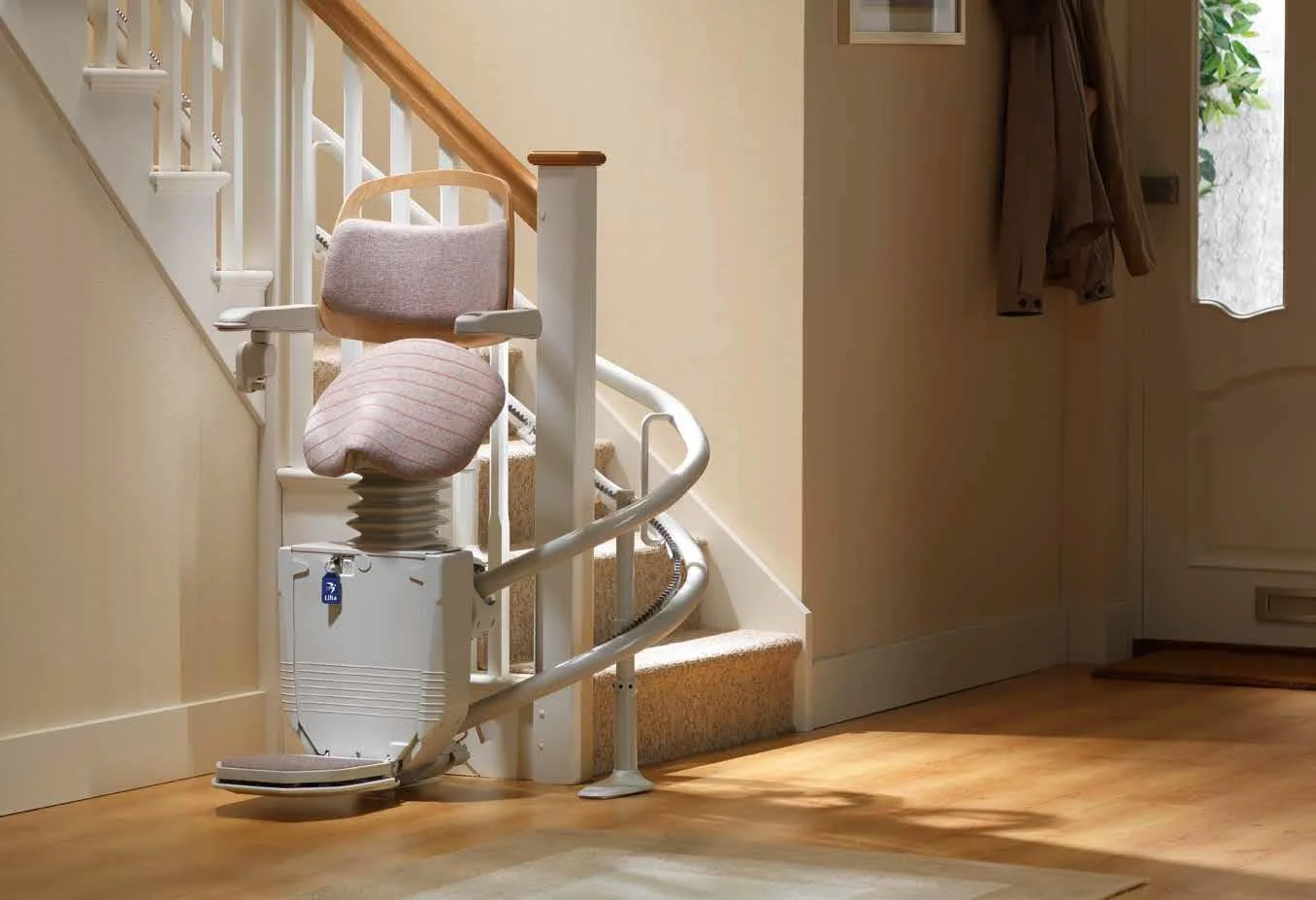
Inner-Beltway communities hold a lot of older single-family colonials and split-levels. A colonial often has one straight run to the second floor, which usually suits a straight stair lift. That is the simplest and quickest type to install.
Split-levels are different. A mid-flight landing or a turn between levels generally calls for a curved lift built to follow that specific staircase. Newer townhouses and row houses farther out, in places like Clarksburg or Montgomery Village, often have narrow stairs across several floors, so measuring width and every turn matters before choosing a model.
Low-rise apartments and condos add another question: who controls the stairwell. A lift inside your own unit is one thing, while common stairs usually need building approval.
The county's land is generally rolling, climbing from near sea level along the Potomac River to about 875 feet in the far north. On sloped lots, the front walk or back door often comes with a run of exterior steps.
Winter makes those steps harder. The higher area around Damascus averages 21.3 inches of snow a year, compared with 17.5 inches in Silver Spring. For a home where the outside steps are the real problem, an outdoor stair lift or a platform lift can be worth looking at alongside an indoor unit.
About 16.4% of the county's 1,020,748 residents are 65 or older, and 66.2% of households own their homes. Owning the house matters, because most of the programs below are built around homeowners making permanent changes.
If someone in your family served, the VA grants and the county veterans office are worth a call before you buy.
Two local nonprofits name stair lifts outright: Independence Now and Rebuilding Together Montgomery County. Those are the strongest places to start if cost is a concern.
Other options, including the VA grants, the state assistive technology loan, Medicaid Community First Choice and the county Design for Life tax credit, do not list stair lifts on their pages. They may still apply case by case, so call and ask before counting on them.
If you are not sure where to begin, the Aging & Disability Resource Unit at (240) 777-3000 is the county's main point of entry for older adults and people with disabilities.
The Center for Independent Living for Montgomery and Prince George's Counties names stair lifts as a covered item, with up to $7,500 per request and a 20% contribution from you, available once every two years. Call (301) 277-2839 or visit 12301 Old Columbia Pike, Suite 101, Silver Spring.
This nonprofit makes free accessibility repairs and modifications, and stairlifts are named on its program page, for homeowners 65 and older or living with a disability. Call (301) 947-9400 or apply at rebuildingtogethermc.org/application to confirm other eligibility details.
A federal grant of up to $126,526 in FY2026 for veterans with qualifying severe service-connected disabilities who own or intend to own the home. The VA page lists ramps and wider doorways as examples and does not mention stair lifts.
Up to $25,350 in FY2026 for veterans with certain service-connected disabilities, and the home may belong to the veteran or a family member. Stair lifts are not listed, so ask the VA about your situation.
A state low-interest loan for Maryland residents with disabilities or older adults who need assistive technology. Stair lifts are not itemized, so call (410) 554-9230 or 1-800-832-4827 to verify before relying on it.
A county property tax credit, run by the Department of Permitting Services, for principal residences with qualifying accessibility features; it lowers tax owed rather than paying a grant. The county page does not name stair lifts or give a credit amount.
A Medicaid service for people who need an institutional level of care but want to stay at home, with an Environmental Adaptations/Technology procedure on file. Stair lifts are not named, so call the Maryland Department of Health at (410) 767-6500 to confirm.
The county's front door for older adults and people with disabilities, with no income test to call. It is a referral service rather than a stair lift fund; reach it at (240) 777-3000.
Older adults
401 Hungerford Drive, 3rd Floor, Rockville, 20850
Veterans
401 Hungerford Drive, Rockville, 20850
Yes. Independence Now and Rebuilding Together Montgomery County both name stair lifts. Independence Now offers up to $7,500 per request with a 20% contribution from you, and Rebuilding Together does free modifications for eligible homeowners.
Rebuilding Together Montgomery County's HARP program serves homeowners age 65 and older or living with a disability. Call (301) 947-9400 to check the remaining eligibility details.
The SAH and SHA grants cover home modifications for qualifying service-connected disabilities, but the VA page does not mention stair lifts. For local guidance, call the Montgomery County Commission on Veterans Affairs at (240) 777-1245.
Usually, yes. A landing or turn generally means a curved lift made to fit that staircase, so we measure the full run before recommending a model.
Start with the Aging & Disability Resource Unit at (240) 777-3000, based at 401 Hungerford Drive, 3rd Floor, in Rockville. It is the county's main point of entry for older adults and people with disabilities.
Tell us about the stairs in your home and we will explain which lift fits, what it costs and how installation works.
