Walk down almost any street in Hagerstown's historic core and you will see homes built from locally quarried Stonehenge limestone, many inside the Hagerstown Historic District, the Potomac-Broadway Historic District, the South Prospect Street Historic District or the Oak Hill Historic District. Most of these houses went up long before anyone designed for accessibility, so the staircase is usually the only way between floors.
Out past the city, from Boonsboro and Smithsburg to Williamsport, Clear Spring and Hancock, the 33 towns of Washington County sit on a mix of valley floor and mountain ridge. Farmhouses with raised entries, hillside homes with basement-level living space, and split-level homes all bring their own stair problems. This page walks through what that means for a stair lift and where local families can look for help paying for one.
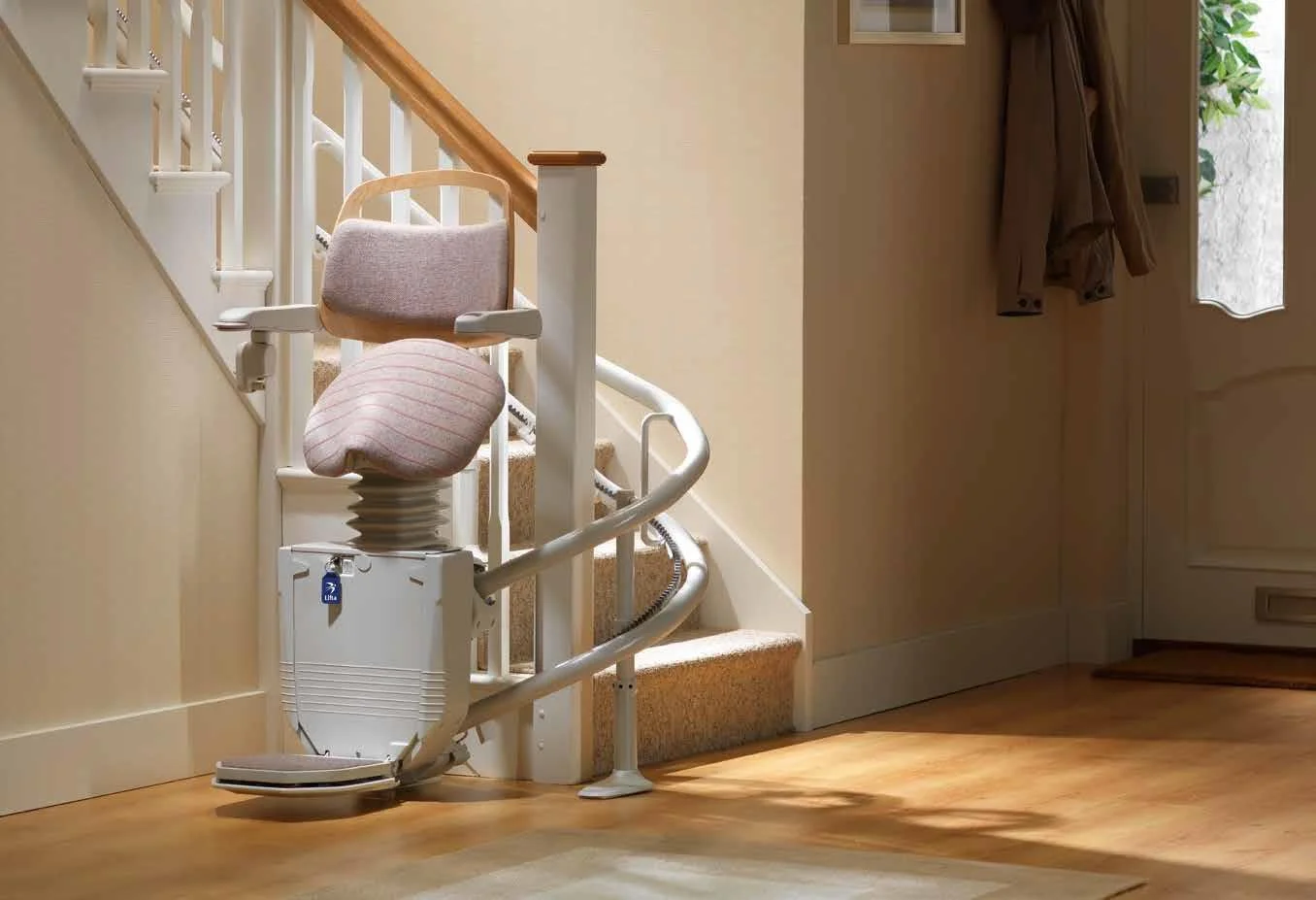
In Hagerstown, Halfway, Funkstown and the other older communities, many single-family homes and townhouses have a main staircase as the only route to bedrooms and bathrooms. When climbing that staircase gets hard, the choice often comes down to adding a lift or moving.
A straight staircase is the simplest case and usually the quickest to fit. Older homes sometimes have turns, landings or narrow runs, and those call for a curved lift built to the shape of the stairs. We measure the staircase in person before recommending either one.
Washington County covers 467 square miles, from the Ridge-and-Valley terrain in the west, across the Hagerstown Valley (part of the larger Cumberland Valley), to South Mountain in the east. On sloped lots in places like Smithsburg, Cavetown or Highfield-Cascade, the hardest steps are often the ones up to the front door.
Raised entries can be handled with an outdoor stair lift built for weather, or with a platform lift where a wheelchair needs to come along. Split-level homes and basement-level living space may need more than one lift, since each short flight is its own run. In walk-up apartments and low-rise buildings, the owner or landlord usually has to approve any installation, so it helps to ask early.
About 17.2% of Washington County residents are 65 or older, and the county's median age was 41 in 2020. Roughly 58.5% of residents own their homes, which matters because owners can usually install a lift without needing anyone else's permission.
For them, VA housing grants and the Washington County Veterans Service Office are worth a call before paying out of pocket.
None of the local or federal program sources we reviewed name stair lifts outright, so the honest answer is that coverage has to be confirmed program by program. The list below includes the VA housing grants, Maryland Medicaid waivers and several City of Hagerstown repair and rehabilitation programs.
A good first call for anyone in the county is Maryland Access Point at (301) 790-0275, which offers information, assistance and referral for older adults and people with disabilities. Statewide programs to ask about include Accessible Homes for Seniors, Community First Choice (Maryland Medicaid), the Maryland Assistive Technology Loan Program and VA Benefits for Veterans (HISA + Prosthetics).
Veterans can reach the Washington County Veterans Service Office at (301) 791-0356, located at 33 West Washington Street, Room 201, Hagerstown 21740.
A federal grant of up to $126,526 (FY2026 cap), usable up to 6 times, for structural home adaptations for veterans and service members who own or will own the home and have a qualifying service-connected disability. The source does not mention stair lifts specifically.
A smaller companion grant of up to $25,350 (FY2026 cap), usable up to 6 times, for veterans with qualifying disabilities such as loss or loss of use of both hands, certain severe burns, or respiratory injuries. Stair lifts are not named on the source page.
Helps SAH- or SHA-eligible veterans adapt a family member's home while living there temporarily, up to $50,961 for SAH-eligible and $9,100 for SHA-eligible veterans (FY2026 caps). The source does not mention stair lifts.
The local information, assistance and referral office for older adults and people with disabilities, which also uses a Level One Screen to connect residents to waiver programs. It is not a cash grant and the source does not mention stair lifts; call (301) 790-0275.
Maryland Department of Health waivers for older adults and people with disabilities who meet Medicaid financial and level-of-care criteria; the general page does not list a home-modification benefit or stair lifts. Call MDH at (410) 767-6500 or Maryland Access Point at (301) 790-0275 to ask about home-modification coverage.
A grant of up to $15,000 for income-qualified Hagerstown homeowners facing a life-threatening condition or one that prevents decent, safe and sanitary living. Stair lifts are not named on the source page, and the department recommends calling (301) 739-8577 before applying.
Covers 75% of an emergency repair, up to $15,000, for homeowners in designated Middle Neighborhoods with income limits from $86,550 for one person up to $163,200 for eight. The source does not name stair lifts; call (301) 739-8577.
Low-interest rehab loans, with emergency-repair grants for qualifying single-family homeowners, subject to CDBG income limits and Hagerstown Loan Review Authority approval. The coverage list is not detailed on the source page; call (301) 739-8577.
A state rehabilitation loan run locally by the City of Hagerstown Dept. of Housing & Community Development for remodeling, home improvements and code compliance. The source page does not mention stair lifts or accessibility work; call (301) 739-8577.
Older adults
535 E. Franklin Street, Hagerstown, 21740
Veterans
33 West Washington Street, Room 201, Hagerstown, 21740
Often, yes. Many homes in the historic districts have a single staircase between floors, which is exactly where a lift helps. Whether it is a straight or curved lift depends on the shape of the stairs, so we look at the staircase in person first.
The city's program pages do not name stair lifts, so it is not confirmed. The CDBG and Middle Neighborhoods programs cover repairs that address conditions preventing safe, decent and sanitary living, up to $15,000. Call the Dept. of Housing & Community Development at (301) 739-8577 before applying.
Call Maryland Access Point for Washington County at (301) 790-0275. It serves older adults and people with disabilities across the county and can point you to waiver programs and other help.
Maryland Medicaid offers HCBS waivers for older adults and people with disabilities, but the general waiver page does not list a home-modification benefit. Ask the Maryland Department of Health at (410) 767-6500 or Maryland Access Point at (301) 790-0275 which waiver might apply.
The VA SAH, SHA and TRA grants fund home adaptations for veterans with qualifying service-connected disabilities, though none name stair lifts specifically. The Washington County Veterans Service Office at (301) 791-0356 can help with the paperwork.
An outdoor stair lift built for weather can handle exterior steps. If someone uses a wheelchair, a platform lift is usually the better fit. Split-level and basement-level layouts sometimes need a second lift inside.
Tell us about the stairs in your home and we will explain which lift fits, what it costs and how installation works.
